

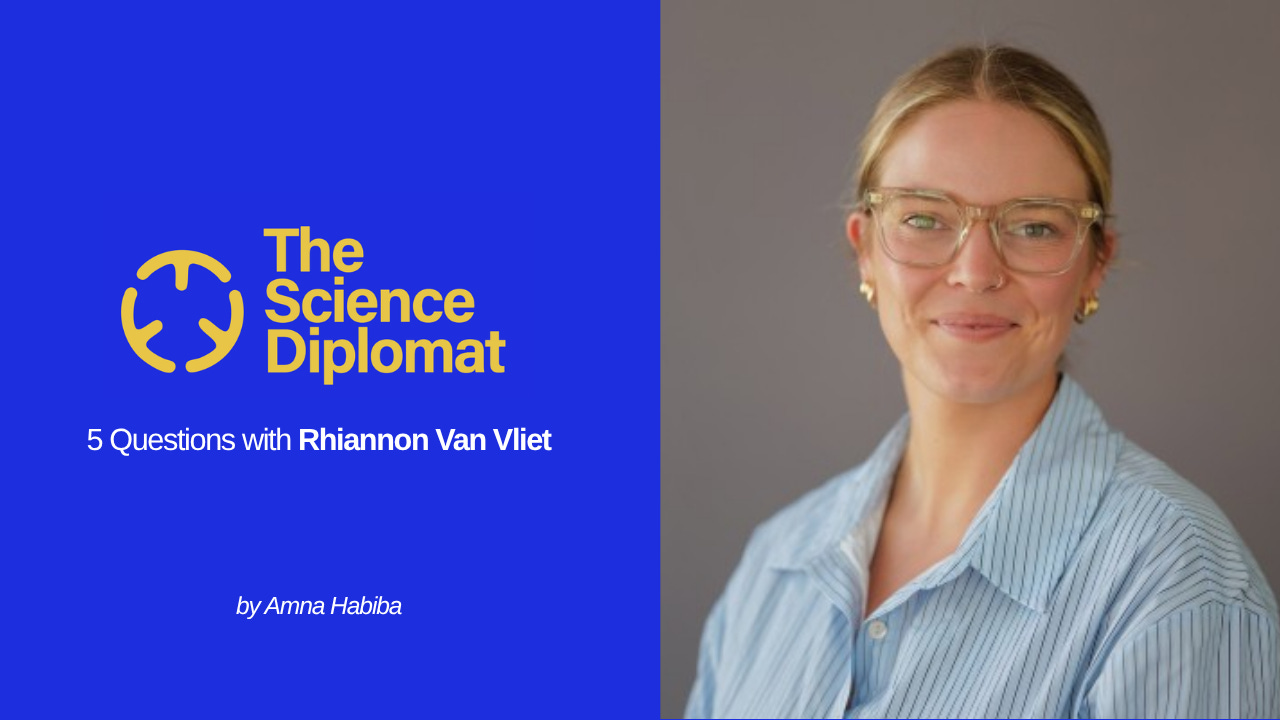
5 Questions is a recurring Science Diplomat series exploring how practitioners, scholars and policymakers view the systems shaping our future.
Rhiannon Van Vliet works at the intersection of research and policymaking. In the Policy Impact Unit at University College London, she helps academics and researchers across UCL and its Faculty of Engineering turn research into something policymakers can use.
Originally from Melbourne, Van Vliet moved to London two and a half years ago. Her work spans science diplomacy, local government and space policy — three areas connected by a recurring question: how researchers can engage with policymakers and have an impact.
When we spoke, the conversation kept returning to people, and whether the right ones were in the room together.
1. You’ve worked across science diplomacy, local government and space policy. What actually carries over between them, and what doesn’t?
“The connecting threads across all three, particularly for my work, are related to policy engagement and impact,” Van Vliet said.
The three fields “might not share an exact playbook or common policy area,” she said, but her role across them is similar: identifying where research can influence policy and helping researchers engage with the people making those decisions.
Science diplomacy and space policy also overlap substantively. Van Vliet describes science diplomacy as a broad process encompassing the ways science and diplomacy interact, whether through cooperation or competition.
Space makes that tension particularly visible. International and multilateral bodies help govern activity beyond national borders, while nations decide when to collaborate and when to protect their own strategic interests.
Local government operates at a different level, but Van Vliet sees connections between local, national and international policymaking. Climate diplomacy offers one example: decisions made internationally can eventually affect electricity bills, infrastructure or flood risk locally.
“When you kind of tease them out and peel back the layers, there are lots of different policy issues, challenges and opportunities that connect all three,” she said.
2. Research security has become a major challenge for science diplomacy. Where do you see the U.K. positioned in balancing openness to international collaboration against protecting sensitive research?
“It’s a core issue for science diplomacy, research and practice,” Van Vliet said.
She describes the U.K. approach as one of “critical engagement,” similar to the European Union’s principle of remaining as open as possible while being as closed as necessary. Where research falls on that spectrum depends partly on the field, a calculation made more difficult by technologies with potential dual uses.
The U.K.’s Research Collaboration Advice Team is one mechanism for navigating that problem, advising universities and researchers on protecting national security interests and intellectual property while maintaining international collaboration.
But research security cannot be understood solely as a national issue.
Van Vliet pointed to restrictions on scientific collaboration with Russia following its invasion of Ukraine. The sanctions were foreign-policy decisions, she said, but they also disrupted scientific relationships and access to research, including climate data that matters internationally because of Russia’s geography.
Her answer ultimately comes back to communication between two professional communities.
“The key thing that we’re trying to suggest through science diplomacy is you need to have scientists and diplomats together in a room having a conversation about the implications,” she said.
Scientists need to understand the geopolitical environment surrounding their research, she said, while diplomats need researchers who can explain what their work involves and how foreign-policy decisions may affect it.
3. There are a lot of competing definitions of science diplomacy. In your own words, how would you define it?
“I would say science diplomacy is a broad umbrella term for processes, research, practice that seeks to understand how science and diplomacy and foreign policy interact,” Van Vliet said.
For her, the important point is that the term itself is neutral.
“You can have international science collaboration, net positive relationships. You can also have strategic and more competitive relationships.”
That includes climate negotiations as well as how nations approach emerging technologies such as artificial intelligence and quantum computing.
“It captures a lot, which I think is not confusing, but it makes the concept a bit harder to grasp,” she said. “But if you see it as a broad umbrella, that really helps break down why we need to be talking about science and diplomacy in the same conversation.”
4. You recently helped build an AI toolkit for knowledge exchange. What prompted that, and what does it actually do?
The problem was practical. After a knowledge-exchange workshop brings academics and policymakers together, producing a report can take two or three weeks.
“By that stage, the policymaker’s moved on to the next big issue,” Van Vliet said.
Her team developed a process using AI to produce a workshop report the following day. In one case, she said, a participant took the report into a meeting with other stakeholders the next morning and used it.
Van Vliet draws a boundary around the technology’s role.
“We adopt an approach to AI to help innovate our work, not do the work for us, but enhance how we connect with policymakers,” she said.
Academic policy engagement depends on relationships and trust, she said, regardless of how efficiently technology can process information.
“There are actual people involved, and humans are at the centre of it, because at the end of the day, it’s all about relationships.”
That requires maintaining “that kind of human in the loop aspect to our work,” she said.
5. You’ve moved from Melbourne to London. How has working across the two countries’ policy systems shaped how you think about the science-policy interface?
Australia and the U.K. share similar governmental traditions, Van Vliet said, but their research and policy ecosystems operate at different scales.
The biggest difference she has noticed is the infrastructure connecting universities and policymakers.
“Since I’ve been in the U.K. for two and a half years, we have a much more established academic policy engagement community in the U.K.,” she said. “I think Australia is moving in that direction, but it’s not as established as the U.K.”
She does not see that as a difference in the quality of research. Australian universities produce strong research and many have substantial relationships with government. Rather, the U.K. has developed a larger professional community specifically devoted to translating academic research into policy engagement.
Each country also brings different pressures to the relationship between research and government, she said, including Australia’s exposure to climate change and geopolitical position.
Her experience in both systems has convinced her of the value of creating permanent positions between researchers and policymakers.
“I would love to see policy engagement specialists embedded in universities,” Van Vliet said. “I’ve only seen the net positive of what that can do in universities across the U.K.”