Access is Power
How access shapes who decides. Part 3 of a five-part series.

Power in global science governance is built into who can operate, measure, access systems, and persist. This series examines those dynamics in five parts, continuing here with access.
In the windowless conference rooms where the International Seabed Authority regularly meets in Kingston, Jamaica, delegates return repeatedly to a principle embedded in the law of the sea: the “common heritage of mankind.”
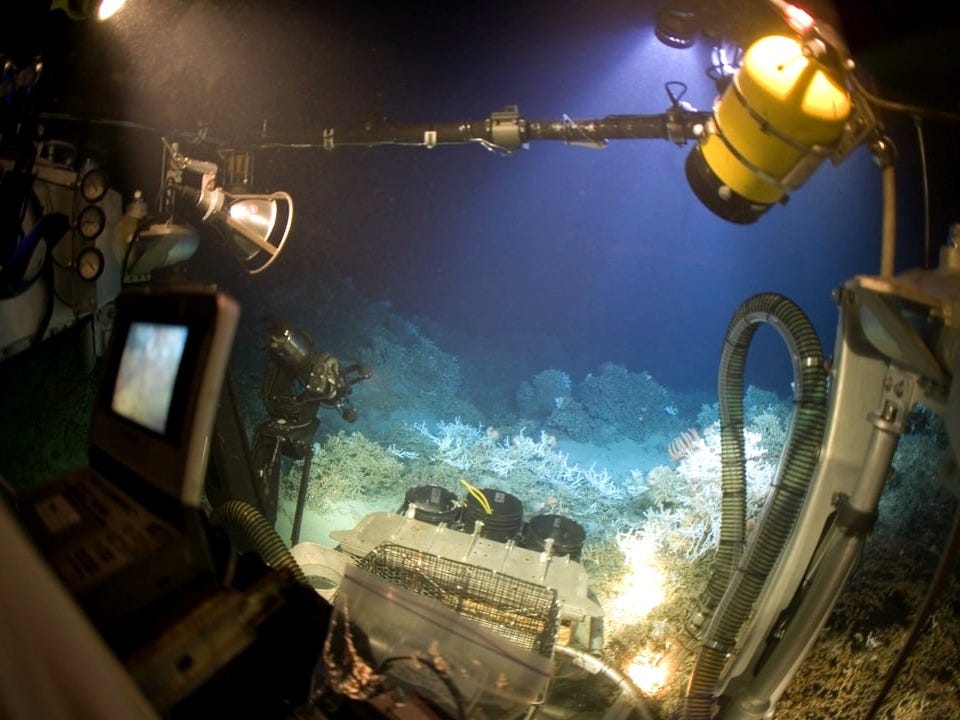
The seabed beyond national jurisdiction, known as the Area, is formally held in trust for all. In practice, reaching that part of the ocean depends on capabilities that are not widely shared.
Operating more than 200 nautical miles from shore requires specialized research vessels, remotely operated or crewed submersibles, and mapping systems designed to function under extreme pressure and distance. Those systems are expensive and technically demanding, concentrated among a limited number of countries and commercial operators.
The regulatory system reflects that reality. The ISA does not conduct exploration itself; it issues contracts that allow nations and their partners to operate in designated areas. Participation depends on both technical capacity and formal approval.
Its structure became more visible in 2021, when the tiny island nation of Nauru invoked a provision known as the “two-year rule.” The mechanism requires the ISA to move toward finalizing regulations for commercial seabed mining within a set timeframe once triggered by a sponsoring nation.
The rule had been in place for years, but its use accelerated negotiations that had been moving slowly. Nauru’s position was tied to a corporate partner already engaged in exploration and equipped with the technology to operate at depth. The procedural step and the underlying capability worked together, allowing a small country to push a larger process forward.
“This process will allow Nauru, and other developing countries to participate in a new industry, accessing valuable resources in light of a historical context that far too often deprived developing countries from reaping the benefits,” Nauru President Lionel Aingimea told the U.N. General Assembly in September 2021.
“Accessing these polymetallic nodule resources is critical to building the clean energy transition we need and towards a circular economy,” he said. “These polymetallic nodules are needed to transform big and small countries’ energy systems and support our fight against the climate crisis.”
A similar pattern appears in the infrastructure that carries global data.
What is often described as “the cloud” depends on a network of subsea fiber-optic cables that carry most international data traffic, including financial transactions, scientific data, and government communications. The cables run along fixed routes across the ocean floor and connect through specific landing points along coastlines.
Digital lifelines and divides
A relatively small group of companies and consortia build and maintain these systems. Their placement reflects long-term investment decisions, commercial demand, and, increasingly, national security considerations.
How those networks are arranged affects how countries take part in the global system. Nations connected through multiple high-capacity cables, with backup routes and several landing points, operate under different conditions than those relying on a single connection or routing data through another country. Differences in speed, capacity, and reliability shape how information moves and how systems respond to outages or disruption.
Landing stations, often low-profile facilities along coastlines, serve as key entry and exit points. Their location and control influence how networks are expanded and maintained.
Recent disputes over cable routes and equipment suppliers have highlighted the strategic importance of these systems. At the same time, new projects are beginning to include environmental sensors in cable design, allowing operators to collect data on seismic activity and ocean conditions as part of routine operations.
“Historically, these waterways served as arteries of global commerce. Today, they have evolved into digital lifelines, carrying trillions of bytes that power financial markets, artificial intelligence platforms and sovereign cloud services,” legal and regulatory expert Hamza Alakalik wrote in The Jordan Times in April.
Scientific findings can be shared widely once produced. But collecting that information, whether from the deep ocean or through global networks, depends on equipment and infrastructure that are expensive and unevenly distributed.
Similar dynamics appear in other systems. In global health, surveillance systems and sequencing capacity influence where outbreaks are first identified and how quickly they are analyzed. In finance, payment and clearing systems determine how money moves across borders. In technology, technical standards shape which systems can connect and which are left out.
“Today’s digital divides are increasingly about quality and affordability,” Doreen Bogdan-Martin, secretary-general of the International Telecommunication Union, said in its 2025 Year in Review.
These systems are rarely framed in political terms. They appear as equipment requirements, network design, or regulatory procedure. Their effects are visible in practice. Cable routes, landing points, and payment systems are built over years and are costly to duplicate. Traffic and investment follow existing lines, reinforcing their use.
As a result, participation varies even among countries that are formally part of the same agreements. Some operate directly within these systems, while others rely on external connections or intermediaries. By the time negotiations take place, those differences are already in place.
Part 4 examines how these dynamics extend over time and how the ability to sustain presence, investment, and participation across decades creates its own form of structural advantage.

