

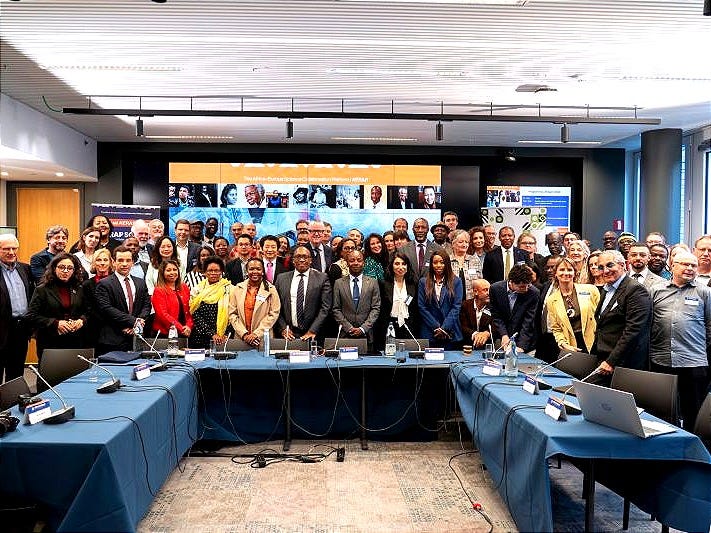
Africa–Europe cooperation on science and innovation is moving into a new phase as officials and researchers shift from designing frameworks to confronting how research is funded, governed and used.
The change in tone was evident across the three-day Africa–Europe Science Collaboration Forum in Brussels, where speakers returned repeatedly to the gap between political commitments and what they described as uneven delivery. Some of Africa’s science diplomacy leaders emphasized the importance of taking a greater role in global governance.
“As policy makers say often, if you are not at the table, this is the menu — you may well be on the menu,” said Yaya Sangaré, a materials physicist who is secretary-general of the Fund for Science, Technology and Innovation (FONSTI) in Ivory Coast. He added that participation often depends on initiative, leadership, and excellence.
“Africa is not waiting to be invited into the global scientific governance,” said Eudy Mabuza, a South African science and innovation policy official, opening a session on science diplomacy. “Africa is changing it.”
That claim of a move from participation to agenda-setting ran up against a more complicated reality at the forum, held at several scientific and diplomatic venues before ending with a network reception at the South African Embassy on Wednesday. Discussions at the 13th annual forum hosted by the Africa–Europe Science Collaboration Platform (AERAP) were anchored in the European Union’s Global Gateway strategy and the 2023 A.U.–E.U. Innovation Agenda, both designed to connect research, investment and development priorities across the two continents.
Jan Marco Müller, who coordinates science diplomacy at the European Commission’s Directorate-General for Research and Innovation, said science diplomacy has become “much more interest-driven, sovereignty-driven, values driven, transactional in a way. It has become less of the ‘cozy, feel-good, let’s all be friends’ space than it used to be.”
At the same time, he said, the field is broadening. “Science diplomacy has become much more inclusive, young, female, South driven, African as well.” Those two shifts toward competition and inclusion are unfolding together, according to Müller and other speakers at the forum, as cooperation continues under tighter political and economic constraints.
Müller said it no longer made sense to treat cooperation and competition as opposites. “Scientists cooperate and scientists compete with each other. And the same in diplomacy. Countries cooperate with each other and they compete with each other, so I think we rather should see it as a continuum,” he said, pointing to the role of research capacity during the COVID-19 pandemic.
The detection of the Omicron variant by laboratories in southern Africa, he said, showed how dependent other regions were on capabilities beyond their borders. “And where science diplomacy can actually help here is to open those spaces. What is joint interest?” he asked. “Where actually competing and cooperating isn't exclusive.”
From coordination to investment
Elsewhere in the forum, speakers were more direct about the risks of imbalance. With the European Union preparing its next long-term budget for 2028–2034, participants said the main structures for cooperation are already in place but the question now is whether they can deliver — and pointed to growing pressure to show measurable outcomes.
That challenge was evident during a session linking science cooperation to investment, where Aline Mugisho, an agribusiness expert and country convener in Nigeria for CGIAR’s public agricultural innovation network, raised questions about who owns the knowledge that is produced, and who benefits from it. She said research collaboration often continues to follow donor priorities.
“We need to be very strategic in agenda-setting when it comes to E.U.-Africa scientific growth and productivity,” she said. “Are we looking into the sectors that are lacking knowledge but very promising that require great scientific investment? Or are we simply continuing with our charity approach by feeling good, by doing good, and then eventually we meet with the challenge of a skills shortage?”
Her remarks reflected concerns raised by several participants that cooperation still carries imbalances in how research is funded, produced and used. “Knowledge sovereignty is a non-negotiable,” she added. “We need to own the knowledge we produce and the investment coming to it needs to be documented.”
“The priority is to move from conceptualization and dialogue into very much implementation,” said Andrzej Dabkowski, head of program performance and operations for the Africa–Europe Foundation. “And this delivery is needed not only at specific initiatives and project level, but very much at a system level.”
He pointed to gaps between research outputs and policy uptake, and between funding commitments and projects able to absorb them. “Even if there is finance available, very often there are no bankable projects that meet the criteria to actually unlock that finance,” he said.
Much of the forum focused on how to better connect major initiatives, including the E.U.’s Global Gateway strategy, Horizon Europe and Africa’s Science, Technology and Innovation Strategy. The concern over who defines priorities and who benefits also surfaced in discussions on mobility and research capacity.
Dr. Ntobeko Ntusi, a cardiologist who leads the South African Medical Research Council, said cooperation remains fragmented across funding streams and policy frameworks.
“Aligning Africa-Europe science cooperation with global priority investment is in my view fundamentally about coherence,” he said. “This gap is not just in relation to the funding volume. It’s also related to coordination and how functional the mechanisms will be. Joint programming, co-funded calls, and synchronized priority setting then becomes really, really important.”
Sean Rowlands, a senior policy officer with the Guild of European Research-Intensive Universities, described a network of more than 100 institutions working across Africa and Europe in thematic research “clusters,” aligned with the A.U.–E.U. Innovation Agenda. The aim, he said, was to create “an enabling environment” for long-term collaboration, rather than relying on project-by-project funding.
South African officials pointed to large-scale infrastructure as one way African countries are trying to change their position. Vinny Pillay, chief director for international resources at South Africa’s Department of Science, Technology and Innovation, said projects such as the Square Kilometre Array radio telescope have required partners to define priorities jointly. “It’s agenda shaping,” she said. “It’s defining how the research infrastructure will look at big data, what sort of commitments partners have, not just financial, but also in the evolving technology.”
She said the projects had also brought new actors into science diplomacy. “It’s not just government partnerships, it’s also bringing in private sector,” she said. “The conversation around science diplomacy these days is not just defined by governments, it’s also defined by multinationals, by global companies who have increasingly powerful voices in science diplomacy.”
From cooperation to influence — and trust
Participants also highlighted gaps between research, education and industry. Michael Hörig, who directs the German Academic Exchange Service (DAAD), said cooperation often treats these areas separately, making it harder to translate research into jobs and economic activity.
“The question is how can we work together that there is a good likelihood that things will happen, that there will be scientific outcomes coming from the investment base, there will be jobs created from the investment,” said Hörig, whose organization is the world’s largest that provides funding for the international exchange of students and researchers.
Part of that effort involves combining intra-African mobility with Africa–Europe exchanges. “One thing that our clusters find that’s quite difficult is that mobility cannot always be integrated so that they are working as a network like a partnership between Africa and Europe which is supporting each other,” he said, describing funding streams that are still fragmented between regions and programs.
Several speakers said policies and funding often fail to translate into projects on the ground, and that cooperation will need to rely more on investment, not just grants. Lucky Pane, who heads research and innovation for South Africa’s Public Investment Corp., the continent’s largest asset manager, said attracting private capital will require changes in how risk and returns are assessed.
“While the policy environment has changed to allow for private capital, investment policies have not adapted,” he said. “For you to drive investment in science, which is new capital into the real economy, private markets are your vehicle. So the starting point would be the need to perhaps have negotiations around adaptation of investment policies or investment mandates.”
Pane also pointed to a decline in European private investment in African markets over the past decade, which he said “has left a big funding hole” in research and innovation around the continent.
Regional initiatives are emerging alongside those partnerships. The Inter-University Council for East Africa has launched a cost-sharing scholarship scheme intended to reduce reliance on external donors. Its acting executive secretary, Idris Rai, said demand far exceeds available places. “The demand is very high, but the supply is limited,” he said, citing financial constraints and coordination problems among universities.
Others questioned whether mobility alone addresses deeper issues. Tobi Mzobe of South Africa’s Council for Natural Scientific Professions said many graduates struggle to transition into the workforce. “We have a high number of university graduates who are actually unemployable,” he said of the gaps between academic training and industry requirements.
He described efforts to map scientific skills across the country and deploy them in response to specific needs, from water management to agriculture. Without that alignment, he said, mobility programs risk producing qualifications without clear application.
Discussion in multiple sessions turned repeatedly to implementation, and to what speakers described as persistent disconnects between research, policy and financing.
Debate over global institutions added another layer. Antonella Di Trapani, a senior research fellow at United Nations University, said science diplomacy needs to return to maintaining cooperation across political divides. She pointed to examples such as CERN, created after World War II, as efforts to rebuild trust through shared scientific work.
“If we want to move from negotiation to implementation, we need to activate this ecosystem,” she said, calling for universities and researchers to embrace more diplomacy. “Not just the diplomatic layers, we need really to activate the whole scientific community itself as diplomatic actors.”
Trust itself emerged as a recurring concern. Vincent Fautrel, who represents France’s Institut de recherche pour le développement (IRD) to the European Union, said cooperation depends less on formal structures than on relationships built over time. “One of the areas where these things actually grow is based on some of the softer issues,” he said, “where you have partnerships that are based on trust, partnerships that have history, that have good collaboration, but also partnerships that are active.”
Editor’s Note: This story corrects an earlier published version that contained a single-word typo in a quote by Jan Marco Müller.