Barbados seeks a seat at the table where global science agendas are shaped
The Caribbean nation’s path toward IIASA membership reflects a broader effort by climate-vulnerable countries to influence not only policy debates, but the scientific frameworks that inform them.

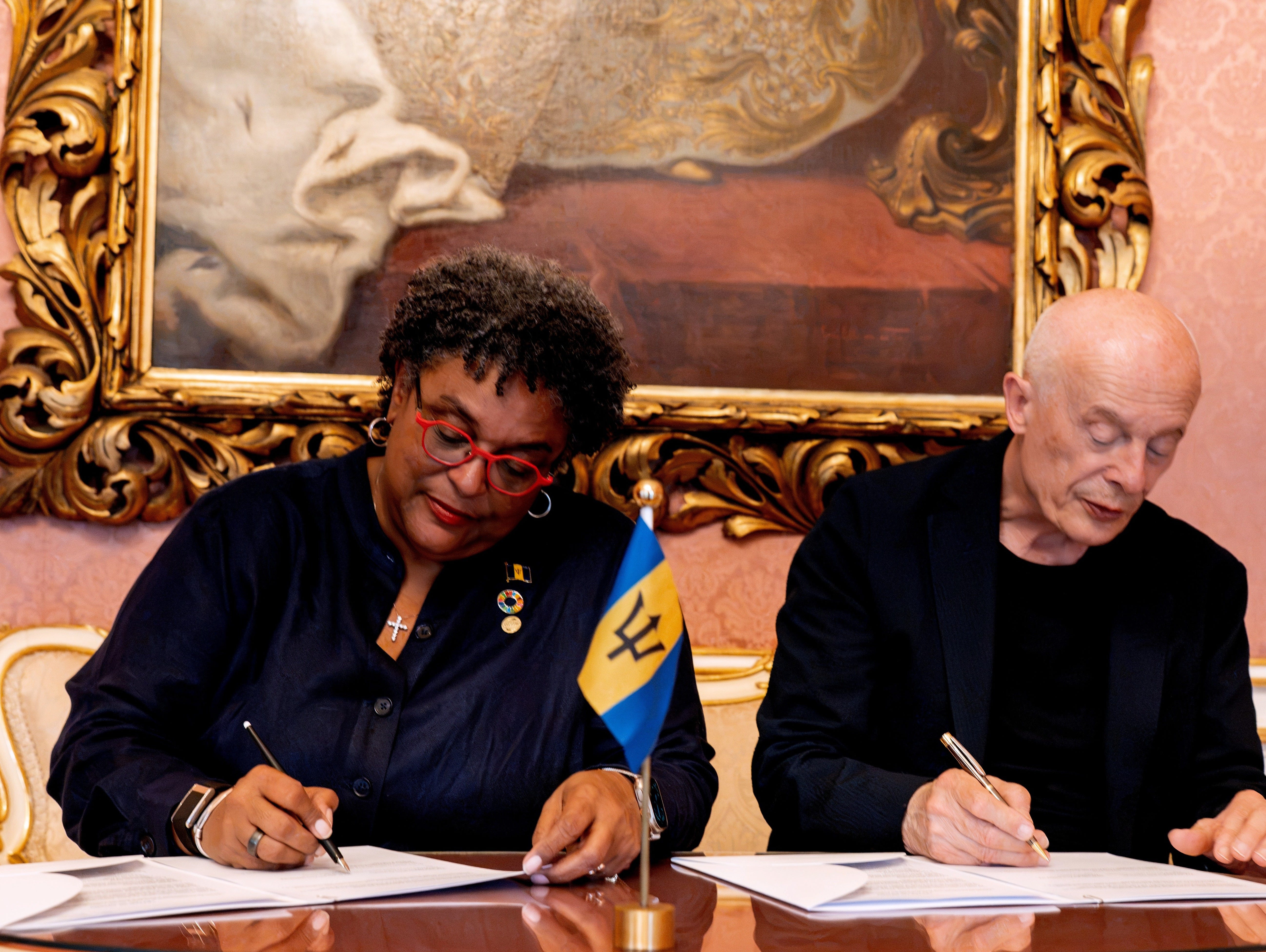
LAXENBURG, Austria — When Barbados signed a letter of intent to join the International Institute for Applied Systems Analysis, the move carried significance beyond research cooperation.
For Prime Minister Mia Amor Mottley, the partnership reflects a longstanding argument that countries on the front lines of climate change should play a larger role in shaping the knowledge systems that influence global decision-making.
“Barbados is proud to be joining IIASA at a time when our planet and our people need us to work together more urgently than ever,” Mottley said during a visit to the institute’s headquarters outside Vienna this week. “We have always believed that science must serve people: it must help make lives easier, economies more resilient, and the planet safer.”
The agreement launches Barbados’ path toward becoming IIASA’s 21st member and establishes a partnership focused on regenerative economies, climate resilience and systems analysis. It also gives one of the world’s most climate-vulnerable countries a direct voice in an international scientific institution whose models, scenarios and analyses help inform policy discussions on climate change, energy, food systems and sustainable development.
Just this month, IIASA welcomed Greece to its ranks through the Academy of Athens, Greece’s national academy and the highest research establishment in the country. IIASA said the addition, which had been in the works for two years, brought new opportunities to address global challenges and reinforced its own growing role as a platform for international scientific cooperation and science diplomacy.
“IIASA’s mission of transforming science into actionable knowledge for policymaking is completely aligned with the Academy’s enduring role in the service of society and humanity,” said Costas Synolakis, secretary of the Academy’s natural sciences division.
IIASA’s current list of 20 members includes Austria, China, Egypt, Finland, Germany, Greece, India, Iran, Israel, Japan, Norway, Russia, Slovakia, South Korea, Sweden, Ukraine, the United Kingdom, the United States, Vietnam and a regional organization, SSARMO, with 18 participating African countries.
If completed, Barbados' accession would represent more than the addition of another member country. It reflects a growing effort by climate-vulnerable countries to participate more directly in the institutions that produce the scientific knowledge used to guide international policy.
The country transitioned from a constitutional monarchy to a parliamentary republic in November 2021, replacing the monarch of the U.K. as its head of state with its own president. In recent years, Barbados also has been at the forefront of championing innovative climate and debt relief solutions.
Amid calls by organizations such as the International Energy Agency for trillions of dollars more in annual clean energy investment by 2030, the Bridgetown Agenda proposed by Barbados’ government called for a transformation of the international financing system to include more emergency liquidity from the International Monetary Fund and multilateral lending by the World Bank, along with more spending for climate adaptation.
A small group of nations led by Barbados, France and Kenya also met on the sidelines of the 2024 annual spring meetings of the IMF and World Bank in Washington to push for more taxes on fossil fuel burning that developing nations could use to deal with climate shocks. And last year, at the U.N.-hosted at the Fourth International Conference on Financing for Development held in Seville, Spain, Barbados, France and Kenya said they will explore taxes on premium air travel and private jets.

A growing web of science diplomacy links
The agreement with IIASA positions Barbados as what both sides describe as a real-world testing ground for a regenerative economy, combining IIASA’s expertise in systems analysis, modeling and scenario planning with Barbados’ efforts to build resilience across food, energy, water, ecosystems, digital innovation and sustainable industrial development.
Yet the broader science diplomacy significance may lie in how the partnership reframes the role of Small Island Developing States, a group of countries that have long occupied the front lines of climate change.
For decades, international scientific institutions have often studied the challenges facing this group, comprised of 38 countries and 18 associate members that belong to U.N. regional commissions. Increasingly, however, countries such as Barbados are seeking to help shape the research agendas themselves.
IIASA’s announcement explicitly links the partnership to ensuring that small-island perspectives are not simply consulted but embedded in the analytical frameworks used to guide climate and development policy.
That distinction matters because institutions such as IIASA do more than conduct research. They help generate the models, scenarios and evidence that governments use to evaluate policy choices. Membership provides access not only to scientific expertise but also to the processes through which scientific priorities are established.
The partnership also reflects a growing interest in co-producing knowledge rather than treating science as something transferred from research institutions to policymakers. Barbados will serve as a “living laboratory,” according to the letter of intent, where systems analysis and policy design can be tested against real-world challenges facing a climate-vulnerable island economy.
“We would love to help and to team up with you, and to learn also with you on how to deal with mitigating and adapting to climate change,” IIASA Director General Hans Joachim “John” Schellnhuber told Mottley during one of their meetings.
For IIASA, the arrangement with Barbados extends ongoing work on regenerative economy research, applying its analytical tools to development strategies intended not merely to reduce environmental harm but to restore ecological and social systems.
The agreement comes as concern grows over the possibility of exceeding the Paris Agreement’s 1.5° Celsius warming threshold. Small island nations are expected to be among the first to experience many of the consequences of climate overshoot, from sea-level rise and coastal erosion to disruptions in food, water and energy systems.
Supporters of the partnership argue that this makes small-island nations valuable sources of policy innovation rather than simply vulnerable recipients of assistance.
The collaboration builds on a series of exchanges between Barbados and IIASA. Schellnhuber traveled to Barbados in May to meet government, academic and diplomatic partners and explore opportunities for cooperation on resilience and innovation. Barbados Minister of Innovation, Technology, Energy and Commerce Jonathan Reid visited IIASA in April to discuss the foundations of the partnership. Full membership negotiations are expected to conclude in the coming months.
Officials also envision links with the United Nations Industrial Development Organization, creating what they describe as an emerging IIASA-Barbados-UNIDO partnership capable of combining science, innovation, artificial intelligence and sustainable industrial policy. The model, they argue, could eventually be adapted elsewhere in the Caribbean, Pacific, Indian Ocean and other small-island regions.
Among those who met with Mottley at IIASA this week was Carl-Friedrich Schleussner, who leads the Integrated Climate Impacts Research Group in the IIASA Energy, Climate, and Environment Program, and has been a scientific advisor to small island nations for the past 10 years.
“Barbados joining IIASA comes at a critical moment, as a 1.5°C overshoot is becoming an emerging reality with serious implications for climate risks,” he said. “Bringing in a Small Island Developing State perspective is essential, not only because islands are among the first affected, but because they bring vital insights into the solutions, too.”


