

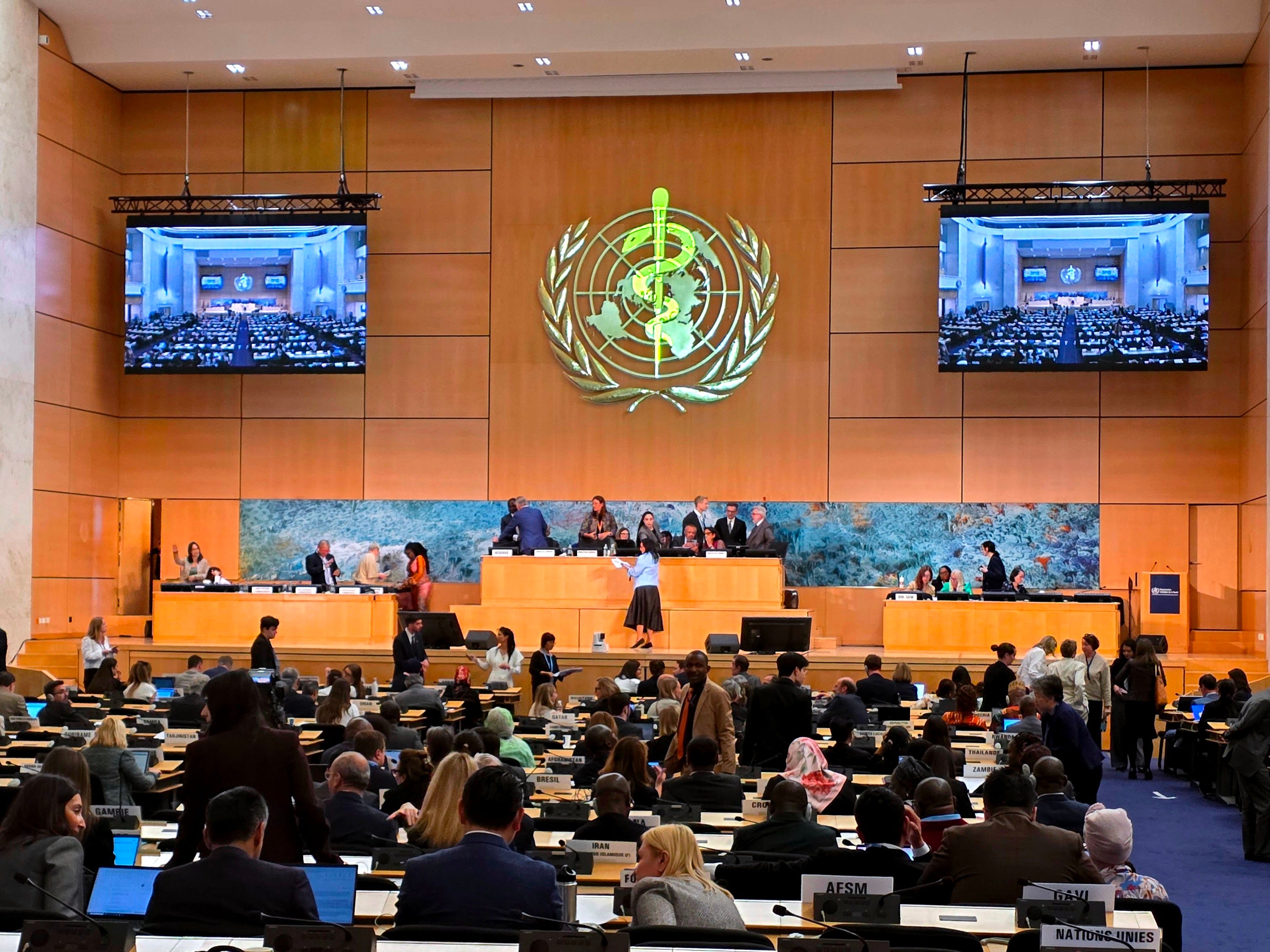
When delegates gathered in Geneva for the 79th World Health Assembly in May, many of them were resuming conversations that had been going on for years.
The formal opening session featured speeches from heads of state, ministers, and WHO Director-General Tedros Adhanom Ghebreyesus. Delegates filed into the assembly hall while journalists positioned themselves in upper galleries. Outside, shuttle buses moved continuously between WHO headquarters and the Palais des Nations, carrying diplomats, technical experts, and health officials between committee sessions and side meetings.
Over the following week, governments approved resolutions on antimicrobial resistance, radiation protection, workforce recruitment, tuberculosis, stroke, liver disease, emergency care, and health financing. Delegates debated conflicts in Gaza, Lebanon, Iran, and Ukraine. WHO officials briefed governments on an Ebola outbreak that had spread from Congo to Uganda. Behind the scenes, governments continued negotiations over the still-unfinished pathogen access and benefit sharing system intended to complete the Pandemic Agreement adopted the previous year.
To an outsider, the Assembly appeared to be a gathering: a week-long meeting where governments arrived, debated, and made decisions. In practice, many of the participants had been working on those issues long before they reached Geneva.
The Pandemic Agreement itself was the product of years of negotiations. The unresolved PABS annex had already passed through multiple rounds of discussion before delegates arrived in Switzerland. Proposed resolutions had circulated through committees, consultations, and regional meetings. Governments had coordinated positions. Technical experts had reviewed language. Amendments had been drafted, challenged, revised, and redrafted.
Tedros acknowledged the visible meeting was just part of a longer chain of interactions when he thanked delegates for “the preparation and discipline” that made the week possible. “Behind every intervention, every draft, every compromise, there has been a great deal of work,” he said. “That work is often not visible, but it is essential.”
The observation points to a less visible form of inequality. Participants do not arrive at international negotiations from the same starting point.
Some have spent years working on the issues under discussion. They know the history of particular resolutions, remember previous compromises, and understand why certain proposals were abandoned. They know which committees matter, which delegates carry influence, and where disagreements are likely to emerge.
Others encounter the process only at its most visible stage. Formally, both groups are participating. Practically, they are beginning from different places.
Every round of engagement leaves something behind: relationships, procedural knowledge, familiarity with personalities, understanding of institutional culture, and awareness of earlier debates. Over time those assets accumulate.
Institutions accumulate history as well. Responding to questions about WHO’s financial crisis, Tedros reminded delegates that many of the reforms helping the organization weather current funding cuts were not recent measures.
“Many people have questions about the impact of those cuts for the future of WHO. They want to know what’s going on. Today, I want to address those concerns by telling you what we’ve done, what we’re doing, and what we will do to build a stable and resilient WHO, and secure its future,” Tedros told the Assembly.
“In fact, that work did not begin last year,” he noted. “It began nine years ago, when we started the WHO transformation — the most ambitious reform agenda in the organization’s history, because we knew such a scenario could happen.”
Momodou Mbenga, a diplomat at The Gambia's mission in Geneva, was attending his third World Health Assembly. Asked whether the withdrawal of the United States had changed the atmosphere, he shrugged off the premise. Delegates, he said, were focused on committee work, resolutions, and a "very stacked agenda." The Assembly was "proceeding in a manner that is set up for it."
Even as delegates debated health emergencies and financing, another process was already unfolding. The race to succeed Tedros as WHO director-general in 2027 had effectively begun. Member nations were preparing nominations, regional groups were calculating support, and the Executive Board was establishing procedures for candidate forums months before any formal vote would occur. By the time the Assembly eventually elects a new director-general, many of the relationships and alliances shaping the outcome will already have been formed.
The same pattern appears beyond global health.
The process that produced the European Union's first science diplomacy framework stretched across several years. Research ministers first called for a European science diplomacy agenda in 2021. The European Commission later convened roughly 130 scientists, diplomats, policymakers and research leaders to develop recommendations.
Public consultations followed before ministers formally adopted the framework in May. By the time the final vote occurred, some participants had spent years helping shape the outcome. Others encountered the framework only when it was announced.
Jan-Marco Müller, the European Commission official who helped lead the process, later argued that "much more important than the end result" was bringing scientists and diplomats together. The effort created relationships, familiarity, and shared understanding that would shape future cooperation.
International institutions often emphasize equal participation. Yet equality at the moment a meeting begins does not erase the advantages accumulated beforehand. Some participants arrive carrying years of relationships, institutional knowledge, and procedural experience. Others are entering the conversation for the first time.
Participation, in other words, is cumulative. The difference is not always visible, but it shapes what happens next. The starting line is rarely where it appears to be.