

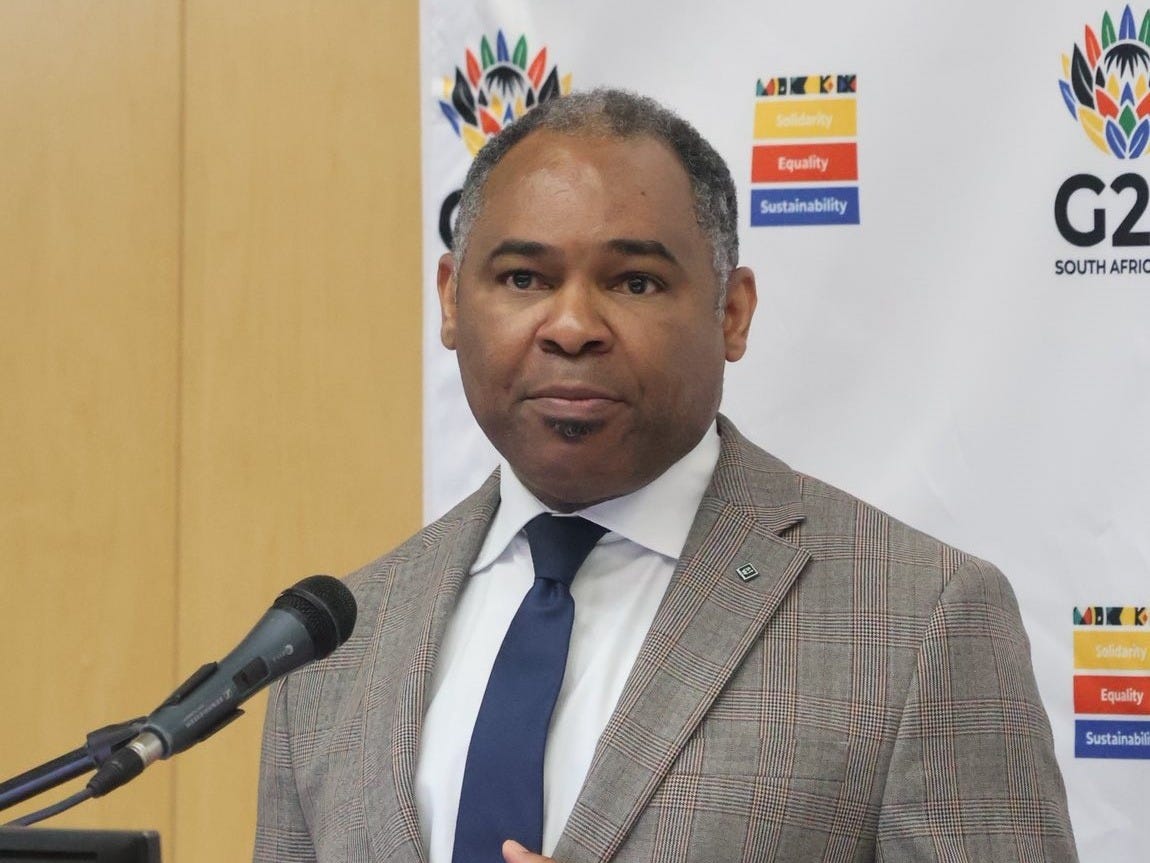
Brando Okolo wants to expand what counts as science diplomacy.
For the head of science, technology and innovation at the African Union Development Agency-NEPAD, international scientific cooperation should extend beyond research partnerships and diplomatic dialogue to include industrial development, entrepreneurship and the ability to turn knowledge into technology.
“I think the current definition of science diplomacy is a bit narrow,” Okolo said in an interview on The Science Diplomat Podcast. “Everywhere where you can find a dot representing science, diplomacy should be in a position to choreograph relationships around that dot.”
Africa is still developing its own definition, one that Okolo expects to encompass industrial cooperation, communications, health and energy.
His perspective reflects an unusual career spanning both continents. A materials scientist and chemical engineer by training, Okolo spent 26 years in Germany, studied in Leeds and taught for five years at the German University in Cairo. He later became an entrepreneur in additive manufacturing before moving into African science policy.
Those experiences now inform how he approaches relationships with scientific partners in Europe, Asia, North America and the Middle East — and particularly his view of what equality should mean between Africa and Europe.
“For me, equality would mean that you have an equal flow of scientific assets, both from the African side to the European side,” he said. “The mobility of scientists has to be friction-free both ways, in my opinion, and the buildup of science infrastructure has to be equal as well.”
The A.U.-E.U. Innovation Agenda is one mechanism for pursuing closer cooperation, but Okolo described it as “only one instrument out of a multitude of instruments” connecting African and European science.
Those relationships are also changing as Africa develops deeper scientific ties elsewhere.
Okolo recalled a research landscape in the 1990s centered much more heavily around Europe and North America. Today, African researchers are increasingly publishing with counterparts in China, South Korea, Japan and India.
“What this means is that Africa has more options,” he said. “Not that Africa’s relationship with Europe or with North America has been diluted. No. It means that Africa has more options.”
That shift has implications for Europe.
“Europe should begin to see Africa as an investment, and Africa should see Europe as an investment as well,” Okolo said. “If Europe fails, it’s not in Africa’s interest. And if Africa fails, it’s not in Europe’s interest.”
He sees demographic change adding urgency to that relationship, pointing to a future in which Africa accounts for a much larger share of the world’s workforce and young people. He also foresees a growing economic relationship among Africa, China and India.
“Twenty-five years from now, we’re going to have a new market size of about 5.5 billion people within an India, China and Africa market space, and it’s an attractive market space,” he said.
For Okolo, however, greater geopolitical choice matters only if it is accompanied by greater technological capability.
He sees potential in technologies such as artificial intelligence and additive manufacturing to shorten the path toward industrialization. Combining AI-assisted design with more decentralized manufacturing, for example, could allow African economies to build production capacity without reproducing every stage of older industrial models.
“I hate to use the word leapfrog, but to design a much shorter path from non-industrialization to industrialization, in my opinion,” he said. That technological ambition still begins with research.
Okolo pointed to the United States and China as examples of the relationship between sustained investment in R&D and technological leadership, including China’s growth in research and manufacturing around electric-vehicle batteries.
“There’s a correlation there that if you invest more in research, one of the key dividends of that is being able to be a technology champion,” he said. But his own career convinced him that research cannot stop at publication.
At 42, while teaching at the German University in Cairo, Okolo decided he wanted “to do something else with my life.” He returned to Germany and helped establish a company developing 3D printers, software and materials for high-performance polymers.
“There was just no way I could have had that level and depth of experience as an entrepreneur, as a business owner, as somebody within the leadership of a tech startup,” he said, “if I was still domiciled within the university environment.”
That experience now shapes his conception of science diplomacy. “Most scientists are undiplomatic, and most diplomats are not scientific,” Okolo said.
He wants science diplomacy to develop into a more deliberate field of training, with curricula designed around the skills needed to work between science and international relations. For Africa, he would add another competency.
“I’m beginning to see a science diplomat who has an understanding of entrepreneurship,” he said. “Because those fantastic research outputs need to be driven by an entrepreneur.”
African institutions are also encouraging countries to appoint science attachés to their embassies so officials with scientific understanding can identify opportunities and build relationships abroad.
Okolo only recently began applying the term science diplomat to himself. “I didn’t know I was one until the beginning of this year,” he said.
Preparing a master class on the subject changed that. As the official leading science, technology and innovation within AUDA-NEPAD, he came to see diplomacy as part of the responsibility that accompanies the job.
“It’s kind of got planted in my consciousness that you’re actually a science diplomat.”