

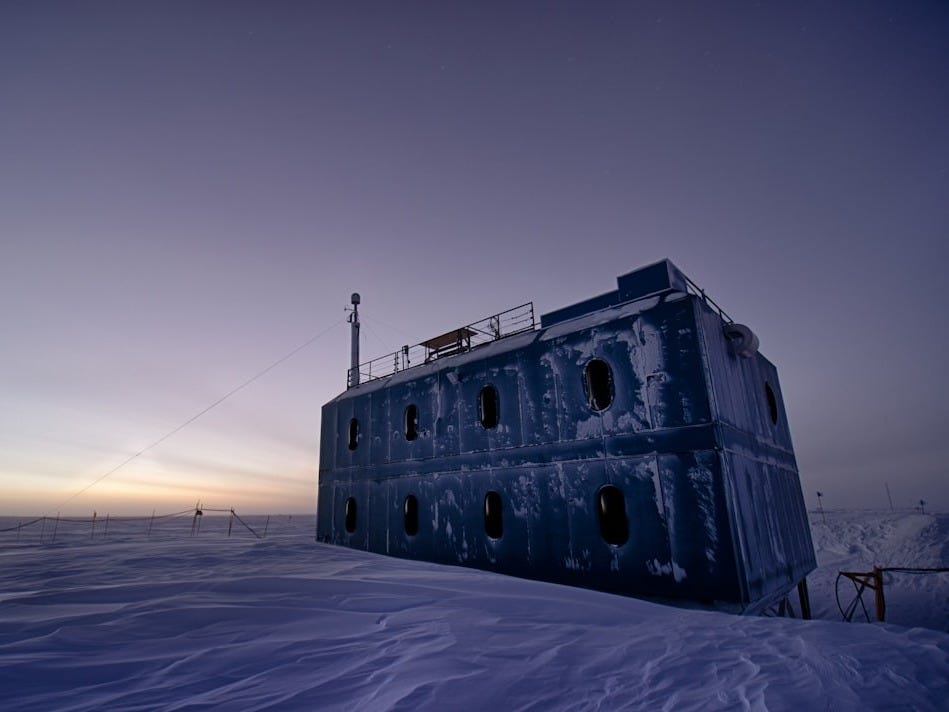
Power in global science governance is built into who can operate, measure, access systems, and persist. This series examines those dynamics in five parts, starting with capacity.
On the wind-scoured edge of the Ross Ice Shelf, where the volcanic grit of Ross Island meets one of the world’s most isolated deep-water harbors, the distinction between a guest and a governor is determined by the mechanical hum of a power plant.
The abstractions of international relations resolve into day-to-day tasks at the Amundsen-Scott South Pole Station and the logistical hub of McMurdo Station. Within the Antarctic Treaty System, authority rests on the ability to operate.
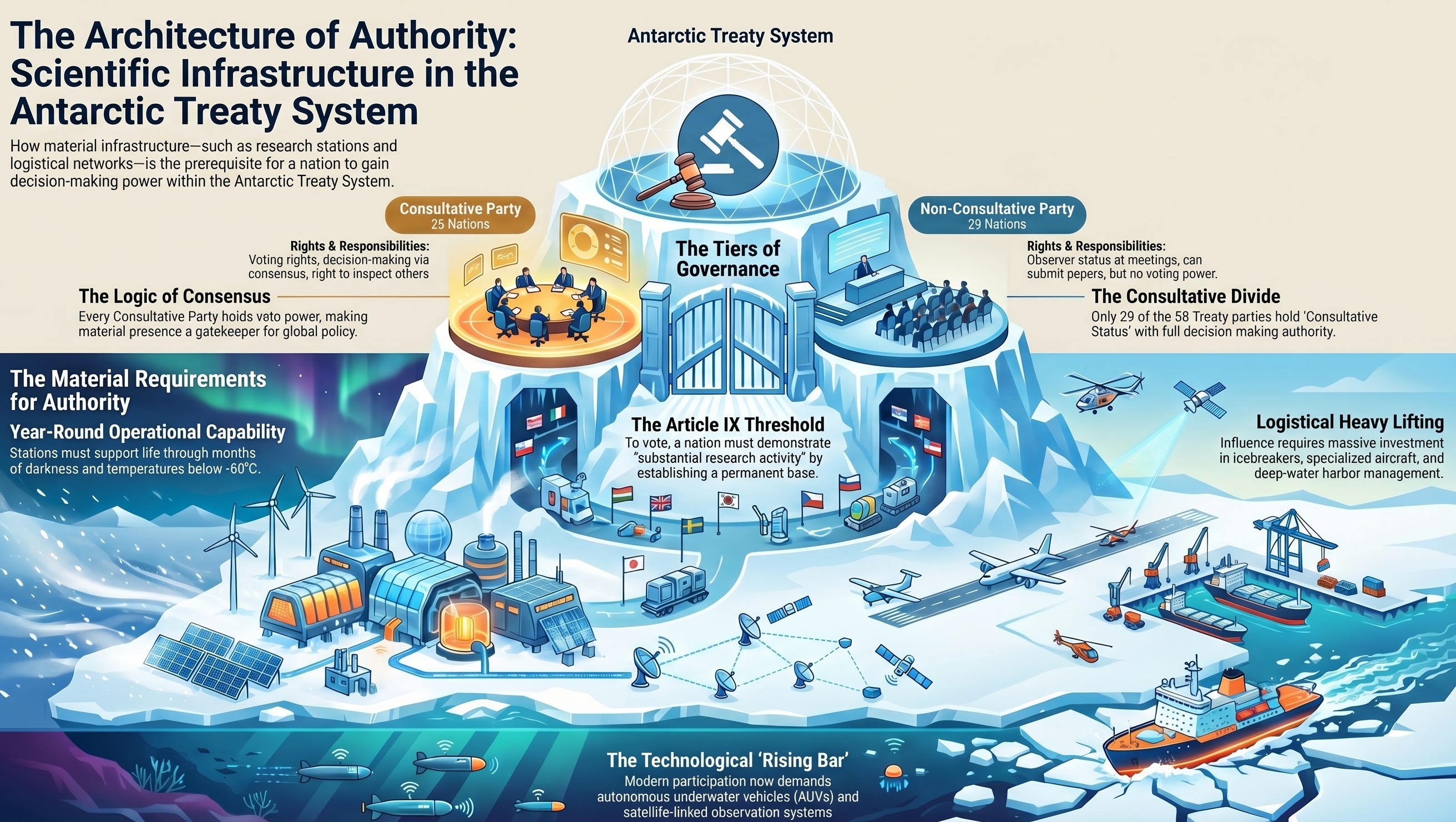
For more than six decades, the Antarctic Treaty has set aside territorial claims while structuring international cooperation around scientific activity. That structure produces a hierarchy. While 58 nations have acceded to the treaty, only 29 hold consultative status — the category that carries decision-making authority.
“The Antarctic Treaty of 1959 created an unprecedented framework that has preserved the continent for peaceful purposes, scientific cooperation, and environmental stewardship,” Horacio Werner, executive director of Agenda Antártica, wrote in a joint publication with Konrad-Adenauer-Stiftung.
Participation alone does not translate into authority. Consultative status is reserved for nations that, in the language of Article IX, “demonstrate their interest in Antarctica by conducting substantial scientific research activity there.” In practice, that requirement functions less as a legal threshold than as an operational one.
The infrastructure of authority
In the Antarctic interior, where temperatures fall below -80°C and evacuation can be impossible for months at a time, “substantial research” becomes indistinguishable from the infrastructure that produces data.
Year-round stations must support staff through months of darkness and isolation. Aircraft and icebreakers operate within narrow seasonal windows that cannot be extended. Equipment must function in conditions where failure cannot always be repaired. Above all, funding must persist across decades.
“Peace in Antarctica is not the passive result of isolation or luck, but rather the continuous product of social and institutional innovation,” Werner wrote. “The treaty ‘froze’ sovereignty claims without attempting to resolve them, allowing states to channel their rivalry into cooperation rather than confrontation.”
The system, he argues, separates participation from decision-making, bridged only by sustained effort — those who maintain the infrastructure shape the system. In practice, that logic is visible in the distribution of presence. The United States has the largest footprint, anchored by McMurdo Station, which supports air operations, overland traverses, and coastal access, and the Amundsen-Scott South Pole Station. Russia operates multiple stations across East Antarctica, including Vostok, above a subglacial lake sealed for millions of years.
The distribution of presence is changing. Australia, the United Kingdom, and France maintain long-standing programs, but China and India have expanded rapidly, building new stations and extending operational capacity. China’s Qinling Station, completed on Inexpressible Island, adds to a network designed for permanence as much as research. Presence is cumulative, not symbolic.
The logic of the consensus gate
At Antarctic Treaty Consultative Meetings, all nations participate in discussion, submit papers, and engage in negotiation. When measures are adopted on environmental protection, scientific coordination, or human activity, only consultative parties can take part in consensus decisions.
As Cecilia Silberberg, an Argentine diplomat and international law expert, wrote in Environmental Policy and Law, the system was designed to let nations with competing claims “set aside their differences in favor of cooperative governance.”
It also produces friction: national interests persist. Proposals to create large Marine Protected Areas in the Southern Ocean, for example, have stalled under consensus rules, blocked by a small number of consultative parties.
At the same time, the threshold for entry is rising. “Substantial scientific activity” is not defined in fixed terms, but in practice it expands alongside the system itself. Autonomous vehicles, satellite-linked observation systems, and high-performance computing have raised both the scale and cost of participation.
As the Antarctic summer ends and winter crews prepare for months of isolation, authority rests on a single principle: the ability to keep operating.
“Any structural change to this arrangement could reignite sovereignty debates, potentially destabilizing the region and disrupting the diplomatic balance that has preserved Antarctica as a zone dedicated to peace, science, and environmental protection,” Silberberg wrote. “Additionally, the current geopolitical climate makes it highly complex to achieve a global consensus on Antarctic governance.”
Part 2 examines how this logic extends beyond formal rules, into systems where power lies in defining what is measurable in the first place.