CERN’s Antimatter Breakthrough Could Redefine Access to Europe’s Most Advanced Science
The successful transport of antimatter may mark the beginning of a more distributed model of scientific research
For the first time, scientists at CERN successfully transported antimatter outside its experimental setup, achieving a technical milestone in particle physics.
The experiment was designed to answer a fundamental question about matter and antimatter, but it also points to a practical shift: the possibility of moving one of the most fragile forms of scientific material beyond the facility that produces it.
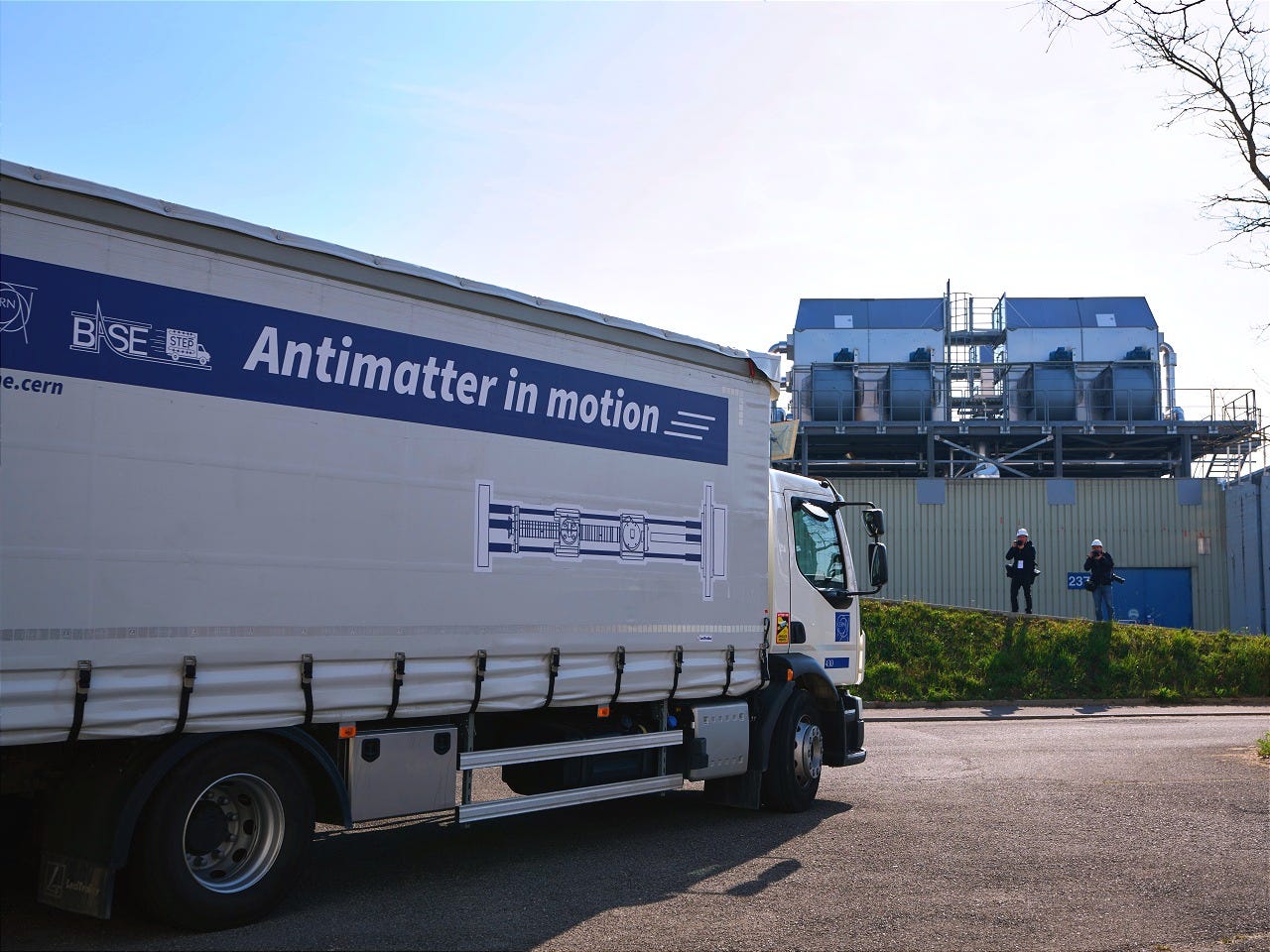
Scientists kept antimatter from coming into contact with actual matter during a four-hour road trip on Tuesday by suspending about 100 antiprotons in a vacuum put within a specially designed portable trap fixed in place with supercooled magnets.
The portable trap designed by the Baryon Antibaryon Symmetry Experiment, or BASE, not only survived the journey intact but also demonstrated that antimatter can be moved without annihilation.
At first glance, the experiment is a proof of concept; its significance is what it enables next. Antimatter is notoriously difficult to store and manipulate, and transporting it opens a door to more precise measurements of its properties, particularly in places with less magnetic interference than CERN’s “antimatter factory.”
The BASE collaboration ultimately aims to deliver antiprotons to external laboratories, including Heinrich Heine University in Düsseldorf, where researchers could conduct higher-precision experiments than are currently possible at CERN.
That required developing the BASE-STEP project to design an apparatus that could store and transport antiprotons. This marks a departure from a model in which antimatter research is tightly concentrated within a single facility.
“Our aim with BASE-STEP is to be able to trap antiprotons and deliver them to our precision laboratories at a dedicated space at CERN, HHU, Leibnitz University Hannover and perhaps other laboratories that are capable of performing very-high-precision antiproton measurements, which unfortunately is not possible in the antimatter factory,” says BASE-STEP’s Christian Smorra. “We validated the feasibility of the project with protons last year, but what we achieved today with antiprotons is a huge leap forward towards our objective.”
BASE-STEP is small enough to be loaded onto a truck and fit through ordinary laboratory doors, and it can withstand the bumps and vibrations of transport. The current apparatus, combining a superconducting magnet, liquid helium cooling, power reserves and a vacuum chamber, weighs 1000 kilograms: much more compact than BASE or any other existing system used to study antimatter.
“To reach our first destination, our dedicated precision laboratory at HHU in Germany, would take us at least 8 hours,” Smorra adds. “This means we’d have to keep the trap’s superconducting magnet at a temperature below 8.2 Kelvin for that long. So, in addition to the liquid helium, we’d need to have a generator to power a cryocooler on the truck. We are currently investigating this possibility.”
Nevertheless, the greatest challenge remains on arrival at the destination: to transfer the antiprotons to the experiment without them vanishing.
CERN’s antimatter factory remains unique: it is the only place in the world capable of producing and storing low-energy antiprotons. For decades, that has made it both the center of research and the gatekeeper of access. Experiments have had to come to CERN. Transporting antimatter reverses that logic.
Toward a Distributed Model
Instead of concentrating scientific capability in one location, the technology would allow experiments to be conducted beyond CERN. Labs that cannot produce antimatter could participate in frontier research, provided they have the equipment to receive and measure it.
In practice, this points toward a more distributed research model, in which rare scientific resources are produced in centralized facilities but used across a network of institutions. Access to such infrastructure has long shaped where research happens. The ability to move those resources, whether particles, data, or specialized materials, can reshape who participates.
In the case of antimatter, the question is not just how to transport it but how access will be structured. Which labs will receive antiprotons and under what conditions? How will this capability be integrated into existing European research frameworks?
The technical challenges remain significant. The current transport system can sustain the required conditions for only a limited time, and transferring antiprotons into a new experimental setup without loss remains a major hurdle. Extending transport beyond CERN’s campus to destinations several hours away will require additional engineering advances. Still, the demonstration establishes feasibility.
More broadly, it offers a glimpse of how advanced scientific infrastructure may be organized in the future. As research becomes more complex and resource-intensive, the ability to share and distribute key inputs, whether particles, data, or specialized materials, could become as important as the facilities that produce them.
“Machines and equipment in CERN’s ‘antimatter factory’ where BASE is located generate magnetic field fluctuations that limit how far we can push our precision measurements,” BASE’s Stefan Ulmer said. “The precision of the measurements taken in BASE is such that gaining an even deeper understanding of the fundamental properties of antiprotons will require moving the experiment out of the building.”


