

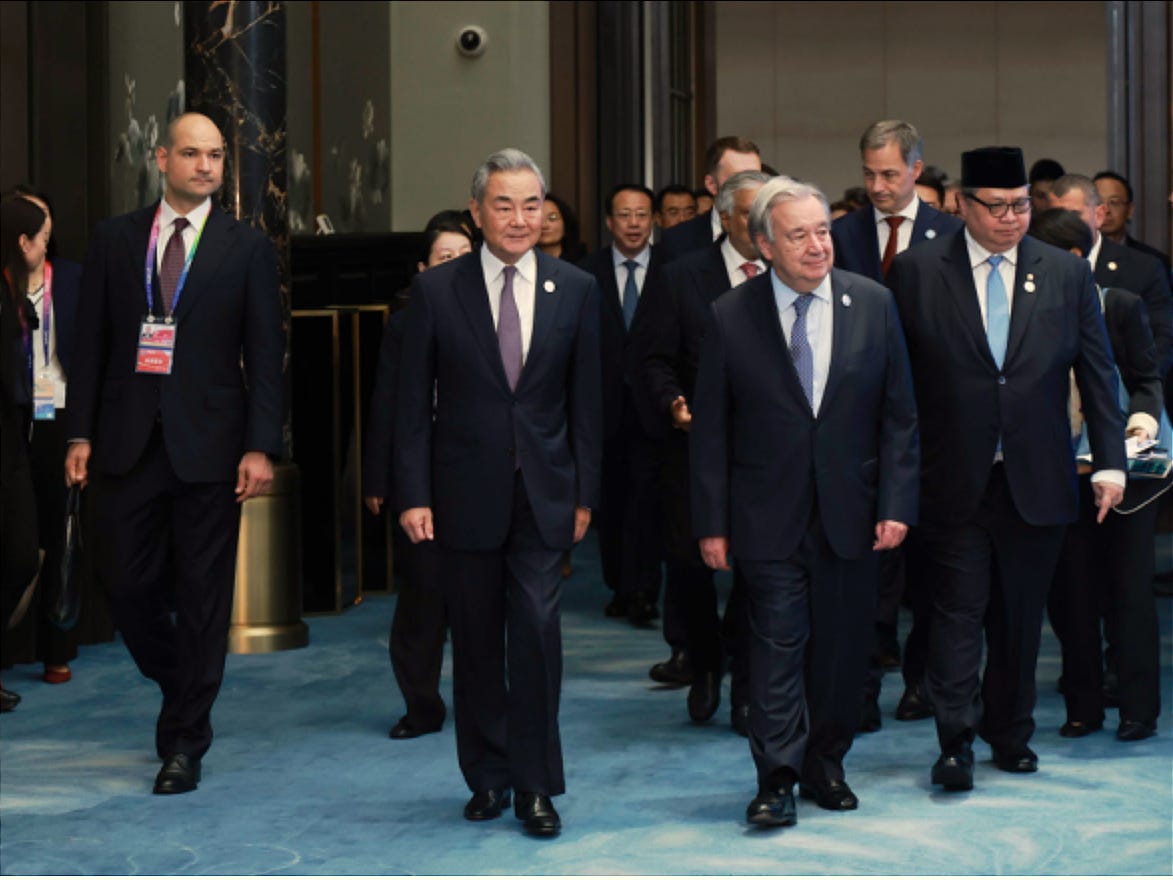
China moved to establish itself at the center of an emerging global system for governing artificial intelligence, formally launching a new intergovernmental organization and offering training, technology and institutional partnerships to countries across the Global South.
The World Artificial Intelligence Cooperation Organization, or WAICO, was established after representatives of 29 countries signed an agreement in Shanghai. China described it as the world’s first intergovernmental international organization devoted specifically to artificial intelligence, with a mandate covering technological development, international cooperation and global governance. Its headquarters will be in Shanghai.
Chinese President Xi Jinping called the organization an “important milestone” in the history of AI development as he opened the World Artificial Intelligence Conference on Friday.
“AI development should not be a solo performance by a single country, but a symphony of international cooperation,” Xi said. “Thanks to our joint efforts, WAICO has come into being in Shanghai.”
The organization’s founding members include Russia, Brazil, Indonesia, Kazakhstan, Pakistan, Belarus, Serbia, Cuba and Venezuela, along with countries from Africa and Asia that China says represent a broad coalition of developing nations.
China said WAICO would be open to all countries and would uphold the purposes of the U.N. Charter, respect national sovereignty and cultural diversity, and promote artificial intelligence that is “beneficial, safe and fair.” The organization aims to support developing countries in strengthening AI innovation, applications and governance while narrowing global technology gaps.
The launch marks a significant step in China’s effort to move from promoting AI governance principles to building permanent institutions. For several years Beijing has advanced initiatives through the United Nations and other diplomatic forums. WAICO provides China with a dedicated international organization through which it can pursue cooperation, capacity building and governance initiatives.
Xi framed the effort as a response to demands from the Global South and warned that unequal access to computing power, data, infrastructure and expertise could reproduce historical inequalities.
“We must carry out extensive international cooperation and help Global South countries with capacity building to bridge the AI and digital divides,” he said.
Xi announced that China would provide developing countries with 5,000 places in AI training and seminar programs over the next five years. China will also establish AI cooperation centers with ASEAN, the African Union, the Arab League, the Community of Latin American and Caribbean States, BRICS and the Shanghai Cooperation Organization.
In addition, China said it would enable 30 countries to use MAZU, an AI-powered meteorological warning system designed to improve forecasting and disaster preparedness.
The announcements place capacity building at the center of China’s AI diplomacy. Beijing portrays open-source AI models, affordable computing resources and technology transfer as alternatives to systems dominated by a small number of Western technology companies.
Xi called for greater openness, collaboration and sharing while also emphasizing that AI systems must remain under human control and be governed through laws, monitoring mechanisms and emergency response systems.
The conference’s chair statement similarly called for open-source AI ecosystems, international cooperation on standards, and greater participation by developing countries in AI supply chains and governance processes. It also warned of emerging risks involving critical infrastructure, frontier models and autonomous AI agents.
The launch came little more than a week after governments, researchers and technology experts met in Geneva for the first U.N. Global Dialogue on AI Governance, part of a broader effort by the United Nations to create a more inclusive framework for international oversight of artificial intelligence.
U.N. Secretary-General António Guterres attended the signing ceremony in Shanghai and delivered a speech that largely welcomed China’s efforts while emphasizing the need for AI governance to remain anchored in multilateral institutions.
“Technology that will shape the future of humanity must be shaped by all humanity,” Guterres said. “It cannot be governed by a handful of countries or a handful of companies.”
Guterres linked China’s initiatives to the Global Digital Compact adopted by the U.N. General Assembly and described the creation of WAICO as part of a broader effort to expand participation in AI governance.
At the same time, he argued that governance must remain grounded in international law and human rights. He called for common approaches to testing, risk assessment and accountability, saying that humans must retain control over life-and-death decisions.
The secretary-general also announced that he would soon present recommendations for a Global Fund for AI intended to support developing countries and said that more than 20 countries, including China, had already nominated centers for a U.N.-supported Global Network for Exchange and Cooperation on AI Capacity Building.
The parallel initiatives highlight a larger question confronting policymakers: whether AI governance will converge around a common international framework or evolve through multiple overlapping institutions and coalitions.
China’s vision emphasizes sovereignty, development, capacity building and open-source technologies. U.N. initiatives have focused on inclusiveness, scientific assessment and global coordination. Western governments have generally placed greater emphasis on safety, regulation and advanced-system risks.
For now, Beijing and the United Nations insist those approaches can be complementary. The conference statement explicitly called for strengthening the U.N.’s central role in AI governance and warned against fragmentation of global governance efforts.
Much about WAICO remains unclear, including its financing, governance structure, membership obligations and relationship with existing international organizations. It is also uncertain whether the body will eventually play a role in technical standards, safety frameworks or international rulemaking.