For decades, scientists have warned that rising seas would increase the risk of coastal flooding. What has been harder to determine is how much of that risk can be directly attributed to human-caused climate change at specific locations.
A new study led by Climate Central suggests that answer is becoming clearer.
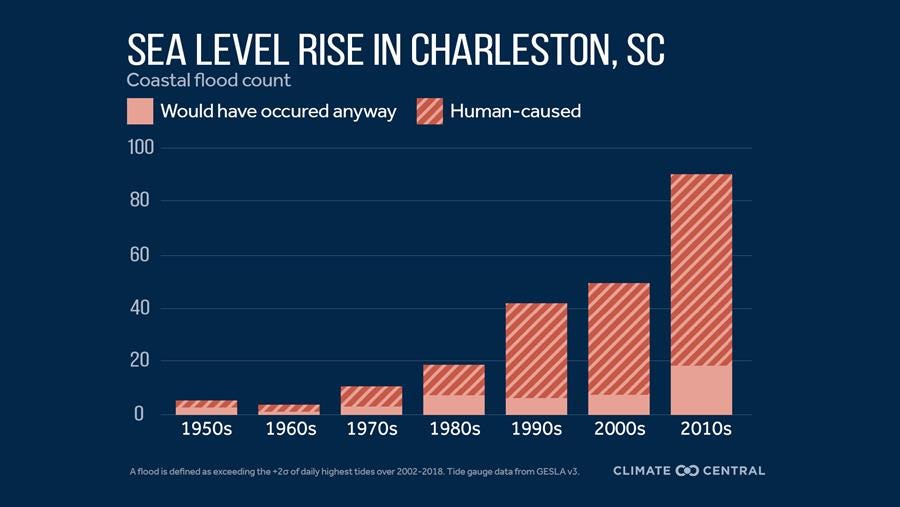
The research, published in Science Advances, finds that human-caused sea-level rise is detectable at 97% of the tide-gauge sites examined worldwide and was responsible for 58% of observed days with extreme water levels between 2000 and 2018. Averaged globally, climate change nearly tripled the number of days exceeding extreme water-level thresholds compared with the 1970s.
The findings mark another step in the rapid evolution of attribution science, a field that seeks to quantify how human-caused climate change contributes to specific impacts and extreme events.
For vulnerable coastal countries, the significance extends beyond scientific understanding. Attribution studies are giving negotiators, adaptation planners and international institutions more precise evidence linking observed climate impacts to human-caused warming.
That evidence is relevant in climate diplomacy, where countries already facing rising seas are seeking stronger support for adaptation, resilience and loss-and-damage responses. The growing precision of climate attribution science comes as international institutions grapple with the consequences of rising seas.
In 2025, the U.N. International Law Commission completed a major study examining sea-level rise and international law, reflecting growing concern among governments about the consequences of climate-driven coastal change for maritime boundaries, statehood and international governance.
The Commission explicitly recognized that sea-level rise was not contemplated when the U.N. Convention on the Law of the Sea was negotiated. The Commission concluded that legal stability, certainty, and predictability require preserving maritime entitlements despite changing coastlines caused by sea-level rise.
The Red Cross Red Crescent Climate Centre describes attribution science as a field that has moved beyond general statements about climate change and extreme weather toward more detailed assessments of how warming affects the intensity and likelihood of specific events. The center says rapid attribution studies are often produced within days or weeks so they can inform public discussion while disasters and policy responses are still unfolding.
The new coastal-flooding research extends that logic to sea-level rise.
Until recently, attribution studies focused largely on heat waves, droughts, storms and other weather extremes. The Science Advances study applies attribution methods to coastal flooding and extreme water levels, offering governments and international organizations a more precise understanding of how climate change is altering risks along coastlines.
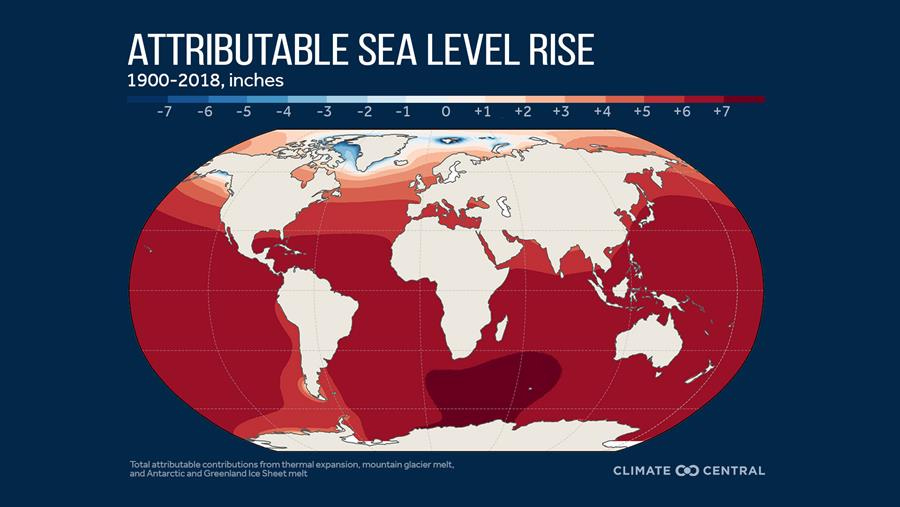
The study analyzed records from 519 tide-gauge sites worldwide using two largely independent methods. One estimated attributable sea-level rise by calculating contributions from ocean warming, mountain glacier melt and ice loss from Greenland and Antarctica. The second compared observed sea levels with modeled scenarios representing a world without climate-warming emissions.
Both approaches produced similar results, strengthening confidence in the findings.
“These studies highlight how we’ve loaded the climate dice against not only our children and grandchildren, but ourselves,” said Daniel Gilford, a climate scientist at Climate Central and an author of the study. “The effects of human-caused climate change are already here.”
Attribution science is moving beyond research and into policy, legal and governance discussions. In a recent paper, University of Ibadan researcher Violet Vihayes described the field as "rapidly transforming how societies assign responsibility for climate harms," arguing that improved attribution methods are increasingly informing courts, governments, regulators and treaty negotiations.
That shift matters for climate diplomacy because evidence is shaping debates over which communities face rising risks, what losses can be documented and what support may be justified
Small island developing countries have long argued that they experience disproportionate impacts from rising seas despite contributing only a small share of global greenhouse-gas emissions. Those concerns have become central to international discussions on adaptation finance, climate resilience and the implementation of loss-and-damage mechanisms agreed through U.N. climate negotiations.
More precise attribution science will not resolve those political debates. It does, however, strengthen the evidentiary basis on which they take place.
Rather than relying only on projections of future impacts, policymakers can point to observed changes and assess how much human-caused climate change contributed to specific risks already being experienced by communities.
The Union of Concerned Scientists has described attribution science as spanning event attribution, source attribution and impact attribution. Event attribution examines whether climate change made a specific event more likely or severe. Source attribution traces contributions to particular emitters or sectors. Impact attribution connects climate-driven changes to real-world damage.
For policymakers and legislators, UCS scientist L. Delta Merner wrote, attribution findings can help quantify climate risks that inform emissions targets, adaptation funding and regulatory standards. She described attribution science as an “evidentiary backbone” for decisions requiring climate-risk disclosure or resilience planning.
The new coastal-flooding study does not assign legal responsibility for individual flood events. But it strengthens scientists’ ability to quantify the extent to which climate change has altered coastal flood risks at specific locations, providing information that could inform adaptation planning, infrastructure investment, climate-risk assessments and international support claims.
The implications extend well beyond U.N. climate negotiations.
Insurers, infrastructure planners, development banks and local governments are seeking location-specific assessments of climate risk as they make decisions about resilience measures, development projects and long-term investments in vulnerable coastal regions.
The Science Advances study was released alongside complementary research in Nature Climate Change that found human-driven sea-level rise has quadrupled the frequency of coastal sea-level extremes since 1900.
“Sea level rise is making both tidal flooding and storm-driven flooding more frequent, extensive and expensive,” said Robert Kopp of Rutgers University, a co-author of the Science Advances paper. “Together, these two studies allow us to pinpoint the human role in driving these changes.”