

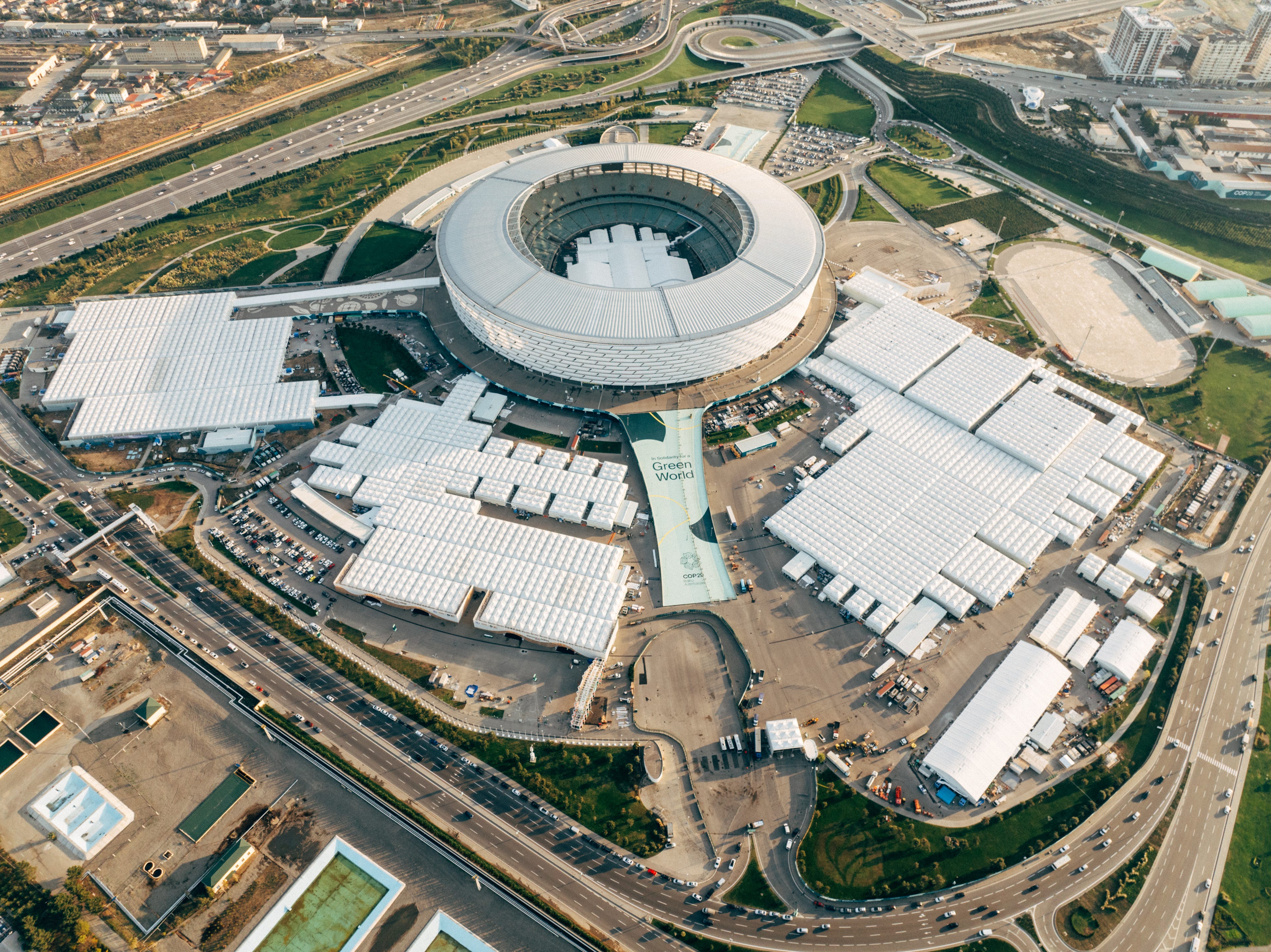
Despite the enormity of Baku Olympic Stadium, where Azerbaijan hosted the U.N.’s annual climate summit in November 2024, many delegates left feeling that the negotiations had narrowed long before the final decisions reached the floor.
From the outside, the closing days of COP29 projected the appearance of orderly global consensus. Delegates sat behind country nameplates in the main hall, listening through headsets as chairs moved rapidly through the remaining agenda. Draft decisions appeared on giant screens and disappeared almost as quickly into formal approval.
But by the time COP29 President Mukhtar Babayev gaveled through a deal committing developed countries to mobilize $300 billion annually in climate finance for developing nations, several governments were openly objecting to both the substance of the agreement and the way it had been assembled. India criticized the process sharply. Nigeria and other countries argued the package fell far short of the $1.3 trillion developing nations had sought for mitigation, adaptation, and climate-related loss and damage.
What unfolded in Baku reflected a recurring feature of international negotiations: the decisive phase often occurs well before agreements reach the largest and most visible rooms.
Inside the maze of meeting rooms spread across the Olympic Stadium complex, negotiations ran simultaneously across multiple tracks covering finance, mitigation, adaptation, technology transfer, and implementation. Sessions overlapped continuously. Some stretched late into the night. Others were scheduled back-to-back with almost no time for delegates to compare revisions or coordinate positions across negotiating groups.
The process itself rewarded endurance. Delegates worked line by line through draft language that would eventually shape international commitments. Chairs regularly asked negotiators whether they could “live with” compromise wording, a familiar procedural formulation that allowed text to move forward without requiring full agreement. In some sessions, interventions were restricted to one minute or less as negotiators queued at microphones while revisions appeared on screens in real time.
Under those conditions, time became a form of leverage. The clock was often the most effective negotiator in the room.
The primary barrier to participation was the inability to be in several places at once. Wealthier countries arrived with large delegations containing technical specialists, legal advisers, and issue-specific negotiators who could track parallel discussions across multiple rooms simultaneously. Smaller delegations, sometimes composed of only a few officials covering the entire conference agenda, were forced to make constant choices about where to deploy limited attention.
If a critical paragraph was revised in one room while delegates were defending a position in another, the change could become effectively permanent before they had an opportunity to respond.
By the second week of the summit, the scope for major revisions had narrowed significantly. Ministers and heads of state were no longer negotiating from open-ended proposals. They were working from texts that had already passed through several rounds of procedural and technical filtering during the first week.
Thousands of people entered the summit process. Only a fraction of proposals survived it. Ahead of the summit, Papua New Guinea’s foreign minister, Justin Tkatchenko, said smaller countries had grown “tired of being sidelined” despite participating fully in the negotiations themselves.
International negotiations are built on the idea that participation gives governments a voice in the outcome. Delegations attend meetings, experts contribute evidence, and decisions are ultimately approved in plenary sessions open to all parties. Yet across fields as varied as climate change, wildlife conservation, and digital governance, the decisive stages often occur much earlier. By the time agreements reach the floor, they have already passed through layers of drafting, technical review, committee negotiation, and procedural filtering that narrow the range of possible outcomes.
What happened in Baku was unexceptional. The same narrowing process appears in negotiations far removed from climate diplomacy.
When governments met in Geneva in February 2025 for the 78th meeting of the Standing Committee to the Convention on International Trade in Endangered Species, or CITES, nearly 600 delegates and observers gathered to discuss species protection, wildlife trafficking, enforcement, and trade monitoring ahead of later meetings scheduled in Uzbekistan.
By the time delegates arrived in Geneva, the challenge was what to prioritize. Opening the meeting, CITES Secretary-General Ivonne Higuero told delegates that the committee faced 127 working documents across 87 agenda items, compared with 49 agenda items at a similar meeting in Geneva in 2009. Organizers added an extra day of negotiations and circulated a document listing roughly 200 potential decisions for consideration.
“Given the scarce resources available, both for the Permanent Committees and the Parties, your discussions this week must focus on actionable and impactful recommendations that will shape the future of CITES,” Higuero told delegates. To support that prioritization, the Secretariat prepared a document consolidating roughly 200 potential decisions emerging from the Convention’s various committees.
On paper, the system appears straightforward. Countries vote. Decisions to list or reclassify species require a two-thirds majority of parties present and voting. Formally, each state participates on equal terms.
But proposals arrive long before voting begins. Scientific assessments, trade data, and technical criteria are submitted months in advance, then reviewed, challenged, revised, and filtered through committee structures before they reach plenary sessions.
Debates over shark protections exposed those tensions. Some governments pushed for stronger restrictions while others challenged the scientific evidence and warned of economic consequences. In several cases, proposals were revised, narrowed, or delayed before delegates ever cast formal votes.
Countries from Southern Africa raised concerns directly at the close of one recent CITES session. In a joint statement, the Southern African Development Community said it had “grave concern” about how decisions affecting the region were being taken despite its participation in the process.
Every country votes but not every country has the same opportunity to shape what reaches the vote. The same pattern appears in digital governance.
In 2025, governments, regulators, technology companies, technical experts, and civil society organizations participated in the 20-year review of the World Summit on the Information Society, the framework that has shaped international discussions around internet governance and digital development since 2003.
Draft language circulated through successive rounds of consultation before a final text reached the U.N. General Assembly in New York. A “zero draft” released during the summer established broad positions on digital access, security, governance, and development. Later versions narrowed or revised many of those proposals as negotiations continued through formal consultations and smaller closed-door discussions.
Some provisions, particularly around data governance and platform regulation, changed repeatedly between drafts. Others disappeared entirely as the text evolved. The final resolution was ultimately adopted without a vote.
Afterward, the European Commission welcomed the agreement and reiterated its support for “inclusive digital governance.” But the drafting process itself had unfolded largely in settings far smaller and less visible than the assembly hall where the final document was approved.
The moments that shape outcomes often are the least visible ones: the drafting sessions, committee meetings, technical reviews, and informal consultations where proposals are revised long before they reach a final vote. The vote may be the most visible stage of a negotiation, but it is not always the most consequential.
Part 2 examines how staffing, expertise, continuity, and institutional resources shape who can remain inside international negotiations long enough to influence them.