Europe and Global Science Bodies Seek Broader Consensus on Research Cooperation
New phase of international dialogue aims to address concerns that existing frameworks reflect Western models of how science is conducted.

A new international effort to define the principles guiding global scientific cooperation is being recast to address concerns that earlier work reflected primarily European perspectives.
As geopolitical competition and widening resource gaps put pressure on global research partnerships, the European Commission is working with the International Science Council and other organizations on the second phase of a multilateral dialogue on research and innovation cooperation, shifting from a largely Europe-led process to what organizers describe as a more globally representative consultation. The ISC brings together more than 250 scientific unions, associations and national academies across disciplines and regions.
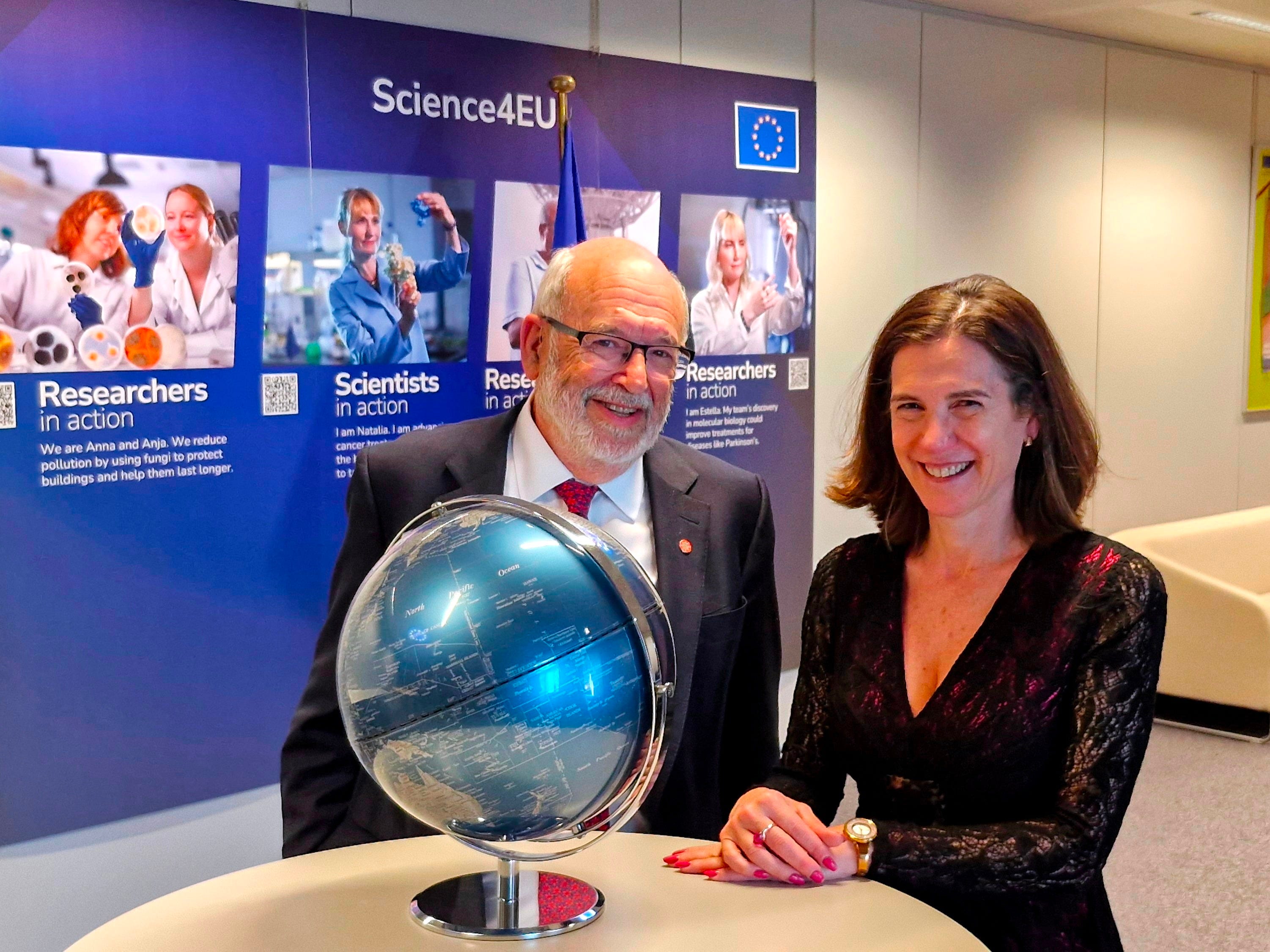
Maria Cristina Russo, the EC’s deputy director-general for research and innovation, and Sir Peter Gluckman, the ISC’s president, formally agreed to transfer the secretariat of the multilateral dialogue to the ISC in Brussels on Wednesday.
The agreement underpinning the project, which comes into effect on Friday, includes a three-year €1.2 million grant from the European Commission to support the ISC in hosting the secretariat. It builds on a first phase that included organizations such as UNESCO and the Organization for Economic Cooperation and Development. Both are expected to be involved as the next phase develops. The transfer marks a shift from a Commission-led initiative to a more globally anchored governance structure.
“Phase two is to actually get away from it being accused of being a dialogue driven by European values, to being a true multinational, multicultural dialogue,” Gluckman said in an interview with The Science Diplomat.
European Commission officials said the ISC was selected to host the secretariat because of its independence, global membership and experience coordinating international scientific networks.
The second phase, expected to run from 2026 to 2029 and to be formally launched later this year, will expand the process geographically and thematically while attempting to translate earlier discussions into operational tools. These include guidance notes, factsheets and frameworks for what the organizers describe as “fair and responsible collaboration.”
The project is rooted in the European Union’s Global Approach to Research and Innovation, adopted in 2021, and the Marseille Declaration endorsed by E.U. research ministers the following year. It builds on a 2022–2024 process led by the European Commission that brought together nearly 60 countries to discuss the principles and values underpinning international scientific collaboration.
That effort concluded with a ministerial declaration in Brussels but also highlighted limits in how broadly those principles were perceived to apply. Gluckman said the next phase is intended to respond directly to that criticism by expanding participation and focusing more explicitly on differences in how science is conducted across regions and cultures.
“Modern science is not Western science. It’s global science. And that’s the hurdle which we need to jump over,” he said. “A lot of science in the Global South is funded from the Global North. But when it’s done from the Global North, it’s not necessarily a good cognizance of the values, the principles, the cultural issues that shape the community in the Global South.”
He pointed to cases where research projects have created tensions because “they’ve been insensitive to the cultural, the internal structural issues in the society.”
Asked how nations might buy into the project, Gluckman pointed to the combined clout of the International Science Council as a global voice for science and the European Commission as a 27-nation bloc, along with the earlier involvement of UNESCO as an intergovernmental voice for science and OECD as a global science policy innovator among major powers.
“If you have something that has that credibility in the steering group,” he said, “it’s going to have a lot of weight if we do the exercise well.”
The initiative reflects a broader shift in science diplomacy, as countries and research institutions place greater emphasis not only on collaboration but also on governance, ownership and the terms under which knowledge is produced and shared.
That shift is also reflected in debates over how research partnerships translate into economic value, particularly in Africa–Europe cooperation, where participants have raised concerns about weak links between scientific output and investment.
While scientific methods are widely understood as universal, Gluckman stressed that the institutional practices surrounding research are not. “The principles that define science are universal,” he said. “But the way science is done, in context, particularly that science which engages with the environment or with communities, needs to be much more sensitive to the nuances in those communities.”
The dialogue will be led by the ISC, in partnership with the European Commission, and will involve consultations with scientific communities as well as governments across multiple regions. Organizers expect the process to run over several years, combining regional and thematic discussions.
Unlike the earlier phase, which focused largely on government-level engagement, the next stage will include natural and social scientists more directly in shaping the outcomes through a series of workshops and consultations across regions, including in Africa, Latin America and Asia, as well as online.
“This will now be with active, natural and social sciences, and their communities,” Gluckman said, describing a process of consultation and reflection aimed at identifying common ground on issues ranging from research ethics and authorship to engagement with local knowledge systems.
Questions such as how to define authorship, how to evaluate research proposals across different systems, and how to incorporate indigenous knowledge are among the issues the dialogue is expected to address.
“There needs to be common criteria in play,” Gluckman said, pointing to situations where joint projects funded by partners in different regions face disagreements over standards or priorities. “Otherwise the Global North party may say this is not cutting edge, or the Global South party may say, you don’t understand — this is core to things that are very important to this environment.”
The effort comes at a time when international scientific cooperation is under pressure from geopolitical tensions, funding constraints and competing national priorities. “Geopolitical and domestic political issues are threatening international science cooperation,” Gluckman said.
At the same time, he argued, the need for collaboration is increasing, particularly in areas such as climate change, biodiversity and global health.
“If we truly want science to be a global language,” he said, “and I passionately believe it is the only global language, not English — and it can do so much for human, social and planetary well-being — then we need to be sure that the principles and values that define how science is conducted across borders and across cultures and across contexts, everybody means the same thing.”
The outcome of the process is expected to take the form of a framework or set of principles that could later be adopted through intergovernmental channels, potentially through UNESCO or a future ministerial declaration on international cooperation in research and innovation.
“I think it’ll be a framework. I think it will be a set of principles. I am sure that at some stage there will be a report in the first instance,” Gluckman said. “I think there’s lots of outcomes here, but let’s do the work first.”