

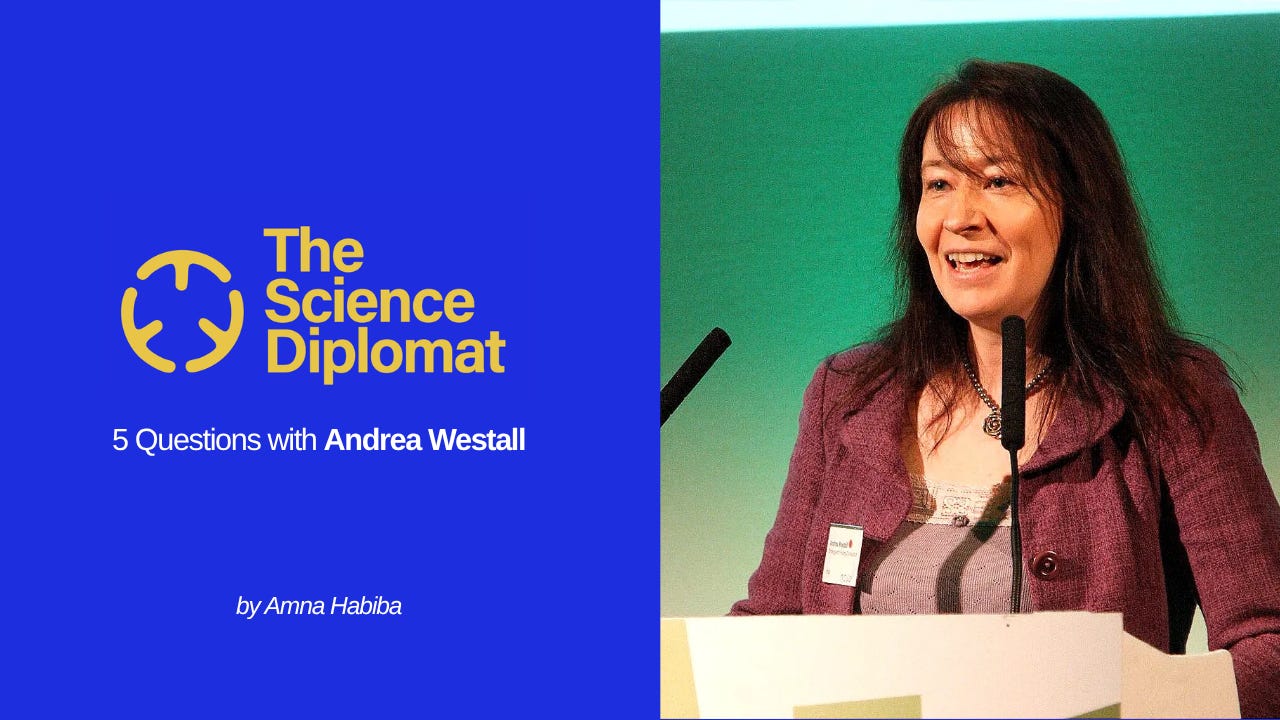
5 Questions is a recurring Science Diplomat series exploring how practitioners, scholars and policymakers view the systems shaping our future.
Modern democracies are often effective at responding to immediate challenges but less successful at protecting the interests of future generations. That tension is part of Andrea Westall’s work. A British political economist, sustainability strategist and public policy expert, she has spent some time examining how institutions make decisions, why long-term priorities are difficult to sustain, and how implementation often diverges from original intentions.
When we spoke in London, our conversation returned repeatedly to a common theme: how societies can build institutions capable of thinking beyond election cycles, quarterly reporting periods and immediate political pressures.
1. Where are governance models failing most visibly on long-term sustainability?
Westall argues that one of the central challenges is that democratic systems are largely organized around short-term promises and accountability, while, for example, economic, societal and environmental sustainability for the long term requires commitments that may necessitate costs in the short term.
People facing immediate concerns such as housing costs, economic insecurity or inequality naturally focus on present needs.
“If we don’t sort out the extremes of inequality, and people’s fears about not being able to pay their bills, we will find it very difficult to bring in governance models and policies for the long term,” she said. “You can’t focus on the long term if you’re just struggling, basically.”
That, she added, is why “all the focus at the moment in the U.K. is generally on firefighting by all the major parties.” Governments more generally tend to spend much of their time responding to urgent pressures rather than building support for long-term goals, leaving future-oriented policymaking difficult to sustain.
She pointed to the Well-Being of Future Generations (Wales) Act 2015 as an attempt to embed longer-term thinking into public decision-making, requiring public bodies to work out, with the Welsh people, “what’s the vision for Wales going forward, and how does the public sector and others work towards those different goals.”
But efforts to involve the public more directly in long-term planning can run into some resistance. She cited, for example, recent polling on deliberative democracy by Carnegie U.K., of which she is a trustee, showing many elected representatives remain cautious about including deliberative practices within governance and policymaking. “They were concerned about legitimacy, role duplication and institutional capacity.”
2. What kinds of institutions are best equipped to represent future generations?
Long-term governance begins with institutional design.
“You can’t effectively change governance frames and democracy if, for example, your constitution doesn’t give you ‘permission’, and sets the direction of travel,” she said, pointing to countries that have written rights for nature or future generations directly into their constitutions.
Constitutions alone do not guarantee long-term policymaking, she argued, but the “rules of the game” still matter. “Human rights constrain a simple rule of the majority to ensure that minority views and rights are considered and/or upheld.”
She also described proposals for institutions less constrained by electoral cycles, including citizens’ assemblies and a reformed second chamber that could focus on ensuring long-term considerations are reflected in legislation.
Whatever form those institutions take, Westall argued, long-term thinking must be embedded within organizational culture and incentives, not left to political goodwill.
3. Why do good sustainability policies often break down during implementation?
Policies often fail not when they’re written, but when they’re put into practice.
“I was teaching in Birmingham, and I talked about how a policy I had been heavily involved in was being implemented there,” she said. “It was very different to how I and others had envisaged that work.”
Part of the reason, she explained, is that “political and policy language can be really, really slippery,” becoming reinterpreted as it moves through different institutions and political contexts.
She also pointed to a city’s employment initiative where discussions with representatives from different sectors revealed frictions and challenges no one had anticipated.
“You need to ask many different kinds of people how are you going to respond to this policy? What is likely to happen? And then pilot it, and see what actually happens.”
Implementation, she argued, should not mark the end of public deliberation.
“Deliberation is not just relevant to good policy design but also to ongoing implementation. You need to continually engage people who are affected to see how a policy is working and how it could be improved.”
4. Are economic and political priorities diluting sustainability?
Long-term policies such as those related to sustainability are often required to justify themselves within existing economic frameworks, she argued.
“The rationale for intervening has long been ‘market failure’, at least in the U.K.,” she said. “If the market’s not working, then the government can legitimately do something to rectify the problem.”
That approach can support policy intervention, she said, but it also makes broader economic transformation more difficult. “Economic growth, GDP per head, is still a primary measure of success. Sustainability and well-being measures are secondary. They have not yet been brought into a wider and long-term set of goals and success measures for the economy and society.”
She also questioned how governments will finance future sustainability transitions as artificial intelligence reshapes economies and public revenues.
“With AI, we might have to completely rethink how we get revenue income as government, whether that is to fund science research, or support complex economic transitions,” she said, “because the tax base we currently have could be severely eroded going forward.”
That highlights, she said, the importance of examining not only sustainability goals but also the economic systems through which those goals are pursued.
5. What distinguishes organizations that genuinely integrate sustainability from those that treat it mainly as a compliance measure?
According to Westall, fully publicly-listed companies, for example, face constraints in responding to long-term challenges, particularly those related to sustainability.
“Many large companies that have majority shares traded on public markets face restrictions in what they can do,” she said, pointing to their perceived obligation to prioritize shareholder returns.
That obligation, she argued, rests on a common misconception.
“Shareholders do not own a company, that’s a myth. They’ve got two rights: rights to return on capital, and rights to control, and those can be separated.”
Long-term thinking depends instead on stewardship. The only way a company can sustain a long-term focus is, in her view, “if the board thinks they are stewards for the long-term” rather than agents of shareholder return alone.
She argued that companies also need to invest in research and development, climate and nature transitions, and their workforce, even if doing so reduces shareholder returns in the short term.
Organizations that genuinely integrate sustainability build it into their governance, ensuring those commitments survive changes in leadership rather than depending on the priorities of individual executives.