

Part 2 of a five-part series on science diplomacy and sovereignty in the Arctic.
If the 19th century treated Greenland as a problem of geography, the 20th recast it as a problem of systems.
The question was no longer whether Greenland was an island, nor who had first mapped its northernmost plateaus. Those matters had been settled quietly but decisively by scientific expeditions and international law. What replaced them was something more consequential: how to occupy, measure, monitor, and maintain a place that could no longer be ignored.
In this transition, science ceased to function primarily as evidence and became something else entirely. It became infrastructure.
Heilprin Land, a remote stretch of northern Greenland named for Angelo Heilprin, is not where science diplomacy was invented. It is where its logic was first exposed, stress-tested, and made durable over time.
“He was primarily a scientist, to whom mountains, as significant manifestations of nature, were objects for study rather than challenges to human prowess,” the late William L. Putnam, a past president of the American Alpine Club, wrote about Heilprin in a book, A Century of American Alpinism, published in 2002.
Heilprin founded the prestigious club at Philadelphia in 1902 not only to advance mountaineering, but also to champion scientific and environmental causes.
From exploration to permanence
The shift began not with climate change, but with war.
During the Second World War, Greenland’s strategic value became unmistakable. German weather stations in the Arctic, critical for forecasting Atlantic storms, made meteorology a military asset. The United States, recognizing Greenland’s position astride transatlantic air and naval routes, moved swiftly to secure access.
That access was formalized in 1951 with the Defense of Greenland Agreement between the United States and Denmark. It was a Cold War document, written in the language of security, but its effects were scientific as much as military. The agreement enabled the construction of permanent installations, the most prominent of which was Thule Air Base, now Pituffik Space Base, in northwest Greenland.
What mattered was not only what Thule did, but what it made possible.
For the first time, Greenland was no longer an episodic destination for expeditions. It was a continuously occupied site of observation. Weather stations, seismic sensors, radar arrays, and later satellite tracking facilities transformed the Arctic from an unknown frontier into a monitored system.
The map had become a machine.
Science as presence
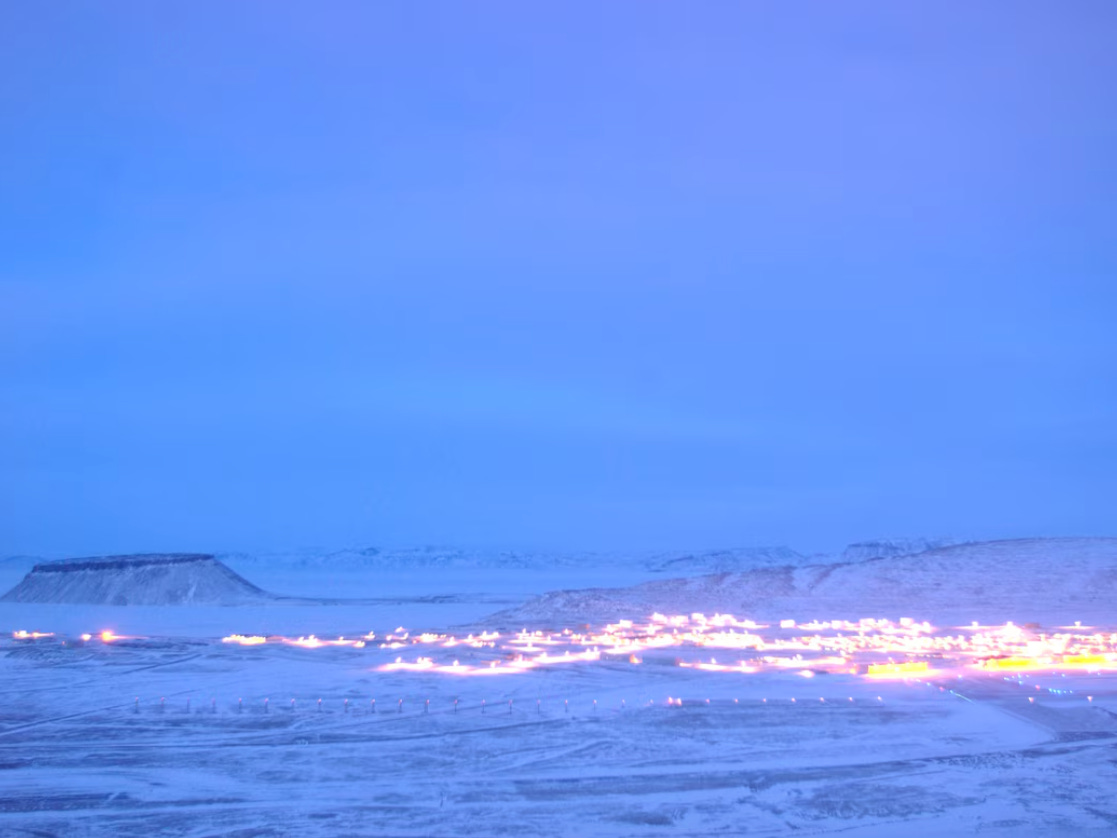
This transformation, which made it more common to spot a radar dome, a runway lit in the polar night, and a weather balloon launch at -30°C., altered the meaning of sovereignty in subtle but lasting ways.
In the age of Angelo Heilprin and Robert Peary, sovereignty was demonstrated through naming, mapping, and physical endurance. In the Cold War Arctic, it was demonstrated through continuity: the ability to maintain year-round technical operations in extreme conditions.
Science, particularly geophysics, glaciology, and atmospheric research, provided the justification. Military logistics provided the means.
At Thule, meteorologists tracked polar air masses; physicists monitored the ionosphere; engineers tested the limits of materials under extreme cold. These activities were framed as neutral or defensive, but their cumulative effect was unmistakable: they embedded the United States permanently into Greenland’s operational landscape.
Denmark, for its part, accepted this arrangement because the agreement affirmed sovereignty. American access was conditional on Danish consent. The distinction mattered. Greenland was not occupied by the Americans, at least in a legal sense; it was shared, under treaty, by the two historical colonizers.
Science had become the language that made this coexistence legible.
The hidden cost of infrastructure
Yet permanence came with consequences that were slow to surface.
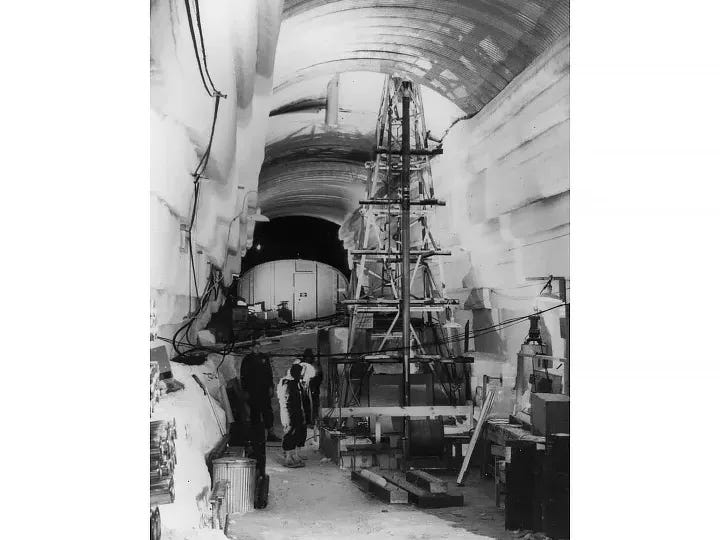
One of the Cold War’s most ambitious and secretive projects was Camp Century, a nuclear-powered research base built beneath the Greenland ice sheet in the late 1950s. Officially, it was a scientific outpost designed to test ice construction techniques and Arctic living conditions. Unofficially, it was a feasibility study for a far more audacious plan: Project Iceworm, a proposed network of mobile nuclear missile launchers hidden beneath the ice.
The project failed. The ice sheet moved too unpredictably. Tunnels collapsed. The base was abandoned in 1967. But Camp Century left behind something else: radioactive waste, diesel fuel, and chemical contaminants entombed in ice that was assumed — incorrectly — to be permanent. The Greenlandic perspective on Camp Century is defined by a sense of historical marginalization and deep concern about environmental contamination. Historically, Greenlanders were excluded from the decision-making process.
Decades later, as climate change accelerated ice melt, the legacy of Cold War science returned as a diplomatic problem.
In April 2024, as a NASA aircraft mapped the depth of the Greenland Ice Sheet and layers of bedrock beneath it, its radar instruments unexpectedly detected something buried within the ice. “We were looking for the bed of the ice and out pops Camp Century,” said Alex Gardner, a cryospheric scientist at NASA’s Jet Propulsion Laboratory, who helped lead the project. “We didn’t know what it was at first.”
What had once been treated as inert infrastructure became an environmental liability, raising new questions about responsibility, remediation, and consent. Today, Greenlanders view the site as a significant threat to their sovereignty and health due to climate change.
Once again, science created facts that diplomacy had to absorb.
Greenland’s political reawakening
As scientific infrastructure expanded, Greenland itself was changing. In 1953, Denmark formally ended Greenland’s colonial status, integrating it as a county (amt), known as the County of Greenland. In 1979, Greenland gained Home Rule. In 2009, it achieved Self-Rule, assuming authority over most domestic affairs, including natural resources.
Each step altered the diplomatic geometry of Arctic science. Research was no longer a bilateral matter between Washington and Copenhagen. It now required engagement with Nuuk, Greenland's capital. Permits, consultations, and impact assessments became part of scientific practice. Knowledge production had to be negotiated.
This shift culminated in the 2004 Igaliku Agreement, which updated the 1951 Defense Agreement to reflect Greenland’s political evolution. Signed by the United States, Denmark, and the Greenland Home Rule Government, it formalized a trilateral framework for managing military and scientific activity.
Under Igaliku, science became an object of governance and no longer merely an enabler of presence.
Measurement becomes power
By the early 21st century, the Arctic had entered a new phase. Satellite observations revealed rapid ice loss. Glaciologists documented accelerating outlet glaciers. Geologists identified mineral deposits newly accessible as ice retreated. Climate models turned Greenland into a bellwether for global sea-level rise.
These measurements did more than describe change. They reordered priorities. Greenland was no longer important because it was remote. It was important because it was measurable, and because what it revealed could not be ignored.
The return of U.S. political interest in Greenland in recent years reflects this shift. Security concerns about Russia and China are real. So are economic interests in rare earth elements and critical minerals. But these motivations operate within a framework built by science.
“The growing practicality and popularity of using polar air routes that result in substantial time and fuel savings on flights between North America, Europe and Asia have opened up new opportunities for Greenland’s airways and airport infrastructure,” historian Dwayne Ryan Menezes writes in a briefing paper for the British Army’s Centre for Historical Analysis and Conflict Research.
“What makes Greenland so strategic, though, is not just where it sits geographically, but also what it holds resource-wise. In 2008, the U.S. Geological Survey estimated that the three major basins off the coast of Greenland could yield up to 52 billion barrels of oil equivalent,” he wrote. “Furthermore, a 2015 study found that Greenland could produce enough hydropower to meet its own needs and export the surplus to Nunavut or Newfoundland and Labrador and perhaps even further through an undersea cable. Greenland’s fish-rich waters also make it one of the world’s largest exporters of cold-water prawns, cod, haddock, halibut and snow crab.”
“Mineral-rich Greenland, moreover, holds large reserves of copper, zinc, lead, iron ore, nickel, titanium, cobalt, gold, precious gemstones, platinum-group metals, rare-earth elements and other minerals.”
Then there is the water contained in the vast ice sheet itself, holding 10% of Earth's freshwater, and in significant subsurface firn aquifers — huge, year-round liquid water bodies found within the compacted firn under the ice, discovered in 2013 and comparable in size to Ireland.
These reservoirs, along with supraglacial lakes, meltwater streams, and subglacial lakes, are crucial freshwater sources but also contribute to sea-level rise as the Arctic warms, impacting global climate and coastal communities.
The United States already possesses extraordinary military optionality in Greenland. What it seeks now is leverage: informational, economic, and strategic advantage in a rapidly transforming Arctic system. Once again, knowledge precedes power.
Heilprin’s shadow
Seen from this perspective, Heilprin Land appears as an early rehearsal. In the 1890s, a cartographic mistake nearly altered the legal status of northern Greenland. In the Cold War, engineering assumptions buried waste beneath ice thought to be eternal. Today, climate models challenge the premise that any Arctic infrastructure is permanent.
In each case, science informed and structured diplomacy. Angelo Heilprin understood this relationship intuitively. His faith in empirical truth was not naïve. It was strategic. He believed that facts, once established, constrained ambition, not by moral force, but by making certain paths untenable.
That belief, or mindset, has been tested repeatedly in Greenland. Sometimes it has held. Sometimes it has failed. But it has never been irrelevant.
The new Arctic problem
What distinguishes the present moment is compression. In the 19th century, decades separated expeditions. In the 20th, infrastructure persisted across generations. Today, feedback loops operate in near real time. Ice loss alters shipping projections. Mineral surveys reshape investment plans. Satellite data informs military posture.
Science diplomacy no longer unfolds at human pace. It unfolds at system speed. This raises a new question, one that Heilprin Land could not answer, but helps us ask: When science becomes continuous, automated, and predictive, who governs its consequences, and on whose behalf?
That question defines the Arctic now. And it is the question that brings us, inevitably, to Greenland’s future.
This five-part series will continue weekly on Wednesdays.
Coming next
Cold War science embedded power into Greenland’s ice. Climate science has begun to melt it back out.
Next, the series turns to the present: how satellite systems, climate models, and environmental data transformed Greenland from strategic territory into a global signal, and why that shift has unsettled long-standing assumptions about sovereignty, consent, and control in the Arctic.
Part 3: The time when facts became territory — how climate science redefined Greenland’s future