

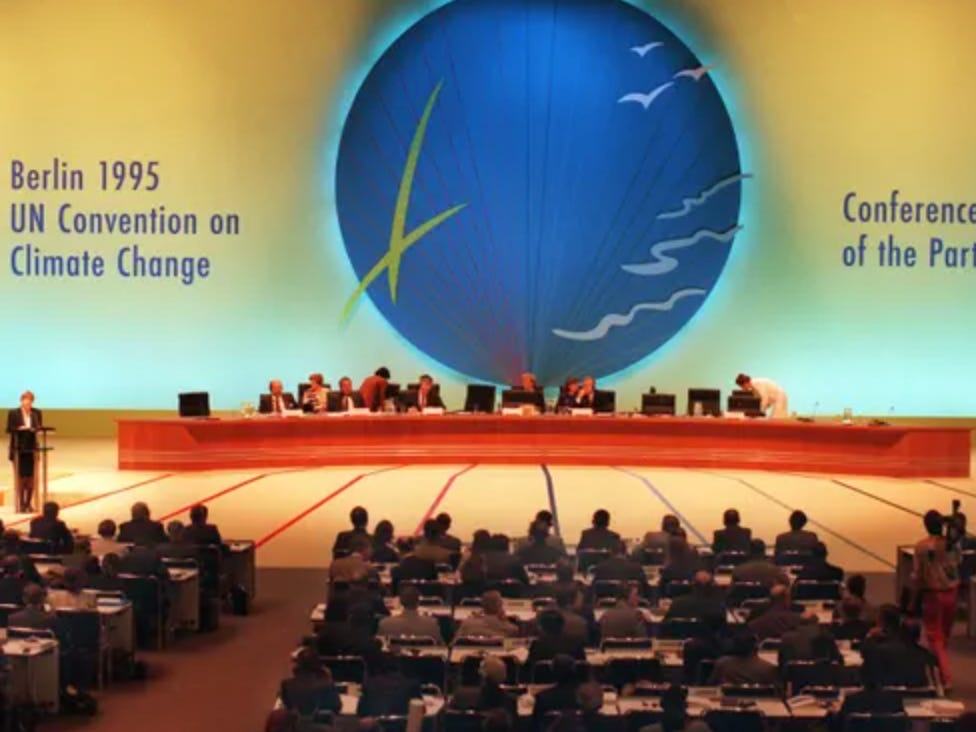
When the Intergovernmental Panel on Climate Change was established in 1988, it did more than launch a study. It shifted power from negotiation to those who define the terms of negotiation itself.
The groundwork had been laid three years earlier, in Villach, Austria, where climate scientists, under the leadership of Bert Bolin, synthesized mounting evidence that human activity was altering the atmosphere, establishing a shared scientific baseline that underpinned decades of climate governance.
The United Nations General Assembly directed the panel to regularly assess the “scientific, technical and socio-economic information relevant for the understanding of the risk of human-induced climate change,” with the explicit aim of informing government response.
From the outset, the panel’s reports became the reference point for climate diplomacy. Emissions targets, adaptation strategies, and investment pathways were debated within parameters defined by scientific assessment. That marked a structural shift: authoritative knowledge began to precede negotiation, narrowing the range of politically viable outcomes before discussions began.
After his election as IPCC chair in 2023, Jim Skea pledged to uphold that model, prioritizing “improving inclusiveness and diversity, shielding scientific integrity and policy relevance of IPCC assessment reports, and making effective use of the best available science on climate change.”
During the Cold War, science diplomacy functioned primarily as a tool of restraint; verification enabled survival. In the decades that followed, scientific assessment evolved into a form of infrastructure — not simply informing globalization, but structuring it.
The Montreal Protocol provides a clear example. Its success rested not only on political agreement, but on the ability of atmospheric science to establish a causal baseline that constrained disagreement. Once the relationship between chlorofluorocarbons and ozone depletion was established with sufficient confidence, the space for political disputes narrowed, and technological substitution became a matter of implementation rather than debate.
Climate was only the beginning. Biodiversity assessments and global health surveillance systems expanded, while chemical regulation regimes came to rely on shared monitoring frameworks. Standards governing telecommunications and digital networks began to underpin economic integration, embedding technical definitions into market structures.
Science was no longer adjacent to diplomacy; it became embedded in the terms through which diplomacy operates.
In 2010, the American Association for the Advancement of Science and the Royal Society formalized the language of the field, distinguishing between science in diplomacy, diplomacy for science, and science for diplomacy.
“Scientific values of rationality, transparency and universality are the same the world over. They can help to underpin good governance and build trust between nations. Science provides a non-ideological environment for the participation and free exchange of ideas between people, regardless of cultural, national or religious backgrounds,” the report noted.
While the framework described practices already underway, the act of naming the field altered it. Science diplomacy became teachable, fundable, and institutionalized. Dedicated units appeared within foreign ministries, and international organizations expanded science advisory mechanisms, embedding expertise more formally into decision-making structures.
That professionalization occurred during a period when multilateralism appeared durable and scientific consensus broadly stable. Those conditions did not hold.
As globalization matured, scientific cooperation became entangled with economic and technological competition. Research ecosystems were increasingly tied to national competitiveness. Data emerged as a strategic asset. Standards began to shape markets as much as they enabled interoperability. The infrastructures that facilitated collaboration also revealed new forms of dependency.
Trust in expertise fractured unevenly as scientific consensus, once treated as a stabilizing baseline, entered more contested terrain. Artificial intelligence systems scaled rapidly while governance frameworks lagged. Semiconductor supply chains exposed geopolitical vulnerabilities. Digital platforms expanded globally within months, while regulatory systems struggled to keep pace.
In response, a new emphasis emerged: anticipation. Institutions began to invest in foresight, horizon scanning, and early warning systems — structured efforts to examine plausible futures before they harden into crises.
Anticipation, however, is not neutral. Which technologies are prioritized, which risks are elevated, and whose expertise is considered authoritative all shape the outcomes of those processes. The capacity to define future baselines extends the same logic that governs present ones.
As U.N. Secretary-General António Guterres argued earlier this year in the context of emerging technologies, “we need facts we can trust and share across countries and across sectors — less noise, more knowledge” — a formulation that underscores the continuing centrality of shared baselines in systems of global governance.
The Cold War discipline of restraint relied on the measurement of known risks. Today, accelerating technological change compresses the time available to establish shared measurements without eliminating the need for them. The question is no longer whether science can stabilize international relations, but whether systems of coordination can operate at the speed required to remain effective.
Science diplomacy “can play an important stabilizing role” in the world, but for it to be effective “it must be grounded in practical policy instruments,” Tateo Arimoto, a prominent Japanese science policy architect, wrote in the latest issue of India’s Science Diplomacy journal, emphasizing the need to integrate foreign policy with research funding, innovation partnerships, and scientific advisory systems.
“Science diplomacy,” Arimoto wrote, “is therefore becoming not merely a supplementary activity, but a core capability for managing geopolitical uncertainty and governing technological change in the 21st century.”