

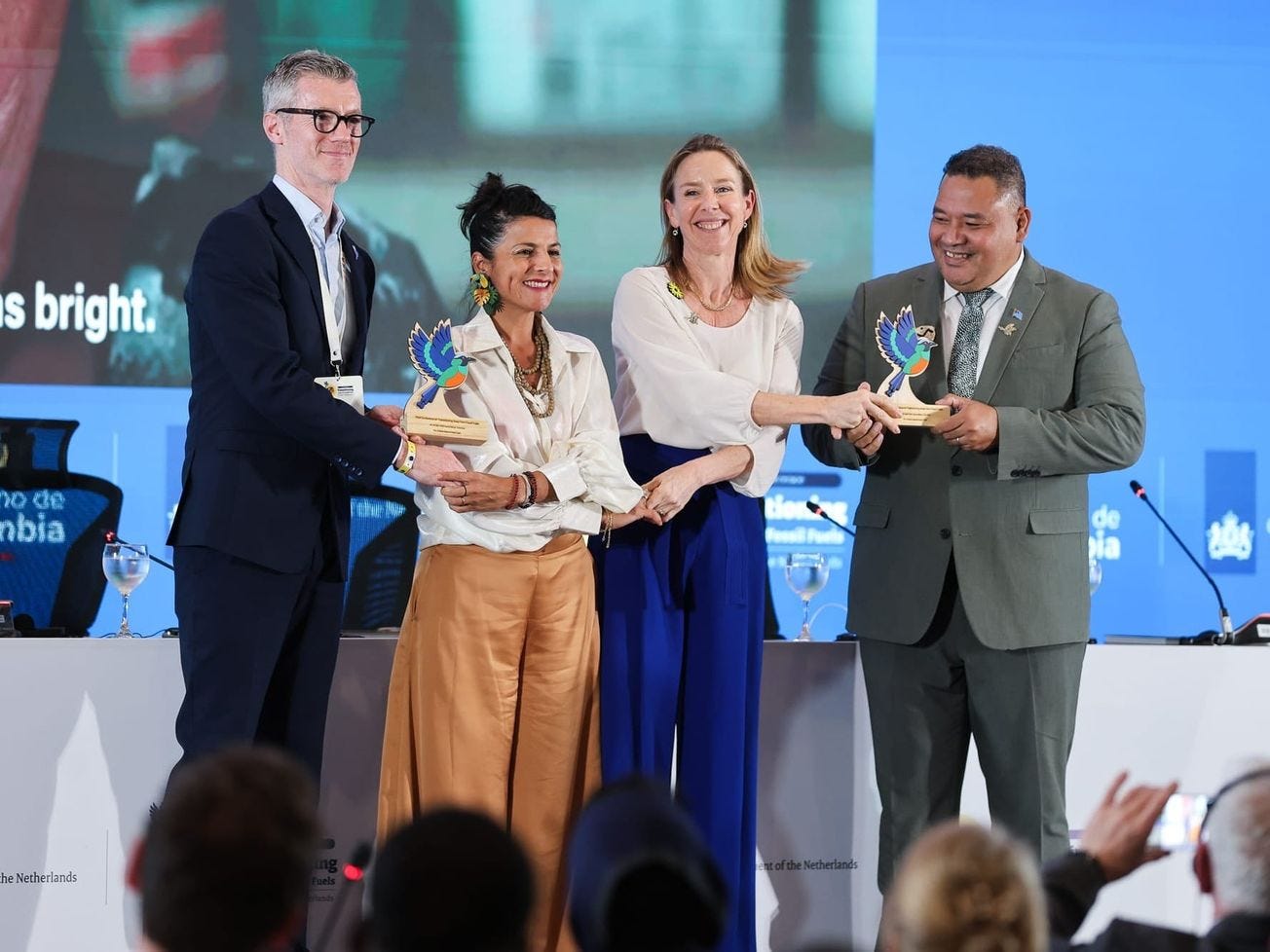
When representatives from governments, Indigenous organizations, scientists, and civil society groups gathered this spring in Santa Marta, Colombia, they were doing more than discussing climate change. They were helping build a new institution.
Co-hosted by Colombia and the Netherlands, the summit on “transitioning away” from fossil fuels produced a declaration and plans for a scientific advisory mechanism intended to accelerate climate action beyond existing negotiating processes. Its significance lay not only in the issues under discussion but in the creation of new structures through which those issues could be addressed.
A second climate summit, co-hosted by Tuvalu and Ireland, is already planned for 2027. Among the key challenges for the next gathering, according to Maina Vakafua Talia, Tuvalu’s minister for home affairs, is “confronting the narrative that forces false choices: multilateralism and international cooperation are not defined by a single process, but rather by recognizing the governance gaps.”
The development illustrates a broader pattern in international governance. Participation is often described as the goal while governments seek seats at negotiating tables and organizations gain observer status, or while communities angle for recognition and researchers take advisory roles.
The most lasting influence often emerges not when participants gain access to institutions, but when their new ideas, forms of expertise, and perspectives become part of how institutions understand the problems they exist to solve.
Participation begins before formal meetings and accumulates over time. Institutions create categories that determine who participates and how. Some participants eventually move beyond participation itself and begin shaping agendas, but what happens next is equally important.
Over time, a governance system can expand its understanding of who has something valuable to contribute. The process can take years or even decades, but many of the biggest changes in international governance emerge from institutional learning. That was one of the lessons advocates pointed to at Colombia’s climate talks.
“From Santa Marta to the Pacific, a new reality is taking shape: this is no longer a one-off moment, but the foundation of an ongoing international process dedicated to phasing out fossil fuels,” said Kumi Naidoo, president of the Fossil Fuel Treaty Initiative, which helped organize and inspire the summit in Colombia.
“What is emerging is a process that can finally match climate diplomacy to the scale of the crisis,” he said. “The Pacific has helped turn a historic opening into a standing process, and the task now is to ensure it delivers the legal and political architecture for a just and rapid transition.”
The growing role of Indigenous peoples in international environmental governance provides another example.
For many years, Indigenous communities argued that their knowledge and experience were relevant to questions involving biodiversity, conservation, health, and climate adaptation. Their participation was often limited, however, and their expertise was not always treated as central to decision-making processes. Gradually, that changed.
International institutions recognized Indigenous knowledge could complement scientific knowledge in addressing environmental challenges. Consultation mechanisms expanded, participation increased and new structures emerged. In 2025, parties to the Convention on Biological Diversity established a permanent subsidiary body dedicated to Indigenous peoples and local communities, creating a formal place within the institution itself.
Colombia’s Environment Minister Irene Vélez Torres, co-chairing a new subsidiary body, called it an “unprecedented step toward greater environmental democracy” in biodiversity work.
“We are facing profound crises — climate change and biodiversity loss — that require stronger conventions and greater impact in the field of environmental democracy,” she said. “That means full participation of Indigenous peoples and local communities.”
The new subsidiary body, years in the making, began its work by deciding how to integrate its traditional knowledge and rights into global efforts to preserve species.
“For two decades, we’ve discussed how to elevate the voices and roles of Indigenous peoples and local communities within our convention, because it’s the right thing to do and because we need them,” CBD Executive Secretary Astrid Schomaker said after two weeks of meetings in Panama.
“The meeting was foundational and delivered what it needed to deliver – establishing rules, fostering openness and participation, and setting the stage for a stronger voice for Indigenous peoples in environmental governance,” she said.
The process is not always successful. At the final round of negotiations for a global plastics treaty in Geneva last year, Indigenous leaders expressed frustration that their perspectives remained largely peripheral to the talks. While governments debated production limits, chemical restrictions, and treaty language, some Indigenous advocates argued the negotiations overlooked more fundamental questions about humanity’s relationship with the natural world.
“We don’t see the environment being separate from human beings,” Indigenous leader Frankie Orona told Arete News after the talks had stalled without agreement.
Heni Unwin, a Māori marine scientist from New Zealand, described a worldview in which environmental stewardship begins by recognizing that people are part of nature rather than apart from it. She shared a proverb from her people: "The river is the first thought and the river is the second thought," meaning that before any decision is made, its impact on the river must be considered both for "the first time" and "the second time." In this way of thinking, Unwin said, "our environment is first and foremost before anything that we do."
Such perspectives, even if they do not resolve diplomatic disagreements, illustrate how participants often seek to introduce new ways of understanding the problems institutions are trying to solve.
Similar questions are emerging far beyond environmental governance as governments, researchers, and international organizations look at how institutions learn from people they historically treated as outsiders to formal decision-making.
A recent OECD discussion paper on citizen participation argued that many citizens feel they lack meaningful political agency and called for new approaches that move beyond consultation toward more substantive forms of participation. The challenge is not unique to democracies. Across governance systems, institutions are confronting a common question: How should they incorporate knowledge, experience, and perspectives that originate beyond traditional centers of authority?
Human rights organizations were once largely external to diplomatic processes. Environmental groups gradually became embedded within international negotiations. Scientific expertise became institutionalized through advisory panels, assessments, and permanent bodies.
The significance extended beyond representation. The institution altered its understanding of what knowledge mattered. Similar debates are occurring across science diplomacy and global governance. “Science is not the only knowledge system that people use,” International Science Council President Peter Gluckman observed earlier this year in an interview, arguing that institutions must understand how scientific knowledge interacts with other forms of expertise and experience.
In each case, the change involved more than admitting new participants into existing conversations. Institutions themselves evolved. The process often begins with a simple challenge to established assumptions.
Participants ask whether a problem is being understood correctly.
They question who is considered an expert and introduce perspectives that existing structures may not fully recognize. Many such efforts fail and some disappear. A few persist long enough to become part of institutional architecture; the history of international governance contains many such examples.
Some major issues wind up being seen through competing lens. Climate change has been approached, alternatively, as an issue that is, alternatively, primarily environmental, economic, security-focused, developmental, legal, or public health facing. Each framing has brought different participants, forms of expertise and institutional responses into the conversation.
The same dynamic can be seen across fields ranging from global health to artificial intelligence. Governance systems not only process information but also decide what kinds of information matter.
That is why participation remains important. New participants often introduce new ways of understanding problems. They identify connections that others overlook and raise questions existing institutions were not designed to ask. Most institutions change slowly, but they do change, as evidenced with Indigenous knowledge.
“Aboriginal knowledge is an important aspect of climate change, because we’ve been here for 60-plus-thousand years,” said Linda Payi Mae Ford, an associate professor at Australia’s Charles Darwin University, who identifies as Rak Mak Mak Marranunggu, from Kurrindju.
“We know and understand the country in terms of song, our dance, our performance,” she told climate scientists and Indigenous people at a 2022 gathering organized by the Healthy Environments and Lives (HEAL) Network, a coalition of 100 investigators and more than 30 groups across Australia. “That’s in our language.”
For global governance, the result is more than a collection of organizations, treaties and procedures. It is also a process through which societies continually reconsider who should participate, what knowledge should be recognized, and how shared problems should be understood.
Participation opens the door. Agenda-setting helps shape the conversation. The most enduring influence comes from changing how institutions understand the world.
One distinction in this series really resonates with me. That is, having expertise represented isn't the same as expertise having influence.
I see this inside many organisations, and it is a frustration articulated in different ways by the experts I work with.
The decision makers can invite the technical expert to the meeting. Give them five minutes on the agenda. Ask for their analysis. Put their recommendation in the papers.
Thank you for your time. Next!
The decision-making process of the decision-makers is designed with written and unwritten rules that result in the expert voice having almost no chance of changing the decision that may have already been made before the expert walked in the room.
Perhaps the question decision-makers need to ask themselves isn't “Were the right experts consulted?”
Maybe it's “What could be possible if their expertise is there?”
- Could we understand the problem differently?
- Could our assumptions and biases get challenged?
- Could other options appear through the discussion, not what is presented?
- Could our decision improve?
Presence is relatively easy to manufacture, but influence is much harder.
Positive impact is harder still. And that requires the decision-makers and the experts to genuinely listen to each other.