

Part 5 of a five-part series on science diplomacy and sovereignty in the Arctic.
In the past century, the region of North Greenland known as Heilprin Land became what diplomats prefer territory to be: quiet and settled in principle if not in practice.
It was known to geologists, revisited occasionally by survey teams, and otherwise absent from public consciousness. Unlike Thule, it hosted no runways or radar domes, and unlike Nuuk, it carried no political symbolism. Its value lay in its stability within a rare ice-free coastal belt, now part of Northeast Greenland National Park, the world’s largest, that provides a hunting ground for species like musk oxen, hares, and lemmings, and nesting grounds for the snow bunting, gyrfalcon and other Arctic birds.
That stability is eroding as the conditions that once made it irrelevant no longer hold. Climate change collapsed distance in the Arctic, while satellite observation replaced remoteness with visibility and global competition turned geological fact into strategic input. In this new environment, Heilprin Land reemerged as a test case.
Science after sovereignty
The disputes that once surrounded Heilprin Land were about ownership, while today’s questions are about use. Who may study the land? Who controls the data it produces? Who decides how scientific knowledge feeds into security, climate policy, and resource planning? These are no longer abstract concerns but are embedded in active research programs.
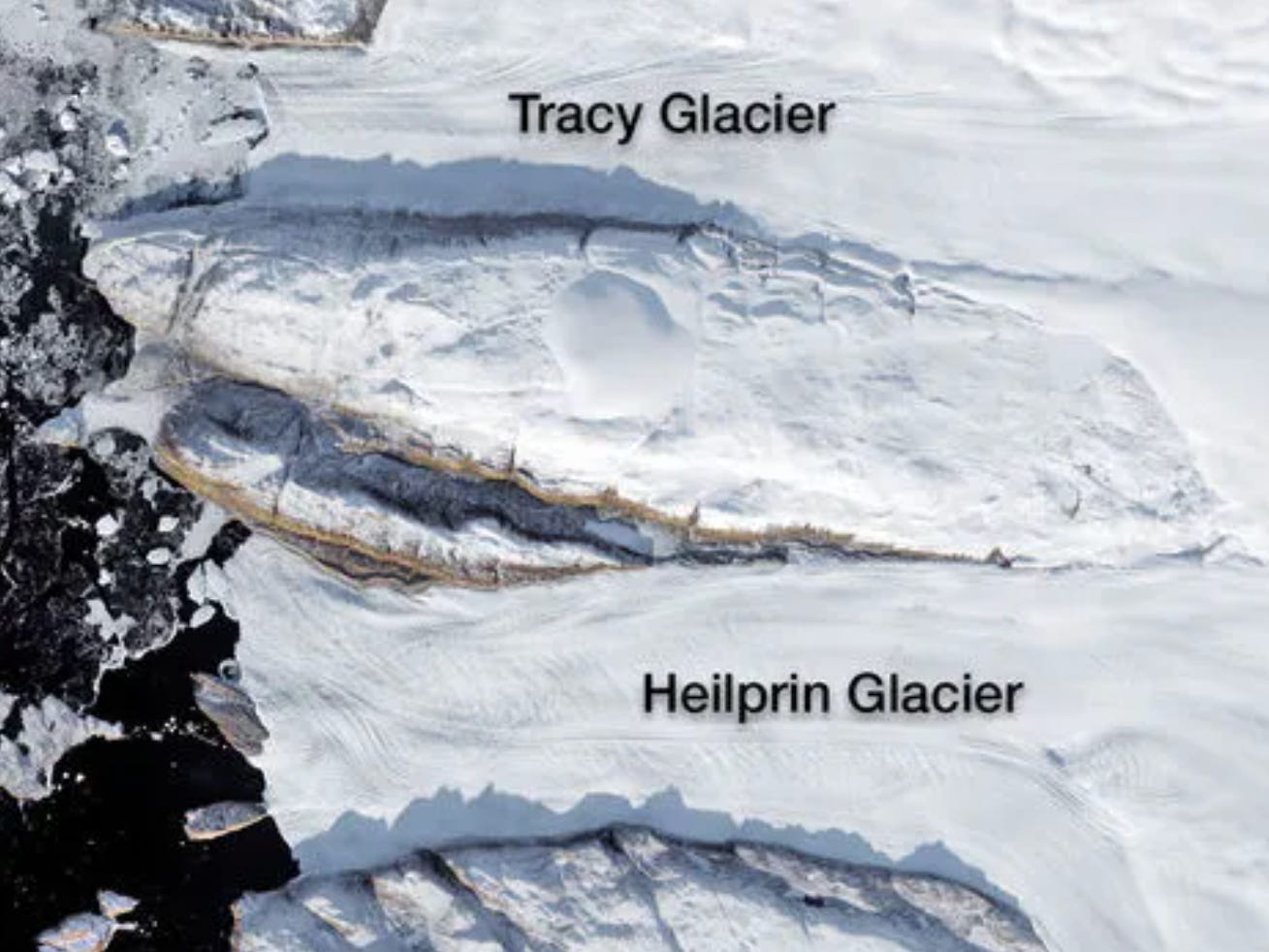
In recent years, Heilprin Glacier, one of the outlet glaciers that drains part of the Greenland Ice Sheet into the head of Inglefield Fjord, has been studied alongside nearby Tracy Glacier as part of NASA-supported research into the variation between how glaciers respond to warming. Though geographically proximate, the two glaciers behave differently, revealing how bedrock structure, fjord geometry, and ice dynamics interact in ways that resist simple modeling.
Heilprin Land has become a controlled environment, a place where variables can be isolated, measured, and compared: a laboratory without walls. It is a site where the Arctic’s physical processes can be observed with enough precision to inform global models. It has become useful again.
The new stakes of measurement
That usefulness carries consequences. In the Arctic, scientific findings travel quickly from academic journals into policy. Ice loss alters shipping projections. Geological surveys inform mineral feasibility. Glacier dynamics shape infrastructure risk. Each dataset becomes a lever pulled not only by scientists, but by planners, militaries, and investors.
This is where Heilprin Land’s earlier history becomes instructive. Once before, a geographic misinterpretation over the Peary Channel nearly altered the political status of northern Greenland. The error was corrected through painstaking fieldwork, and the correction stabilized sovereignty for generations.
Today, the danger is instrumentalization: When science becomes precise, it becomes actionable and enters the domain of power. Models guide decisions. Projections justify priorities. Measurements set baselines against which future claims are assessed. The Arctic is no longer a blank on the map; for science, it is a spreadsheet.
From discovery to governance
What has changed since scientist Angelo Heilprin’s time is the scale and speed of the relationship between science and politics. In the nineteenth century, it could take years for an expedition’s findings to influence policy. Today, satellite data updates daily. Climate assessments feed directly into international negotiations. Scientific advisory bodies sit alongside diplomats. Greenland sits at the center of this convergence.
In 2011, glaciologists drilling for ice cores to study snow accumulation in southeast Greenland turned up something unexpected. As they brought the ice core samples to the surface, water dripped from them. Buried beneath the ice was a large liquid water reservoir. Over the next several years, researchers used NASA’s Operation Icebridge, the largest airborne survey of polar regions in history, to map the reservoir.
It extended for more than 69,930 square kilometers (27,000 square miles), equal in size to the nation of Georgia, or the Navajo Nation, the largest Native American reservation in the U.S. The water in the aquifer, they found, alone could raise global sea level by 0.4 mm (0.016 inches).
“When I heard about the aquifer, I had almost the same reaction as when we discovered Lake Vostok [in Antarctica]: it blew my mind that something like that is possible,” said Michael Studinger, a NASA project scientist. “It turned my view of the Greenland ice sheet upside down. I don’t think anyone had expected that this layer of liquid water could survive the cold winter temperatures without being refrozen.”
The acquifer is fed by meltwater that percolates from the surface in summer. Researchers say they now believe Southeast Greenland’s high snow accumulation is what keeps the acquifer in liquid form throughout the year by insulating it from the cold winter surface temperatures.
The island is no longer discussed solely as territory. It is discussed as a system: climatic, geological, strategic. The U.S. interest that has resurfaced is about access: to positioning, to infrastructure, to data, to minerals critical for energy transitions.
Denmark’s authority remains intact. Greenland’s self-rule is recognized. The legal questions are settled. What is unsettled is how science will be governed within that framework. The 2004 Igaliku Agreement formalized trilateral consultation between the United States, Denmark, and Greenland. It acknowledged that scientific research is something that must be coordinated with political authority and local consent. That agreement is now being stress-tested.
As research intensifies and stakes rise, consultation must contend with urgency. Climate models do not wait for consensus. Security planners do not pause for ethnographic sensitivity. The risk is not confrontation, but slippage where decisions outrun governance. Heilprin Land sits precisely at this fault line.
Why this place matters
It is tempting to treat Heilprin Land as symbolic, a historical curiosity repurposed for a modern argument. That would miss the point. Its value lies in continuity.
Heilprin Land has been claimed, stabilized, measured, and remeasured over more than a century. Its sovereignty was settled through scientific verification. Its obscurity preserved it from politicization. Its reemergence now offers a rare opportunity: to observe how science diplomacy functions when borders are no longer in question, but interests are.
In this sense, Heilprin Land, named by explorer Robert Peary to honor his friendship with Angelo Heilprin, serves as a control sample. It allows us to ask a sharper question than usual: What happens when science is no longer used to claim territory, but to manage a shared future? The answer is not reassuring by default.
While science illuminates our world, it also sharpens the edge of global rivalry. It is a bridge for cooperation that simultaneously favors the nations with the greatest technical prowess. Even the transparency that once secured peace can now produce strategic imbalance. Angelo Heilprin, who practiced what we would now recognize as science diplomacy, believed deeply in the disciplining power of facts. He trusted that geological truth could override political fantasy. In his lifetime, that faith was largely justified. Whether it remains so is an open question.
The Arctic Problem ends quietly
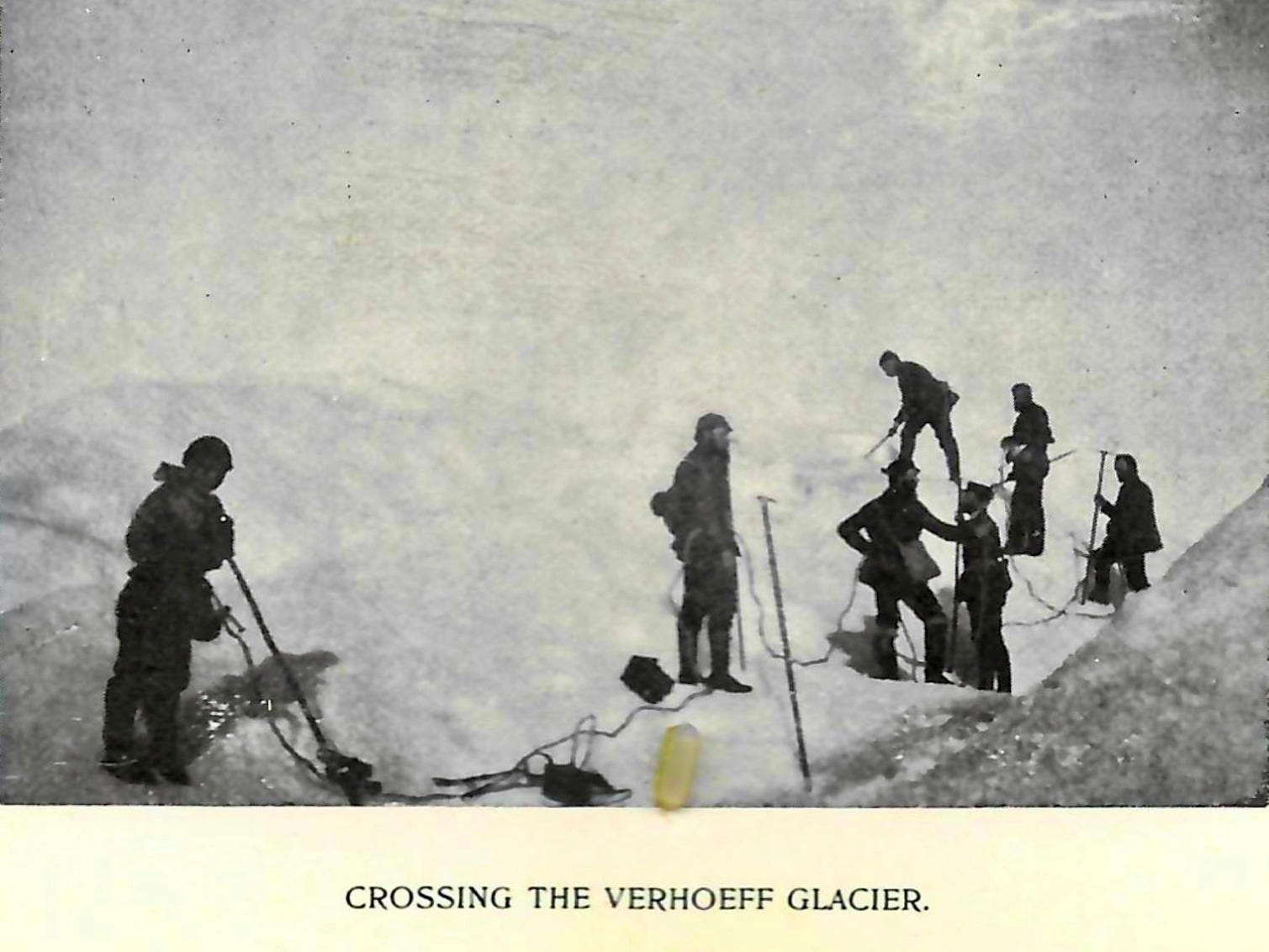
In August 1892, as the Arctic summer waned and Peary’s North Greenland Expedition prepared for its voyage home, a shadow fell over their hard-won success. On the eve of departure, the party’s mineralogist, John Verhoeff, ventured alone into the frozen wilderness to collect final specimens and never returned.
Angelo Heilprin, leading the relief mission aboard the Kite, led a desperate nine-day search across the jagged terrain of Prudhoe Land. The searchers eventually tracked Verhoeff’s footprints to the edge of a massive, crevassed ice flow, now known as the Verhoeff Glacier, where his trail vanished into the blue-white labyrinth.
Though theories endured that Verhoeff, a scientist whose bent for solo excursions to collect specimens gave him a reputation for eccentricity among his crewmates, might have sought a permanent life in Greenland, Heilprin was forced to make a grim conclusion: the glacier had claimed him.
Today, the glacier presents a 30-meter-high ice wall at the head of the Siorapaluup Kangerlua fjord that stands as a silent monument to one of the most enduring mysteries of Arctic exploration. But after 165 pages of logistical struggle, Arctic danger, and one of the most dramatic rescue missions of the nineteenth century, Angelo Heilprin’s 1893 book, The Arctic Problem and Narrative of the Peary Relief Expedition, does not end in triumph or reflection. He returns, instead, to the ice.
“The glaciers (and their workings) of Greenland seem to me to be the exact counterpart of those in the Alps,” he writes, carefully stripping away the romance of difference. The variations he observes, he insists, are “individual and not specific.” Large or small, fast or slow, fissured or smooth — the glaciers obey the same governing forces. And then, almost as an aside, comes the line that now reads with startling clarity: “All are now, or have been in a recent period, undergoing contraction (recession).”
That this observation appears at the end of a scientific work, which first appeared in narrative form in Scribner’s Magazine and amplified an address he gave to the Geographical Club of Philadelphia as its president, is not incidental. Heilprin was completing an argument rather than summarizing an adventure. The expedition existed to understand the land; the danger was secondary to the data.
It is tempting, from the vantage point of the twenty-first century, to read this passage as a prophecy. But it is more accurate, and more interesting, to read it as method. Heilprin was doing what modern climate science still depends on: comparison across regions to identify governing patterns. Greenland mattered because it was legible.
This same logic underlies contemporary research at Heilprin Glacier, even though the glacier lies some distance from Heilprin Land itself. The distinction clarifies the connection; the name on the map marks a continuity of inquiry. When NASA scientists compare the retreat of Heilprin Glacier with neighboring Tracy Glacier, they are asking the same question Heilprin posed more than a century earlier: what explains the differences, when conditions appear similar?
In that sense, Heilprin Land and Heilprin Glacier together form a proving ground for epistemic authority. They are places where hypotheses confront ice, where interpretation must answer to measurement, and where error carries consequences beyond academia.
This is what science diplomacy looks like before it acquires institutions, acronyms, or summits. It is the slow construction of facts sturdy enough to outlast ambition. In the nineteenth century, those facts settled a territorial dispute. In the twentieth, they underpinned security treaties. In the twenty-first, they frame debates over climate, minerals, and access.
Angelo Heilprin imagined science as a stabilizing force, as a way for its practitioners to anchor power to reality rather than remain neutral. In the Arctic, where borders are invisible and interests collide, that remains its most diplomatic function. The ice retreats, the questions return, and once again the map must answer to the land.