As war moves online, the Red Cross wants its emblem to follow
The ICRC launches a new phase of a project to extend humanitarian protections into cyberspace as hospitals, aid groups and critical services become vulnerable to online attacks during armed conflict.

GENEVA — For more than 160 years, the Red Cross emblem has conveyed a simple message on battlefields around the world: do not attack.
Displayed on hospitals, ambulances and humanitarian workers, the emblem signals protection under international humanitarian law. It helps identify those who care for the wounded and assist civilians caught in war.
Now, as warfare extends into cyberspace, the International Committee of the Red Cross is trying to carry that protection into the digital age.
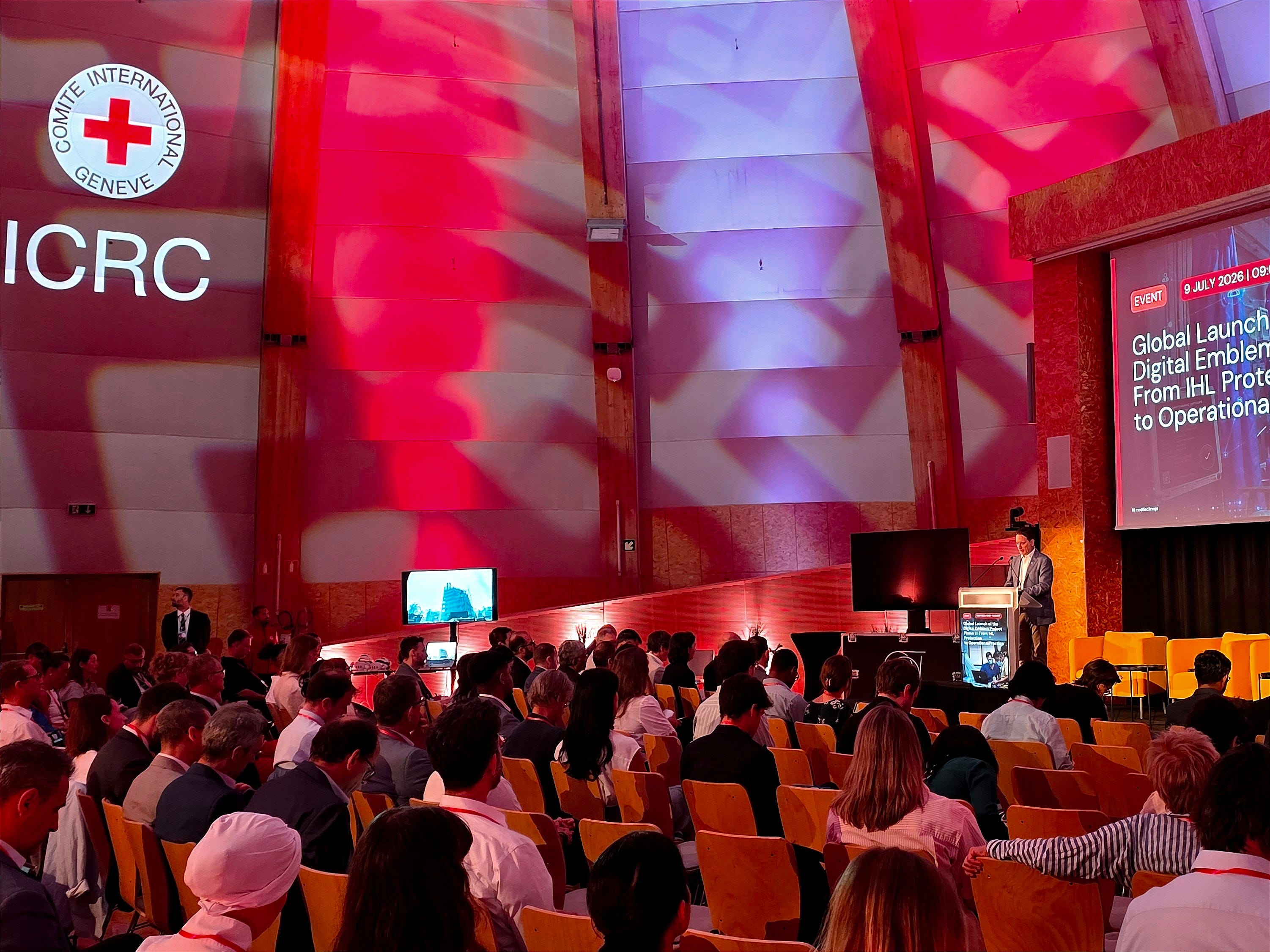
At CERN’s Globe of Science and Innovation on Thursday, the ICRC formally launched the second phase of its Digital Emblem Project, an initiative aimed at creating a digital equivalent of the Red Cross, Red Crescent and Red Crystal emblems for networks, servers and other digital infrastructure used by humanitarian and medical organizations.
“The front line is no longer confined to the physical battlefield,” ICRC Director-General Pierre Krähenbühl told a launch ceremony. “It extends into cyberspace and to the digital world where new threats to humanity continue to emerge.”
The launch marks a shift from concept to implementation. The next phase will focus on determining whether a digital emblem can function reliably under real-world conditions and become part of the international architecture governing conflict in cyberspace.
The initiative reflects growing concern that cyber operations affect the critical civilian infrastructure on which modern societies depend.
Hospitals now rely on networks, cloud services and digital records to provide care. Humanitarian organizations depend on digital systems to coordinate aid operations, manage logistics and reconnect families separated by conflict. As these systems have become essential, they have also become vulnerable.
“When that happens, the consequences are real,” Krähenbühl said. “Medical treatment is delayed, ambulances cannot be dispatched, families remain without news of missing relatives, aid cannot reach those who need it, and people suffer and lives may be lost.”

The battlefield expands into cyberspace
For the ICRC, the project is not primarily a technology initiative. It is an effort to preserve a humanitarian principle that predates the digital era by more than a century.
“For more than 160 years, the Red Cross, the Red Crescent, and more recently, the Red Crystal emblems have carried a very simple message in the midst of war,” Krähenbühl said. “This person, this vehicle, this building is protected. Respect them, protect them, do not attack them.”
“The power of these emblems does not come from the fabric on which they are printed or the paint with which they’re modeled,” he added. “It comes from a shared agreement grounded in international humanitarian law that certain people and objects must be spared because of the humanitarian and medical functions they perform.”
The challenge is that while those protections are visible in the physical world, no comparable mechanism exists in cyberspace.
“There is currently no universally recognized digital sign alerting those planning or conducting cyber operations that networks, servers, or digital services linked to medical or humanitarian activities are protected under international humanitarian law,” Krähenbühl said.
The Digital Emblem Project seeks to address that gap. Since 2020, the ICRC has worked with governments, cybersecurity experts, technology companies, standards bodies and academic institutions to explore whether the protective function of humanitarian emblems could be translated into the digital environment. The effort ultimately produced a prototype known as the Authentic Digital Emblem, or ADEM, which was demonstrated publicly during Thursday’s event.

From prototype to practice
The second phase of the project focuses on key practical questions. “Phase two, which we’re launching today, must now answer some hard questions,” Krähenbühl said. “Can the digital emblem operate reliably in real-world conditions? Can it be integrated into existing systems and operational processes? How should it be authenticated and verified? What forms of governance and authorization will be needed?”
The breadth of participation in the project underscores its unusual position at the intersection of humanitarian law, cybersecurity, diplomacy and internet governance.
Speakers at the launch included representatives from Microsoft, the International Telecommunication Union, Cloudflare, UNESCO, the Swiss National Cybersecurity Centre, the Global Cybersecurity Forum and the Internet Engineering Task Force, one of the principal organizations responsible for developing internet standards.
Swiss Ambassador Thomas Gürber, who represents Switzerland at the United Nations and other international organizations in Geneva, described the initiative as part of a longer historical evolution involving international humanitarian law, or IHL.
“The distinctive emblems have never been static,” he said. “From the cloth armband in the nineteenth century to the radio and light signals recognized in the 1977 Additional Protocols, the emblem and means to signal IHL’s special protections have always evolved with the technology of the time.”
“A digital emblem is simply the next logical step in this evolution, translating the same message of protection from fabric and radio waves into ones and zeros.”
Tomas Lamanauskas, deputy secretary-general of the International Telecommunication Union, argued that the project comes at a moment when both armed conflict and reliance on digital infrastructure are increasing.
“Civilians, hospitals, and humanitarian organizations increasingly depend on digital communications and infrastructure,” he said. “If humanitarian protection is to remain effective in an increasingly digital reality, it must be visible not only on buildings and vehicles, not only in armbands, but increasingly in digital systems and networks.”
Microsoft’s chief responsible AI officer, Natasha Crampton, said the project illustrates a broader challenge facing technology governance: turning principles into practical systems.
“The hard part is not usually naming the principles that the technology ought to reflect,” she said. “The harder work is in making those values real.”
For the ICRC, the Digital Emblem Project arrives at a moment when humanitarian protections face growing pressure from both technological change and geopolitical tensions.
“At a time of deep geopolitical tensions, when the respect for international humanitarian law is under immense strain, initiatives that bring states and other actors together around practical measures of protection are more important than ever,” Krähenbühl said.
Whether the digital emblem ultimately achieves widespread adoption remains uncertain. It will require cooperation among governments, militaries, technology companies, standards organizations and humanitarian actors. It will also depend on whether those conducting cyber operations choose to recognize and respect the protections it signals.
The ICRC argues that the effort reflects a larger challenge confronting international institutions: preserving humanitarian protections as warfare evolves beyond traditional battlefields.
“The distinctive emblem transformed a legal protection into a sign that could be recognized on the battlefield,” Krähenbühl said. “Our task now is to ensure that this protection can also be recognized in the networks and systems on which human lives increasingly depend.”
In the video above, Felix Linker, an independent consultant and postdoc at ETH Zürich, introduces the Digital Emblem for which he served as lead designer. (The Science Diplomat)

