IIASA looks beyond research to science diplomacy and decision intelligence
Festival discussions highlighted science diplomacy, systems analysis and decision intelligence as pillars of the institute's evolving plans.

LAXENBURG, Austria — Leaders and advisers at the International Institute for Applied Systems Analysis gathered this week to rethink how science can respond to consequential challenges that demand international cooperation, even as the institutions and political relationships needed to support that cooperation come under increasing strain.
Explorations during this week’s IIASA Interaction Festival 2026 focused on how science diplomacy, systems analysis and decision intelligence might bridge that gap.
In a first day of town hall-style sessions followed by a second day of panel discussions and a featured lecture, participants repeatedly returned to a common concern: global risks are becoming more interconnected while the systems designed to address them remain fragmented, and even compelling scientific evidence does not always translate into action.
“Producing excellent research is not enough in order to impact policy,” said Susie Kitchens, IIASA’s new director of science diplomacy, situating science within a rapidly changing geopolitical environment characterized by misinformation, polarization, technological disruption and growing complexity. Her remarks reflected a broader recognition at IIASA that generating world-class knowledge is just one part of the equation. Increasingly important is building the diplomatic, institutional and relational capacity needed to move scientific evidence into the decision-making arenas.
Kitchens described science diplomacy not as a separate activity from research, but as a set of tools that can help amplify scientific impact by strengthening relationships among researchers, policymakers, and international partners. Her comments, and others speaking during forum discussions, suggested that institutions such as IIASA are increasingly being called upon to act not only as producers of knowledge, but also as conveners, translators, and trusted intermediaries in the current global landscape.
At the opening session of the Interaction Festival, held on the lawns and historic grounds of Schloss Laxenburg and the nearby Wittgenstein Palace, IIASA Director General Hans Joachim (John) Schellnhuber reflected on how scientific collaboration can create hope amid global uncertainty. Drawing on Austrian philosopher Ludwig Wittgenstein’s observation that he would “wake up with hope and go to bed with despair,” Schellnhuber inverted the sentiment, describing how working alongside researchers from around the world transforms his own outlook.
“I go to bed with hope,” he told the festival-goers.
His remarks underscored a central premise of IIASA’s international mission, that interaction across disciplines, generations, and nations is itself a form of resilience. Schellnhuber suggested that scientific cooperation remains one of the few places where collective problem-solving can still generate optimism.
Elena Rovenskaya, IIASA’s program director and principal research scholar for applied systems analysis, introduced an emerging scientific vision guiding IIASA’s next decade of work on systems analysis for sense making and decision intelligence. Framing the institute’s evolving role, she described a shift in how systems science is organized and applied, moving from traditional disciplinary structures toward “domains of inquiry.”
Within this framing, she emphasized that IIASA’s ambition is to serve as a hub for integrated analysis across human, biosphere, and technological systems, and to support decision makers who must act amid uncertainty and interconnected crises.
“IIASA is the institution that governments, non-state actors and multilateral processes turn to when they need integrated, rigorous, policy-relevant analysis of the systems that shape human and planetary futures,” Rovenskaya said, underscoring that science must function not only as analysis but as a guide for navigating polycrises.
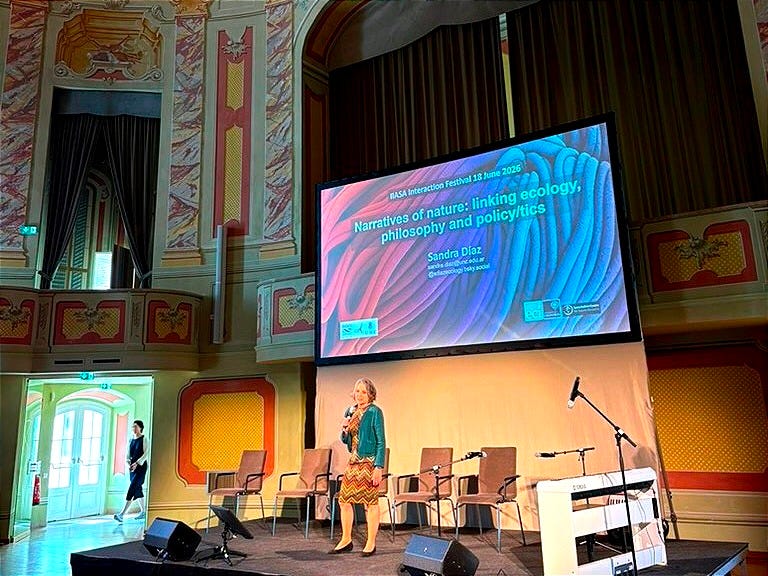
In her festival lecture, Argentine ecologist Sandra Diaz invited participants to reconsider the stories that societies tell about nature, arguing that these narratives fundamentally shape environmental policy and action. Moving beyond dominant frames that either treat nature as a set of resources to be managed or as something pristine and separate from human life, she traced the emergence of the more relational perspective in which humans are embedded within the living fabric of the planet, toward “a narrative of coexistence, negotiation and tolerance.”
The two-day event brought together researchers, governing council members and scientific advisers to examine how an organization founded during the Cold War can adapt to an era marked by overlapping environmental, technological and political challenges — and the festival agenda reflected that shift.
Participants also explored themes such as climate and energy transitions, regenerative economies, human futures, decision intelligence and science diplomacy, with discussions focused on how systems thinking can bridge scientific knowledge and policy action. IIASA planning documents show the institute wants to strengthen its role as a convener, advisor and facilitator, alongside its traditional role as a producer of scientific research.
That ambition featured prominently in a panel discussion examining pathways from science to policy. The session focused on how research can influence international decision-making through networks, negotiation, communications and institutional engagement.
Originally established in 1972 as a joint East-West scientific initiative, IIASA has long served as a neutral forum for researchers from countries with competing political interests. Participants suggested that role may become more important as geopolitical tensions complicate collaboration on global challenges that no single country can address alone.
The institute’s scientific vision, still in the works, reflects that assessment. Among the concepts explored during the festival were “Science Diplomacy as a Bridge: Transforming a Divided World” and “Systems Analysis for Sense-Making and Decision Intelligence,” both of which are expected to inform IIASA’s strategic direction over the coming decade.
“We need a range of tools,” said Kitchens, “to create the conditions for science to have impact.”