

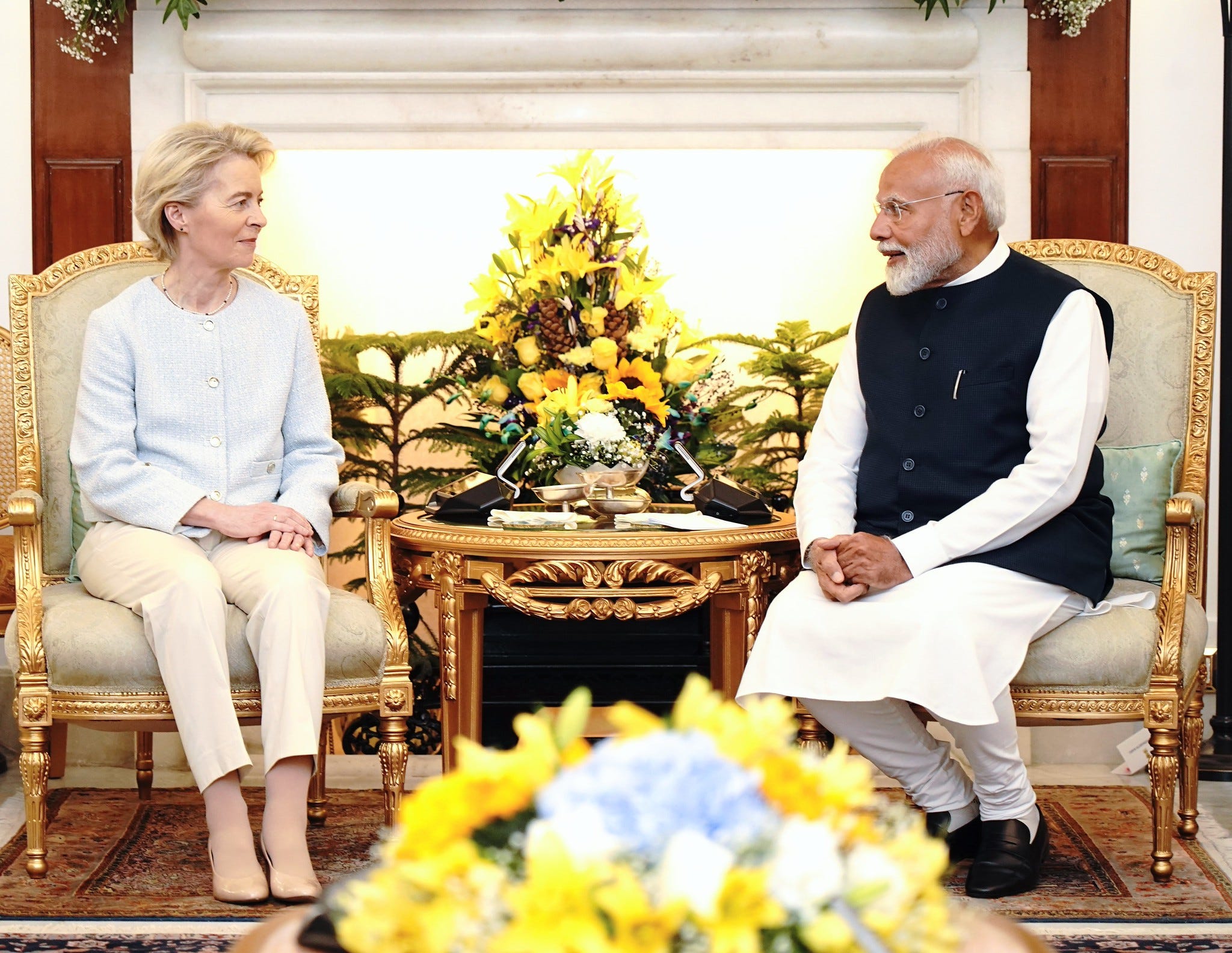
As India and the European Union announced a sweeping strategic agenda, officials on both sides framed it as a landmark agreement. European Commission President Ursula von der Leyen called it the “mother of all deals.”
Completed at the India–E.U. summit in New Delhi this week, the package brings together trade, technology, sustainability, and security cooperation under a single political framework, formalizing years of parallel negotiations and signaling a shift in how both sides approach global governance.
The security dimension of that shift was made visible a day earlier in New Delhi, when an E.U. military contingent marched in India’s Republic Day parade for the first time. The appearance, marking the first time an E.U. flag has flown in the annual parade, offered a rare public signal that the partnership’s security pillar extends beyond statements and into symbolic and operational alignment.
The symbolism was reinforced in the summit communiqué, which committed both sides to deeper cooperation on maritime security, cyber resilience, and defense-related technologies.
The timing is deliberate. Global trade governance remains paralyzed, international negotiations on artificial intelligence are fragmented, and strategic competition between the United States and China has narrowed the space for neutral multilateral solutions.
Against that backdrop, India and the E.U. are signaling that deeper bilateral alignment, particularly on technology governance, may be a way to exert influence where global consensus is hard to reach.
Technology cooperation sits at the heart of the agenda. The two sides committed to closer alignment on digital public infrastructure, artificial intelligence, data governance, trusted connectivity, and research collaboration.
For Brussels, India offers scale, engineering talent, and a fast-growing digital ecosystem. European Commission President Ursula von der Leyen described India as a “like-minded partner” in shaping the digital and green transitions, emphasizing the need for shared rules rather than fragmented approaches.
For New Delhi, the E.U. provides regulatory credibility, market access, and experience in translating norms into enforceable rules. Indian Prime Minister Narendra Modi has framed technology partnerships with Europe as part of India’s effort to co-develop solutions rather than adopt external models wholesale.
“This agreement will bring major opportunities for the people of India and Europe,” Modi said. “It represents 25% of the global GDP and one-third of global trade.”
What distinguishes the finalized agenda from earlier trade or cooperation deals is how explicitly governance is embedded into its structure. Rather than focusing narrowly on market access, it prioritizes standards-setting, regulatory dialogue, and scientific cooperation — treating governance itself as a shared strategic asset.
One of the most immediate outcomes of the summit was agreement on a technical memorandum addressing the E.U.’s Carbon Border Adjustment Mechanism, which enters its transitional phase this year. The tax on carbon-intensive imports such as steel, cement, and electricity is designed to ensure that foreign nations pay the same price for their emissions as European producers, preventing "carbon leakage" and encouraging cleaner industrial standards globally.
Indian officials have argued that the carbon levy could disadvantage exporters from economies with different regulatory structures. While the memorandum does not alter the regulation itself, it provides clarity on data requirements, reporting timelines, and transitional treatment, easing near-term friction without reopening the underlying policy.
That approach mirrors a broader shift in global affairs. With formal multilateral mechanisms under strain, countries are increasingly pursuing what might be called governance by alignment. Instead of waiting for universal rules, they seek compatibility with trusted partners, creating blocs of shared standards that can shape markets and norms over time.
The agreement also formally relaunches negotiations toward a comprehensive free trade agreement, alongside parallel talks on investment protection and geographical indications. While trade has dominated headlines, officials on both sides emphasized that the broader strategic agenda, particularly on technology and standards, is intended to shape long-term alignment beyond tariff schedules.
"This is India's biggest free trade agreement," Modi said, adding that it would ease access to European markets for India's farmers and small businesses.
The India–E.U. partnership fits squarely into that pattern. Cooperation on AI risk management, data flows, and digital infrastructure is designed to support bilateral engagement and to strengthen both sides’ positions in international forums where technical standards and regulatory models are contested.
The E.U.’s regulatory-heavy approach does not always align neatly with India’s preference for flexibility and domestic capacity-building. Data localization, intellectual property, and regulatory equivalence remain sensitive issues. While the agreement stresses convergence, it leaves political trade-offs largely intact.
Nor does it guarantee execution. Like many broad frameworks, it sets direction more than deadlines. Its impact will depend on whether joint working groups, research programs, and standards initiatives move beyond dialogue into sustained implementation, a challenge that has limited previous partnerships.
Still, the strategic logic is clear. For Europe, deeper ties with India support efforts to diversify supply chains and reinforce strategic autonomy. For India, closer alignment with the E.U. complements its ambition to be a rule-shaper rather than a rule-taker in global technology governance.
If translated into coordinated positions in standards bodies, research institutions, and development finance, the partnership could begin to shape how emerging technologies are governed beyond Europe and India themselves.