

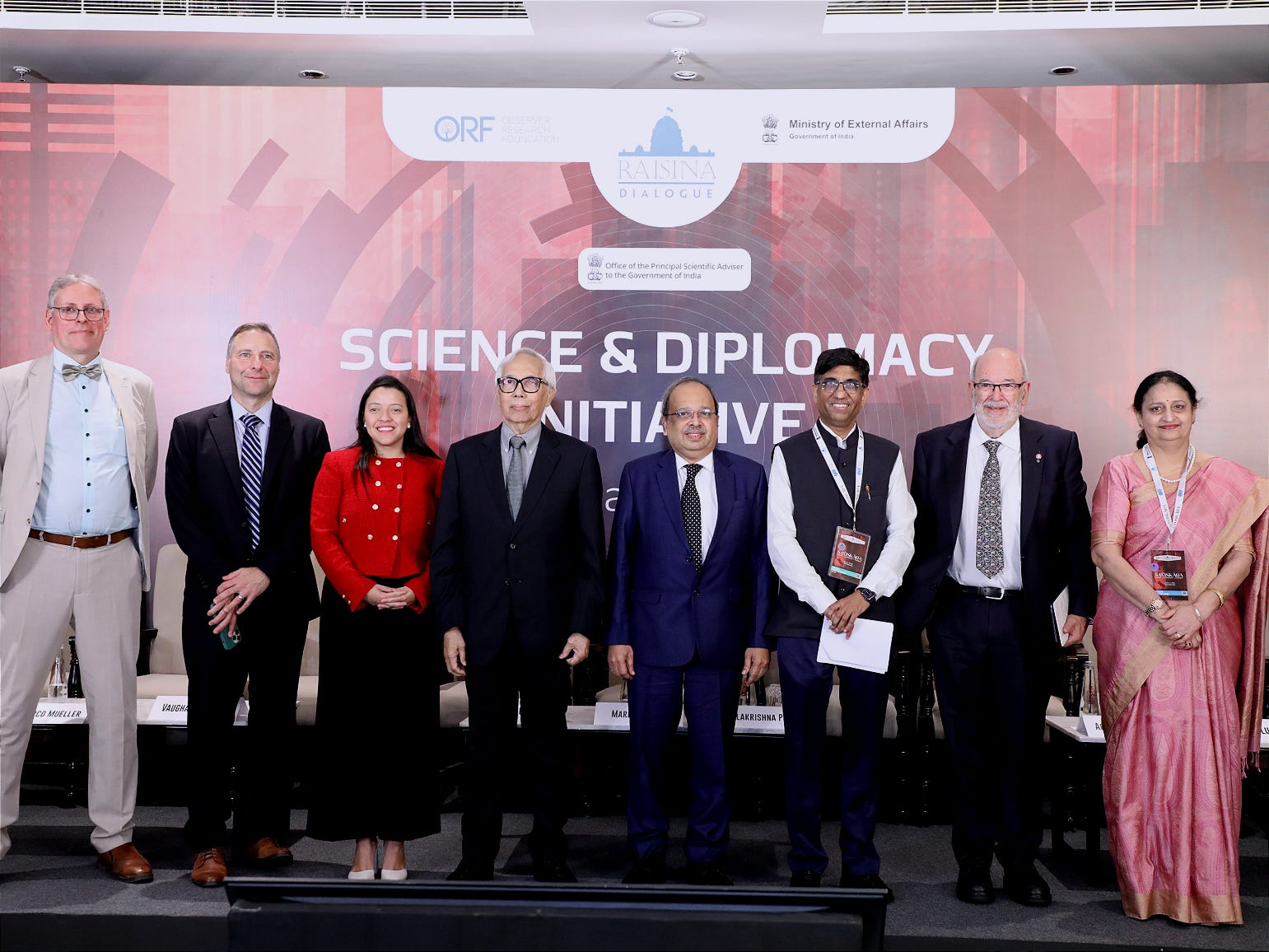
India is testing a new platform for science diplomacy as emerging technologies increasingly shape international politics.
The inaugural Raisina Science Diplomacy Initiative convened scientists, diplomats and policy leaders in New Delhi on Thursday alongside the Raisina Dialogue, India’s flagship conference on geopolitics and international affairs. The initiative joins a growing number of efforts to link science policy and diplomacy as governments experiment with new forums to keep pace with the implications of new technologies.
The Office of India’s Principal Scientific Adviser, together with the Observer Research Foundation, organized the initiative. Roughly 80 participants from governments, international organizations and research institutions met in a closed-door format intended to encourage candid discussion.
The gathering was chaired by Ajay Kumar Sood, India’s principal scientific adviser, and co-chaired by Sir Peter Gluckman, president of the International Science Council; Marilyne Andersen, director general of the Geneva Science and Diplomacy Anticipator; and Vijay Chauthaiwale, who oversees foreign affairs for India’s ruling Bharatiya Janata Party. Samir Saran, president of the Observer Research Foundation, also participated in the launch.
Discussions centered on a question increasingly confronting governments: how to sustain international scientific cooperation as technologies such as artificial intelligence, biotechnology and advanced computing become strategic assets.
In opening remarks, Sood emphasized that science diplomacy must evolve as scientific research becomes more tightly linked to national development agendas, economic competitiveness and global security. He also pointed to the growing influence of private-sector technology companies in shaping frameworks for anticipating and governing disruptive technologies.
Participants examined how governments pursuing greater technological autonomy are reconsidering the balance between open scientific collaboration and strategic control over critical capabilities.
Another focus was how international institutions might manage technologies advancing faster than regulatory frameworks or diplomatic agreements. Speakers highlighted the need for stronger science advisory systems, improved risk-assessment mechanisms and new forms of cooperation that reduce widening technological gaps between countries.
Additional presentations included remarks by Jahnavi Phalkey on the historical evolution of science diplomacy and a briefing by Steen Søndergaard on NATO’s technology foresight work.
Organizers said insights from the initiative will feed into broader international discussions on science diplomacy and technological governance.
The launch reflects a wider shift in global affairs. As emerging technologies reshape economic competition and security policy, governments and international organizations are experimenting with new forums linking science policy, diplomacy and strategic planning.
India’s new initiative adds another node to that evolving network.