

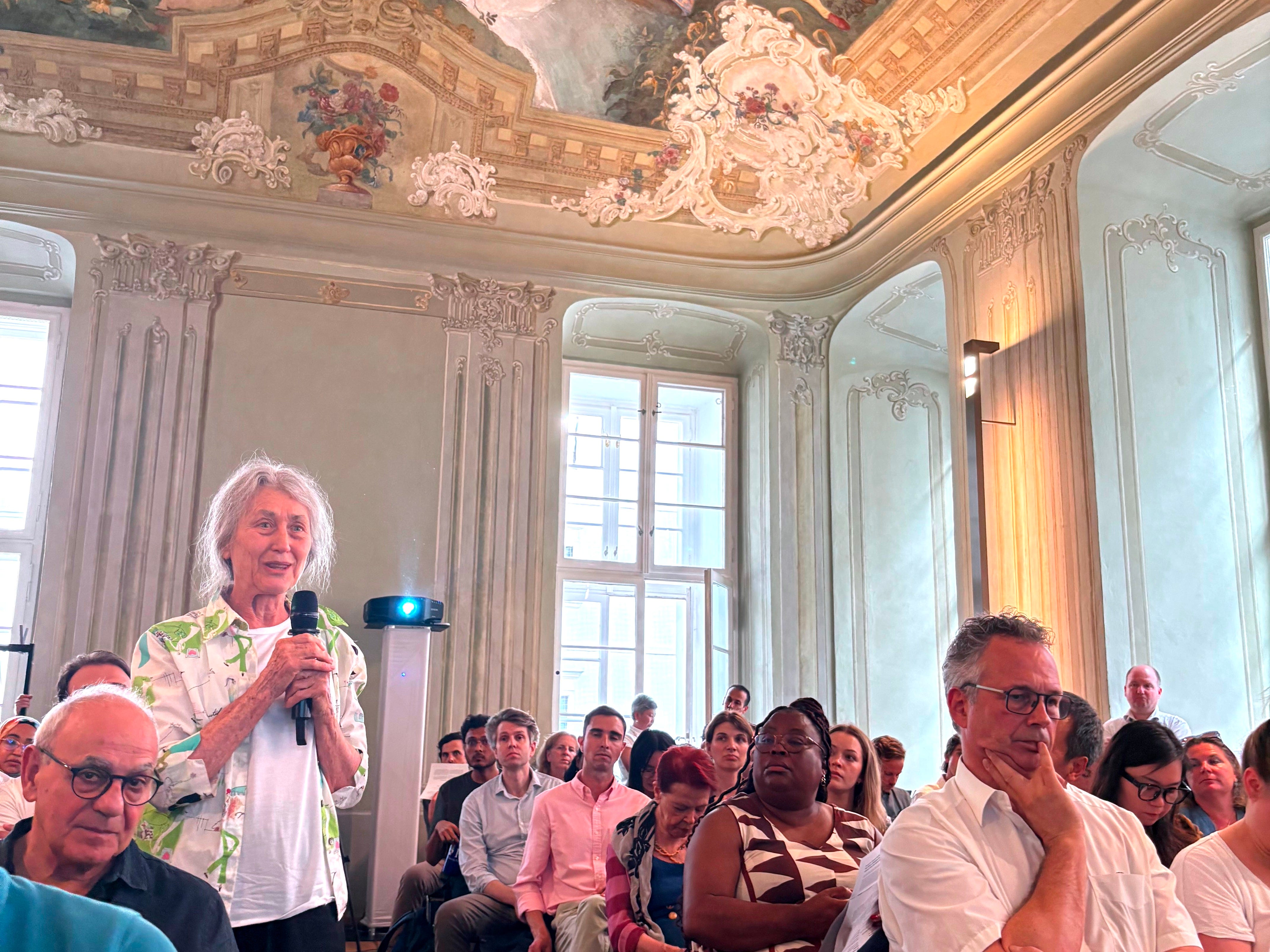
LAXENBURG, Austria — Policymakers rarely have the luxury of waiting for perfect evidence. Decisions about energy, public health and emerging technologies often must be made while scientific uncertainty persists and stakeholders remain deeply divided.
That challenge was at the center of the second day of the Raiffa Academy’s inaugural short course, where participants explored how structured decision analysis can help policymakers make choices even when uncertainty cannot be fully resolved.
The morning session on Wednesday focused on the decades-long controversy over possible health risks from electromagnetic fields generated by power lines. Detlof von Winterfeldt, professor emeritus at the University of Southern California, used the case to show how decision science can help stakeholders navigate disputes when evidence is uncertain and interests conflict.
The challenge, von Winterfeldt said, was not simply analyzing the science. It was creating a framework that allowed stakeholders to focus on a simplified set of decisions that mattered most.
“Most of these problems involve some amount of science,” he said. “The lesson from this particular case is how to simplify problems, because they usually, when they come to you, are awfully complex, with too many objectives, too many alternatives, too many stakeholders.”
Through interviews with utilities, regulators, residents and public health advocates, von Winterfeldt’s research team identified the objectives driving the conflict. These ranged from concerns about health risks and property values to costs and electricity reliability. The analysis reduced 19 potential criteria to four factors that stakeholders could evaluate together.
“The transition from complexity to simplicity, with approval by the stakeholders, provides the clarity,” he said. “And clarity is the most important thing if you have multiple stakeholders, because often they just talk by each other.”
The exercise introduced participants to stakeholder analysis, helping them map the objectives, concerns and tradeoffs facing utilities, regulators, property owners, public health advocates and community groups. The goal was to identify where competing interests might be reconciled and which factors ultimately mattered most when evaluating policy alternatives.
The themes extended beyond the power line case itself. Similar tensions between scientific uncertainty, competing interests and political constraints shape decisions on artificial intelligence, climate adaptation, biotechnology and public health.
The afternoon session shifted from domestic policy challenges to international negotiation, placing participants in the roles of governments seeking agreement on transboundary air pollution across Europe.
Drawing on one of IIASA’s longest-running contributions to environmental policymaking, the simulation challenged participants to negotiate emissions reductions while balancing scientific evidence, economic costs and national interests.
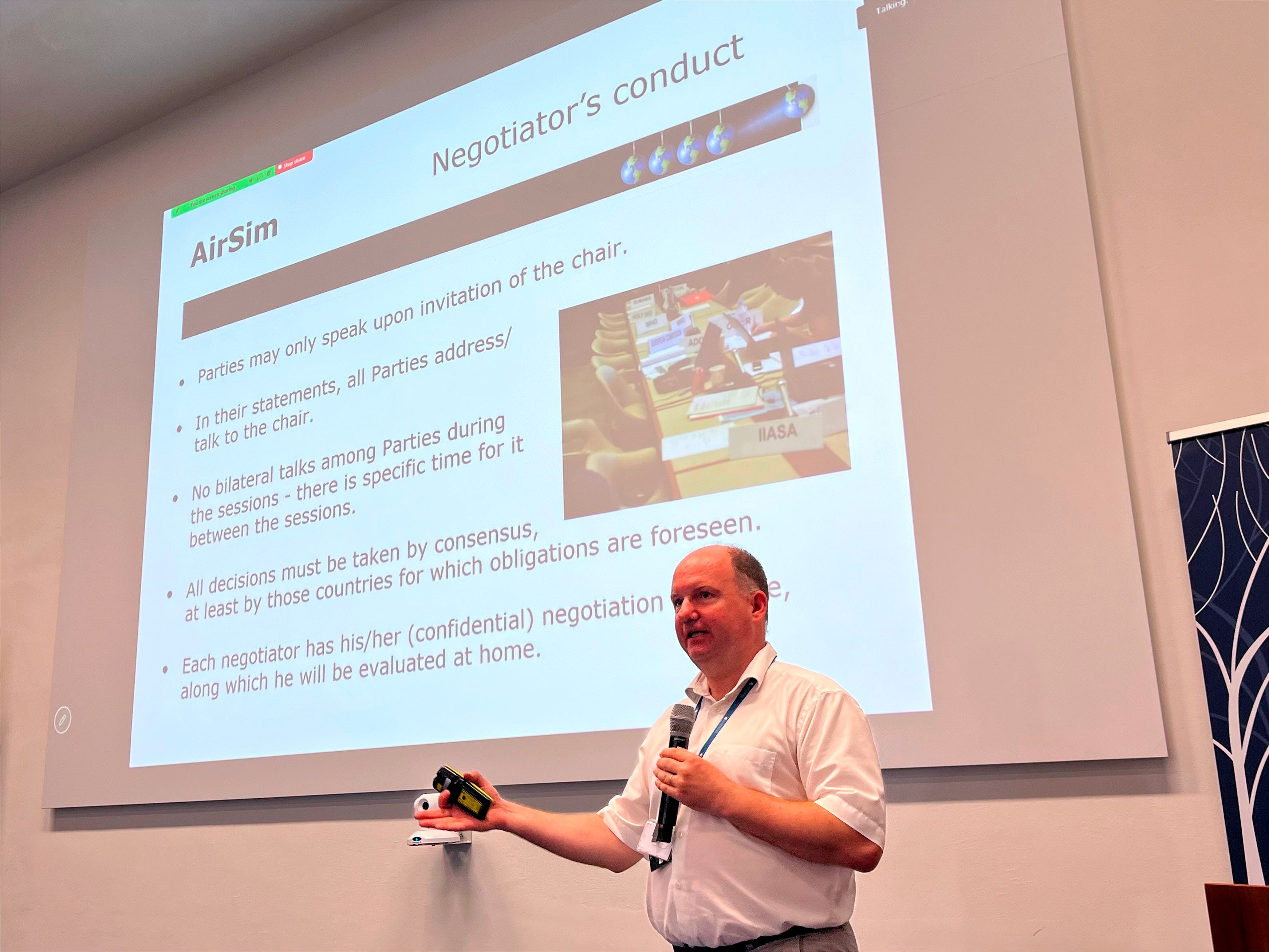
‘Negotiations reveal something about yourself’
Before negotiations began, IIASA principal research scholar Fabian Wagner briefed the group on the science underpinning the exercise, introducing a simplified version of the institute’s GAINS integrated assessment model, which has helped inform European air pollution agreements for decades.
Wagner said the exercise demonstrated that IIASA’s role extends beyond producing scientific research to developing practical tools that support policy decisions.
“IIASA’s tradition is not only to produce knowledge and write scientific papers, but also to develop tools that are actually useful for decision makers,” he said.
Participants used the model to test different emissions-reduction scenarios, explore their environmental and economic consequences, and negotiate a written agreement among countries with differing priorities and capacities.
Wagner said the value of the model was not that it produced a perfect answer, but that it gave participants a shared foundation for negotiating difficult trade-offs.
“Everybody now understands that the GAINS model is not necessarily the most accurate model, nor is it maybe the most efficient model,” he said. “But it provides a common methodology that everybody can work with.”
Beyond the technical exercise, Wagner said the simulation was intended to help participants better understand their own negotiating styles.
“The negotiations reveal something about yourself,” he said. “You can observe yourself. How do you react in certain situations? Where are your strengths? Maybe where are your weaknesses?”
The compressed timetable also reflected the realities of policymaking, where negotiators are often forced to reach decisions under significant time pressure.
“Negotiations are often like this,” Wagner said. “You wish you had more time. You had actually planned to have more time, but in the end, you have to take decisions really quickly.”
For participants, the exercise demonstrated how scientific evidence can inform negotiations without determining their outcome.
Kevin Hsu, a doctoral student at the Massachusetts Institute of Technology whose research focuses on energy and infrastructure policy, said the simulation highlighted the intersection between scientific analysis and the human dimensions of policymaking.
“There’s a scientific basis for understanding the problem, but there are also very human challenges because we’re dealing with societies, stakeholders, corporations, nonprofit groups and the public,” Hsu said. “Being able to understand the scientific basis, but then translate it into this human side of problem-solving, seems to be what’s animating our conversations.”
Hsu said the academy’s interdisciplinary cohort, including researchers and practitioners from multiple countries and disciplines, reflected the kind of collaboration needed to tackle complex policy challenges.
“I think they’re really striving for that interdisciplinary problem-solving approach, which I think more of could be done in the real world,” he said.
Although the exercise simplified real-world negotiations, Hsu said it provided an opportunity to practice approaches that participants could apply in more complex settings.
“The real world is more complex, but there are still lessons you can draw from a shorter practice experience,” he said.
Thanks for sharing - we wrote about using the perceived or fabricated lack of evidence being used as an alibi for inaction - check out the paper in Lancet Public Health: https://www.thelancet.com/journals/lanpub/article/PIIS2468-2667(26)00120-9/fulltext