

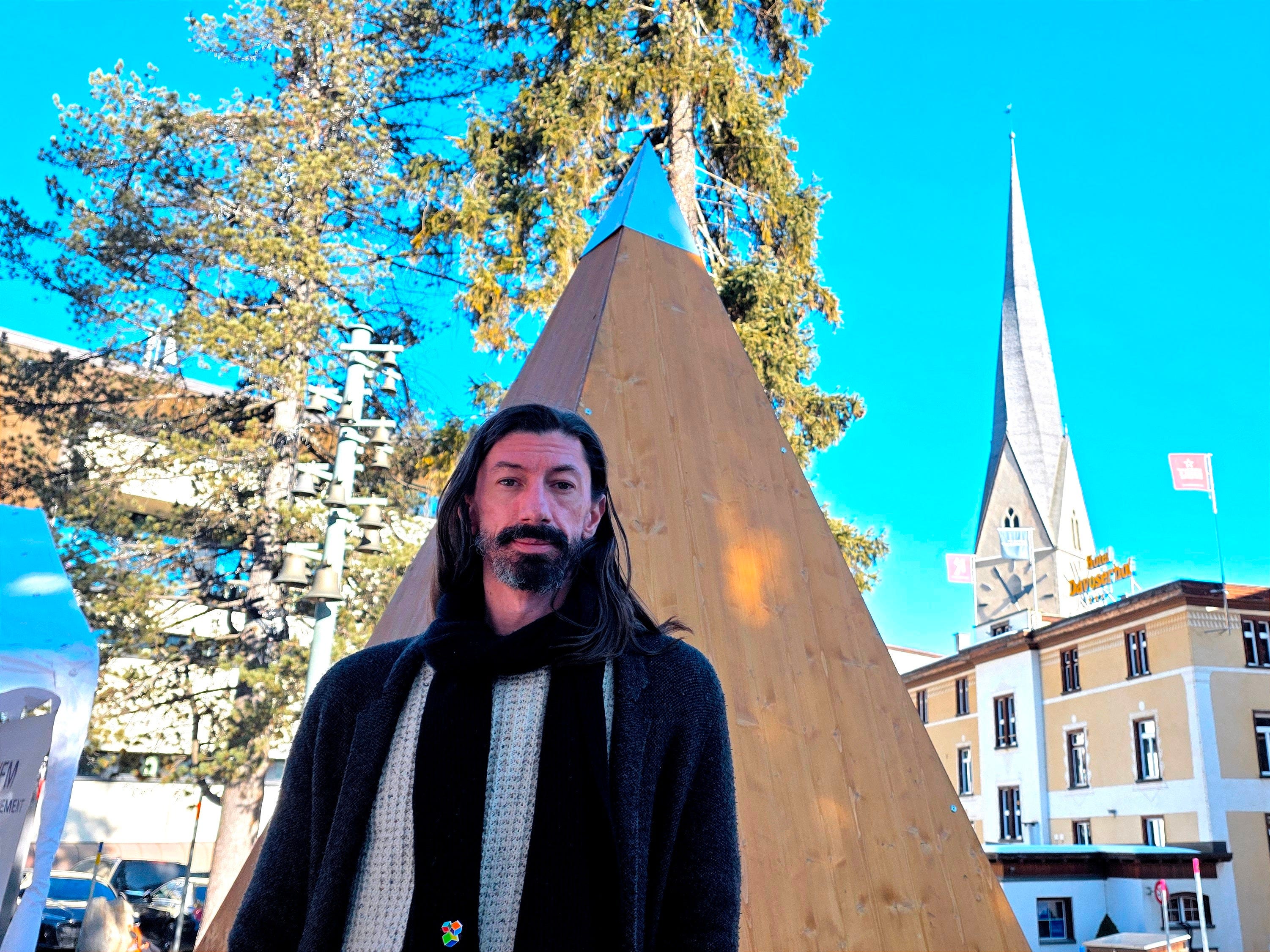
DAVOS, Switzerland — This is conceptual artist Samuel Stubblefield’s moonshot. Next summer, the surface of the Moon will be his canvas for a first-of-its-kind artwork: the creation of a lunar sanctuary.
Stubblefield, an American artist, works not in metaphorical space but in outer space itself. His space art, he says, uses technology “to observe, explore, experience, understand, and build,” both inwardly and outwardly, across the far reaches of the known universe.
The project he discussed in Davos last week, whether understood as preservation, provocation, or symbolic overreach, is unusually situated at the intersection of contemporary art, space governance, and what diplomats often call soft power.
Through a partnership with a private lunar rover company operating under NASA’s Commercial Lunar Payload Services program, Stubblefield plans to use rover wheels to inscribe a large circle on the Moon’s south polar surface.
The marked area, he says, will function conceptually as a sanctuary, an intentionally designated space meant to provoke debate about preservation, governance, and restraint in an era of accelerating lunar activity.
Art inside a legal framework
Stubblefield said he holds a memorandum of understanding with the rover company, approved through NASA channels, and that the project has been developed explicitly within the constraints of the 2020 Artemis Accords, the U.S.-led nonbinding framework that sets norms for civil exploration of the Moon and beyond.
“The Artemis Accords are very real,” he said in an interview during the World Economic Forum’s annual meeting. “We want to play within the confines of that.”
Those confines matter. The Accords discourage the creation of territorial claims or exclusionary zones on the Moon, reflecting sensitivities around sovereignty and the Outer Space Treaty. That’s why the project was termed a sanctuary and not a preserve, which might carry the implication of exclusion.
The choice reflects a trend in lunar activity: non-government entities are increasingly setting precedents in an environment where formal legal guidance remains limited. In a 2025 public talk at MIT, Mehak Sarang of the Open Lunar Foundation argued that private and nonprofit lunar missions are “setting important precedents through action, because there’s really no formal framework to guide them,” and warned that “norms without legitimacy or inclusion … can provoke backlash.”
The distinction is not merely semantic. Stubblefield emphasized the sanctuary would not constitute a border or enforceable zone. Instead, the rover will place a passive reflector, detectable but non-interactive, at the center of the circle, allowing future missions to detect the marked area and potentially choose to avoid disturbing it.
“What we do want,” he said, “is to demark a place that might have us think maybe we shouldn’t tread all over the Moon.”
Preservation as provocation
Physically, the intervention is minimal. Conceptually, it is meant to be catalytic.
Because the Moon lacks weather, any mark on its surface can persist for geological timescales. “Neil’s boot is still up there,” Stubblefield said of Neil Armstrong, the American astronaut who, as commander of the 1969 Apollo 11 mission, became the first person to walk on the Moon. “Anything you do there kind of stays.”
That permanence drove him away from representational imagery. After considering drawings and symbols, he concluded that almost any figure would carry excessive personal ego. The circle, by contrast, was chosen precisely because it minimizes authorship while maximizing interpretive force.
“As much as it is a sanctuary, it’s conceptual art. It’s to ignite this debate,” he said. “To provoke the question, and get out of the way.”
The project is scheduled to launch over the summer, though Stubblefield declined to specify dates, citing the number of moving technical components involved. He expects to be in Los Angeles during operations, observing from mission control as the rover executes preprogrammed movements.
Soft power beyond science
Stubblefield frames the lunar sanctuary explicitly as a soft-power intervention. He drew parallels to the unifying symbolism of the Apollo era, arguing that space exploration once functioned as technological competition and a cultural and ideological signal.
Today, he said, the dominant funding logic in space is “dual use,” for civil and military applications intertwined that leave little room for non-instrumental projects.
Against that backdrop, he sees art as a way to reopen collaborative space. Ideally, he said, the sanctuary would evolve into a multinational effort, with digital payloads contributed by different countries using flags, artworks, or culturally significant symbols.
He described having some recent conversations with diplomats and astronaut teams from multiple countries, including Saudi Arabia, and said he would welcome participation regardless of any geopolitical rivalry.
The proposal pushes at the edges of what science diplomacy typically encompasses. While grounded in space science and engineering, the project operates through cultural signaling rather than research output or formal agreement.
Whether such cultural signaling constitutes science diplomacy in a formal sense remains contested. Stubblefield does not claim it resolves governance gaps around lunar environmental protection, a domain where binding rules remain limited, but rather that it makes those gaps visible.
A year ago, those gaps led the Vienna-based U.N. Committee on Peaceful Uses of Outer Space (COPUOS) to create the Action Team on Lunar Activities Consultation, a new framework for governing activities on the Moon.
With private companies making lunar landings and resource extraction a reality, the U.N. recognized a need for clear rules to prevent conflict, protect scientific sites, and manage environmental impacts.
Through COPUOS, nations have been discussing how they might coordinate lunar activities that involve both governments and private companies. Some envision stronger international coordination, but no binding framework or new governing body has yet been agreed.
The first attempt to govern such activity was the 1979 Moon Treaty, which only a small number of countries ratified and tried to fill in the gaps left by the 1967 Outer Space Treaty. It had a major flaw: Article 11 called for a new agreement on outer space resource activity, without giving any specifics.
Space-faring nations generally opposed the creation of a new supra-national authority that could oversee resource extraction similar to how the International Seabed Authority regulates ocean projects under the U.N. Convention on the Law of the Sea.
A real project, with real constraints
This will not be Stubblefield’s first lunar mission. Last year, he took part in a privately organized art payload that flew aboard Firefly Aerospace’s Blue Ghost mission, coordinated by a group called LifeShip. The forthcoming sanctuary project, however, is more operationally and legally complex, and entirely self-funded.
He came to Davos with the hope of finding a primary patron for the project, since the financial and logistical burden is not insignificant. “This is quite real,” he said. “No pressure.”
Whether the lunar sanctuary ultimately influences policy or practice is an open question. Stubblefield does not claim otherwise. What he is attempting, he said, is to shape how future governments and businesses conceptually approach the Moon before activity there becomes too entrenched to reconsider.
“If you wait until we’ve occupied the whole south pole,” he said, “we don’t get to go back and carve out an area that’s untouched.”
In that sense, the project functions less as a policy proposal than as a preemptive marker: a cultural artifact embedded directly in an emerging domain of international activity, asking how restraint, preservation, and cooperation might be signaled before the rules are fully written.