


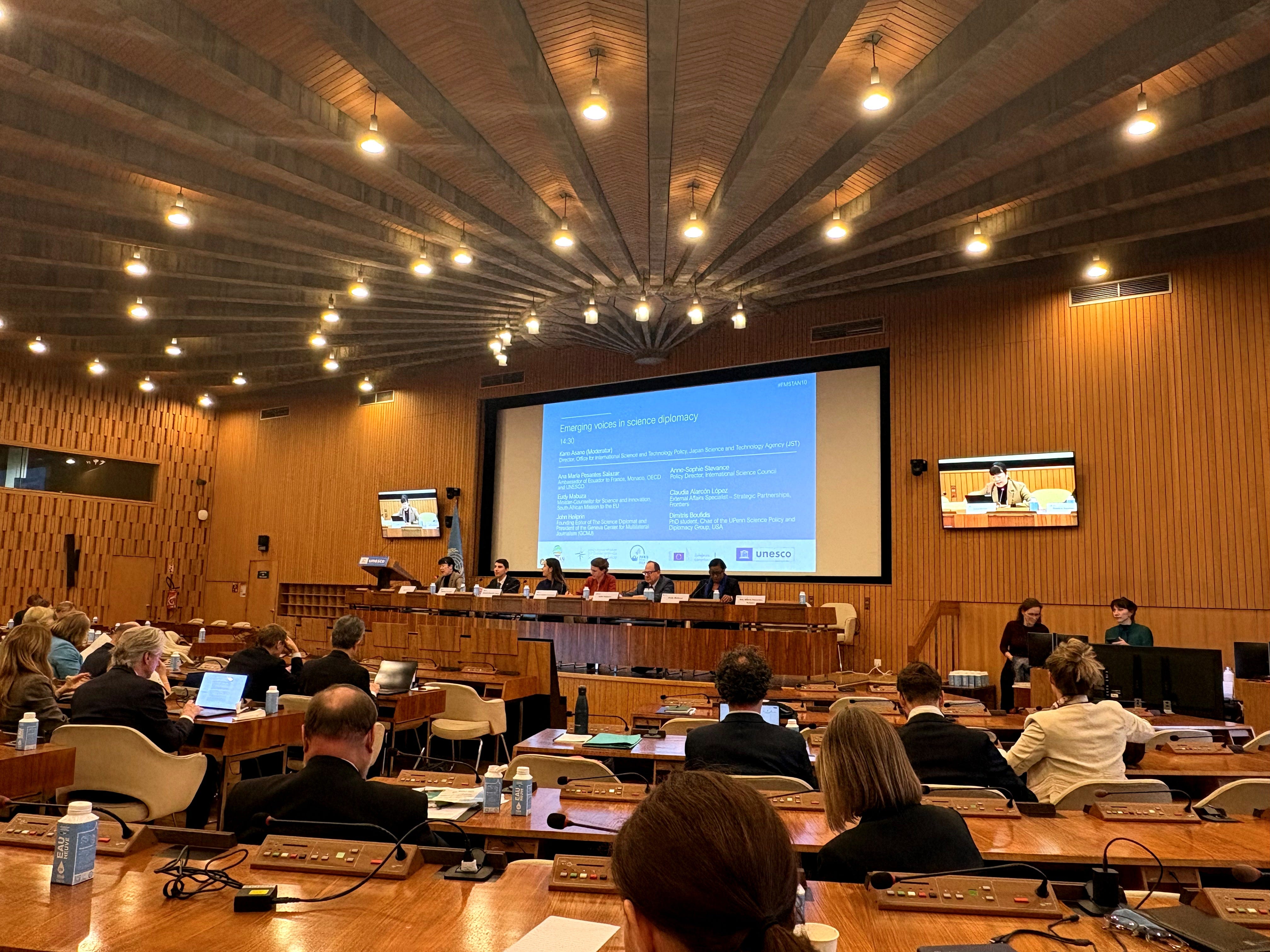
PARIS — Young scientists, journalists and Global South diplomats are building their own routes into science diplomacy and raising harder questions about who owns science, speakers told a symposium.
The discussion on Monday took place at UNESCO’s headquarters to mark the 10th anniversary symposium of the Foreign Ministries Science and Technology Advice Network, known as FMSTAN, where organizers asked what difference a wider cast makes to the agendas, partnerships and outcomes of science diplomacy.
FMSTAN began in 2016 as an invitation-only community of science advisers and diplomats working inside foreign ministries. It operates under the International Network for Government Science Advice, known as INGSA.
Two of the six panelists were diplomats. Ana María Pesantes Salazar is Ecuador’s ambassador to France and UNESCO, and Eudy Mabuza is minister-counselor for science and innovation at South Africa’s mission to the European Union. The others were a journalist, a science-council policy director, a publisher’s partnerships specialist and a doctoral candidate. Kana Asano of the Japan Science and Technology Agency moderated.
“Before going to the U.S., I didn’t even know science diplomacy existed,” said Dimitris Boufidis, a doctoral candidate in bioengineering at the University of Pennsylvania whose brain research focuses on Parkinson’s disease. “How do you enter a field that you didn’t know exists?”
With no formal pathway, Boufidis said, the student-led science policy and diplomacy group he chairs is trying to build another group for master’s and doctoral students in STEM fields that provides training, immersion and outputs. Its global initiatives, run with embassies and international partners, include an Asia team working with Japan on vaccination policy, a European team working on the EU Quantum Act and Google Quantum AI, and an Africa team mapping biobanks across the continent.
Claudia Alarcón López, who works on strategic partnerships at the Swiss-based publisher Frontiers, said she was hired last year to help bring stakeholders together at the World Economic Forum in Davos for a week of sessions on topics ranging from emerging technology to AI governance to planetary health, with the aim of putting transformative science on the agenda. Frontiers has also run a mini science house at Falling Walls in Berlin and plans another at COP31 this weekend, she said.
She also credited the institutions that built the room. “I am the result of the effort you have put throughout the years,” she said, speaking to the International Science Council, known as ISC, and INGSA. “If ISC and INGSA were not in place today, we would not have the forum to be here.” Without them, she said, emerging voices from the Global South and youth would not be possible.
Anne-Sophie Stevance, ISC’s policy director, said her career has been spent developing the pathways for international science to have a seat at the table, beginning in 2012 with the creation of Future Earth around the Rio+20 conference. An example shared by the Academy of Sciences Malaysia led in 2024 to the Kuching Declaration on the Tropics, she said, and ISC has worked to boost evidence in Amazon science that also brings in Indigenous knowledge and counters the power asymmetries that pervade global organizations.
Pesantes Salazar offered a concrete case. Ecuador works with UNESCO on youth issues and artificial intelligence, using its international guidelines to help build AI capacity in the country. “That is science diplomacy in practice,” she said. When Ecuador presented its national AI strategy in Quito in March, she said, different groups saw different parts of the problem. Researchers could study a real problem in the field, scientists could say when risk is rising, and community groups could see who would be left out. If AI is used in public services, she asked, who can actually use it when few people in rural areas have internet access?
For Mabuza, the issue is who benefits from Africa’s resources. “The green transition that everyone is talking about should be a just transition,” she said, and most of the minerals it requires are on the African continent. Because of that, she said, Africa should use its own scientific excellence to add value to mineral processing.
She said the African Union-European Union Innovation Agenda works differently from other partnerships because the sides are co-partners seeking win-win solutions, as South Africa marks 30 years of science cooperation with the EU. The inaugural Africa Science Diplomacy Conference takes place in Pretoria from Nov. 30 to Dec. 1.
John Heilprin, founding editor of The Science Diplomat, who has reported on science and international institutions for 35 years, said science diplomacy is “much older than the words we use for it.” The more interesting question about new voices, he said, is who owns science, which is “not only about cooperation but about power, dependence and control.”
For a journalist, he said, greater diversity in the field of science diplomacy means more sources, more experience and competing accounts. “It doesn’t mean a new voice is automatically right,” he said.
Looking ahead, Boufidis said he is on the panel “to a large extent because of chance” and wants to recognize students who lack such opportunities. His group has created an open access curriculum, recently secured funding to help new student groups start their own, and wants to share and test its simulations so others can improve them.
The symposium is an official side event of the Paris Peace Forum, which runs Nov. 10-11. On Tuesday, UNESCO and South Africa, with India’s support, will convene a Chief Science Advisors Roundtable at UNESCO headquarters.
Heilprin’s recommendations were for institutions. They should make more of the work visible, he said, by helping journalists reach the researchers, students and local partners doing it: go on the record when they can, share documents and be honest about gaps.
After a conference agreement or a new network, he said, the questions are whether the money was spent and whether the partnership continued. Interviews and documents let journalists compare what was promised with what happened, he said.
His third recommendation was to support independent journalism. He said the new European framework for science diplomacy, for example, could do more to recognize the role that journalists can play by shedding light and triggering change.
Heilprin closed by saying that if greater diversity changes science diplomacy, independent journalism “can show whether it actually does and how.”