The next U.N. leader may need to be a science diplomat
As governments begin positioning for the race, scientists and policy leaders are making a new argument: the secretary-general's job is increasingly shaped by science and technology.

The next secretary-general of the United Nations will need many of the qualities traditionally associated with the world’s top diplomatic post: political judgment, the ability to build consensus and the credibility to navigate conflict among countries.
But those qualities may no longer be enough, according to Michael Møller, the former director-general of the United Nations Office at Geneva, who has over 40 years of experience as an international civil servant in the United Nations.
“You need a leader who has a very clear vision of what the future might be or what it takes to harness the system and to reform the system in such a way that for the next 20, 30, 40 years we are going to come with a structure that is actually going to help ensure that humanity has a grip on that future,” Møller said.
His comments point to a growing reality confronting the United Nations as governments begin positioning themselves for the race to succeed António Guterres: the job description of the secretary-general is changing.
For much of its history, the office centered on diplomacy among countries, conflict resolution, humanitarian coordination and the management of international crises. Those responsibilities remain. Yet an expanding share of the challenges confronting the international system now emerge from scientific and technological change.
Climate change, artificial intelligence, biotechnology, quantum computing, pandemic preparedness, cybersecurity and space governance shape international affairs through questions that are as scientific and technological as they are political.
Scientific expertise already underpins many of the most consequential functions of the multilateral system. Climate diplomacy depends on assessments produced by the Intergovernmental Panel on Climate Change. Pandemic preparedness relies on scientific research coordinated through the World Health Organization. Nuclear non-proliferation depends on highly technical verification systems. Emerging debates over artificial intelligence governance increasingly rely on scientific advisory mechanisms and expert assessment.
Scientific knowledge is no longer simply an input into international negotiations. It has become part of the infrastructure through which international decisions are made.
That reality was underscored when the International Science Council, representing more than 250 scientific organizations across the natural and social sciences, called on candidates for the U.N.’s highest office to strengthen the role of science throughout the multilateral system.
The council’s argument went beyond calls for more scientific advice. It urged the next secretary-general to treat science as a core pillar of multilateral governance, warning that scientific knowledge remains “too often an ad hoc input to decision-making” even as governments confront increasingly complex challenges ranging from climate change and inequality to artificial intelligence and biotechnology.
“The next secretary-general will take office at a moment of acute tension between the scale of global challenges and the fragility of multilateral cooperation,” the council wrote in an open letter earlier this month.
The council called on the next U.N. leader to strengthen institutional pathways connecting scientific knowledge to international decision-making, place the social sciences at the center of efforts to anticipate technological and societal change, and expand equitable access to scientific knowledge for low- and middle-income countries. It argued that scientific cooperation should be treated not merely as a resource during crises but as a standing component of how the international system functions.
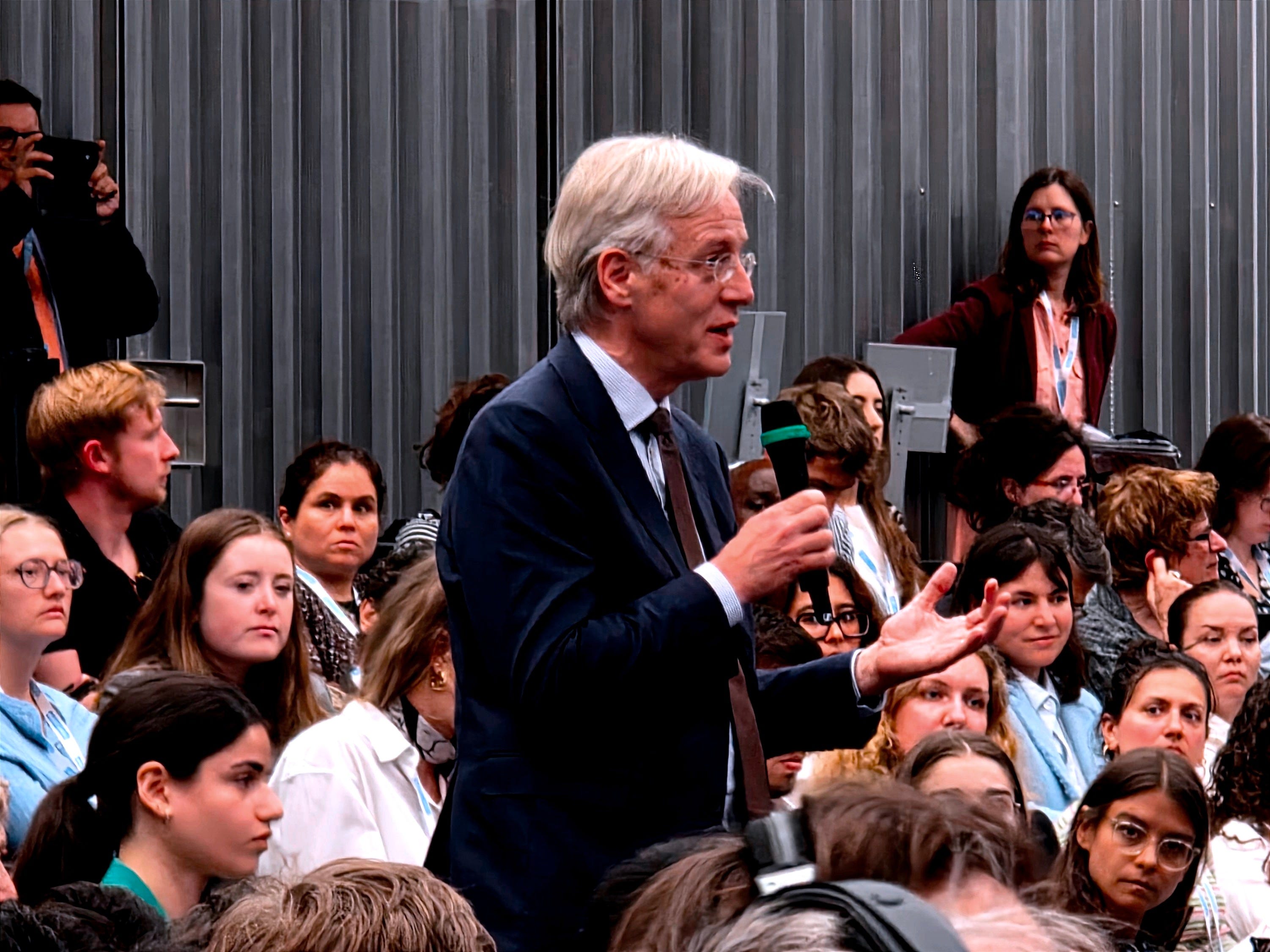
The intervention did not emerge in isolation. Two days before the letter’s publication, incoming International Science Council President Robbert Dijkgraaf raised many of the same themes during a public debate among secretary-general candidates convened by GWL Voices, in collaboration with the United Nations Foundation, at the Geneva Graduate Institute.
“It’s clear in the future, science will be more important to address global challenges, and it can be a source of optimism,” Dijkgraaf began. “So what are your ideas to make the role of science in the U.N. stronger, more structural, in particular more equitable, in the sense of engaging all member states in terms of gender equality, but also in terms of listening to all the voices?”
His question reflected a broader concern within the scientific community that the U.N. increasingly depends on scientific knowledge while lacking sufficiently robust institutional mechanisms to integrate that knowledge consistently into decision-making.
Similar arguments have surfaced repeatedly this year among leaders working at the intersection of science and governance.
In an April interview with The Science Diplomat Podcast, Rémi Quirion, Québec’s chief scientist and president of the International Network for Government Science Advice, said the next secretary-general should ideally be a science diplomat and argued that science should become a core component of multilateral leadership rather than a peripheral advisory function.
“It will be great if the next secretary-general is a science diplomat, or thinks that he or she is a science diplomat,” he said. “Of course, there are many other things that they have to think about.”
In a separate Podcast interview, Jan Marco Müller, a senior European Commission official who helped draft the European Union’s newly adopted science diplomacy framework, argued that with science and technology “permeating into all areas” of foreign and security policy, leaders at the highest levels of international governance increasingly must engage directly with those science diplomacy issues.
“You have many United Nations bodies and agencies that are very much science-driven,” he said. “I don’t know whether they all will be science diplomats, but definitely they have no choice other than having to deal with science and technology and take it into consideration in the decision-making.”
Even within the United Nations, steps are already being taken in that direction.
In March, Guterres convened the first meeting of the Independent International Scientific Panel on Artificial Intelligence, a body established to provide independent scientific analysis of rapidly evolving AI systems. The panel reflects a broader trend toward creating standing scientific advisory mechanisms rather than relying solely on ad hoc expert consultations.
“No country, no company and no field of research can see the full picture alone,” Guterres told participants, arguing for a shared global understanding of artificial intelligence grounded in scientific knowledge rather than ideology.
Outgoing ISC President Sir Peter Gluckman has similarly argued that science diplomacy is becoming more important, not less, in a period of geopolitical rivalry. As competition among major powers intensifies, he says, scientific cooperation remains one of the few mechanisms capable of sustaining dialogue across political divides.
“Science never makes policy,” he said in a Podcast interview in late January. “Science informs policy. Policymaking is making a choice between different options, including the option to do nothing, which affects different stakeholders in different ways. Yes, science provides, in many cases, the baseline knowledge on which decisions are made. But then you’ve got to think about cost, impact, public opinion, ethical and social concerns, diplomatic considerations. All of that comes into the decisions that are made.”
The race to succeed Guterres remains in its intermediary stages, but the candidates being discussed illustrate the breadth of experience now seen as relevant to the role.
Former Chilean President Michelle Bachelet, a surgeon and pediatrician, brings a record in human rights and digital governance. Rebeca Grynspan, secretary-general of the United Nations Conference on Trade and Development and former Costa Rican vice president, is an economist focused on development and technological transformation. Rafael Mariano Grossi, director general of the International Atomic Energy Agency, has a PhD in international relations and spent years navigating the intersection of technical expertise and high-stakes diplomacy.
Former Senegalese President Macky Sall, a geological engineer, has emphasized development, energy and institutional reform. María Fernanda Espinosa, former president of the U.N. General Assembly and former foreign minister of Ecuador, has studied geography, anthropology and social sciences, and built much of her career around environmental diplomacy and sustainable development.
Together they represent different visions of twenty-first century multilateral leadership. Yet the growing intervention of scientific institutions suggests that a new criterion may be emerging alongside more traditional considerations.
The question is no longer simply who can manage diplomacy among countries but also who can govern in a world where scientific knowledge, technological disruption and geopolitical competition have become inseparable.
Møller argues that the next secretary-general must also possess qualities that cannot be measured by expertise alone.
“Well, it’s several things. It’s one who listens. It’s one who has empathy. It’s one who takes decisions. Once you’ve listened and you’ve taken the opinion of those around you, then you take a decision and you make it stick and you go with it.”
He also cautions against focusing too narrowly on today’s dominant technological debate.
“I’m not just talking about artificial intelligence like everybody else is talking right now,” he said. “We’re talking about quantum. We’re talking about neurosciences.”
The next secretary-general will still be expected to broker peace, build consensus and defend multilateralism. But the role also requires the ability to build institutions capable of connecting scientific knowledge to political decision-making.
As the International Science Council argued, the question is no longer whether science should inform global governance but whether the United Nations is prepared to make science a permanent pillar of it.