
Science Diplomacy Becomes Policy: A Conversation with Jan Marco Müller
The European Commission official who helped draft the E.U.’s Science Diplomacy Framework reflects on definition, strategy, evidence and the politics of making science usable in foreign policy.

Season 1, Episode 4
Duration: 40:31 minutes
Recorded: April 3, 2026
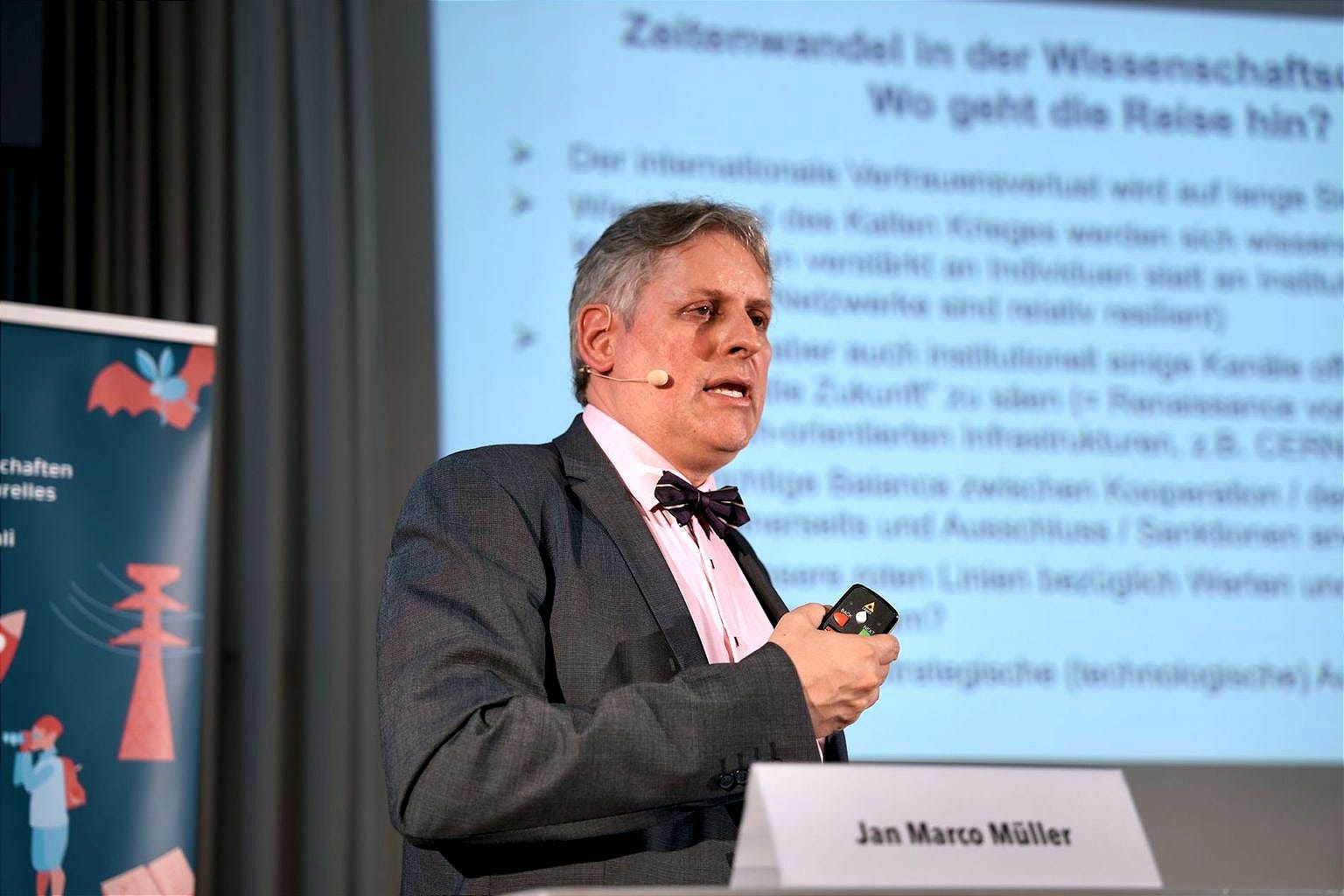
Jan Marco Müller, team leader for Global Approach, Multilateral Dialogue and Science Diplomacy at the European Commission’s Directorate-General for Research and Innovation, joins The Science Diplomat for a conversation to discuss the transition of science diplomacy from informal practice into formal policy.
Müller discusses his role in developing the European Union framework for science diplomacy, including the challenge of defining the term for regulatory purposes. He argues that earlier definitions were designed for a different geopolitical moment, and that science diplomacy today must account not only for cooperation and bridge-building, but also for sovereignty, values, strategic interests and technological competition.
The conversation examines the process of building an E.U.-wide approach across 27 member countries, research ministries, foreign ministries, scientific institutions and diplomatic services. Müller describes the difficulty of bringing scientists and diplomats into the same process, and why the framework was built through working groups co-chaired by both communities.
The episode also explores why science diplomacy has become more urgent in a period marked by war in Europe, strained multilateralism, sanctions, technological competition and the political uses of scientific evidence. Müller argues that science diplomacy must become a practical instrument in the diplomatic toolkit, not merely a language of goodwill.
The discussion turns to the Global South, where countries including India, South Africa, Costa Rica and Rwanda are increasingly shaping science diplomacy agendas of their own. Müller reflects on the need for equitable partnerships, global dialogue on values and principles, and the importance of academic freedom as a universal value of science rather than a regional preference.
Finally, the conversation examines how evidence becomes actionable in policy. Müller emphasizes timing, communication and political context, noting that scientific advice often fails when it arrives after decisions have already been made. He also discusses cases where evidence is clear but political outcomes remain difficult, including global negotiations on plastic pollution, climate and other areas where economic interests complicate agreement.
The conversation closes with a reflection on process: Müller argues that getting scientists and diplomats into the same room may matter as much as the final document itself. In a moment when both science and diplomacy are under pressure, he suggests the two communities may have a shared interest in defending a rules-based international order.
Listen to the full conversation below.
The Science Diplomat Podcast — Season 1, Episode 4
Key Themes
Science diplomacy as a formal policy instrument
Defining science diplomacy for regulatory purposes
The E.U. framework for science diplomacy
Scientists, diplomats and institutional translation
Sovereignty, values and strategic interests in science diplomacy
The Global South and equitable science diplomacy partnerships
Evidence, timing and political decision-making
Science and diplomacy under pressure
Transcript
This is the verified transcript of Season 1, Episode 4 of The Science Diplomat podcast, featuring Jan Marco Müller. The text has been lightly edited for clarity and minor transcription corrections. The substance of the conversation has not been altered.
Amna Habiba: Hello and welcome back to The Science Diplomat podcast. Science diplomacy is often talked about as a feel-good collaboration. Scientists shake hands across borders, but increasingly it’s becoming a grittier systems strategy for how knowledge actually survives the journey into high-stakes decision making. Today, we’re joined by someone who has spent the last two decades building those very systems within the European Union. Jan Marco Müller has been the first in many rooms, from the chief scientific advisor’s office to the European External Action Service. We’re diving into what happens when science diplomacy moves from a vague practice into a formal policy that 27 different nations have to agree on. Jan Marco, welcome to the show. I want to start with your trajectory. You began in geography and moved into the heart of E.U. policy. Was there a specific moment where you realized that scientific evidence wasn’t really reaching the right desks, and you had to be the one to build that bridge?
Jan Marco Müller: Hello and thanks for the invitation to this podcast. Well, as I say, I studied geography, I have a PhD in geography. So I feel I am both a natural and a social scientist, being able to talk to all scientific disciplines, which I think is an important skill in that context. But it was clear for me, I’m never going to be a 100% researcher. I was always interested in how science makes an impact on society and on policy, and that’s why, after my PhD, I went first into science management, to basically learn a little bit the basics of how science works around stakeholder relations, science communications and all the rest of it. And then went into the area of science advice to policy making. And my observation at the time was there was a lot of science advice happening but it was very technical in a sense. And obviously providing advice, for instance, to a technical agency or ministry is something different than providing scientific advice to an elected politician, and they are the ones who ultimately take the decisions.
John Heilprin: In those earlier days, what did the interface really look like between science and diplomacy? Was it a formal report or formal discussion, or more of a conversation in a hallway before a vote?
Jan Marco Müller: Well, obviously, I was initially just in science advice. I went into science diplomacy a little bit later. Of course, it was very, as I said, technical in the sense there were reports being produced, there were expert meetings being organized, and a lot around standards and definitions and measurements and all these sorts of things. And this a little bit changed then, at least in the European Commission, when President Barroso at the time, decided to establish the role of chief scientific advisor. And I at the time worked for the Joint Research Center, the JRC, which is the science service of the European Commission, which has been around, actually, since 1957 already, but got its policy pull or support mission in the 1980s, and had a role, basically, to provide the evidence to underpin legislation, but it wasn’t mandated actually to talk to the high level politicians. And that’s what President Barroso wanted to change when he installed the office of a chief science advisor. And I had the honor to be actually the first staff member there. And this actually changed it quite a lot, because a chief science advisor is a person of confidence. It’s the famous single number to dial for a politician. And very often politicians, they don’t need the extensive briefings also. They just want to have somebody to talk to. ‘Can you tell me what is your opinion about this? Does it make sense?’ And that’s the advantage of having actually an individual science advisor. And the other role, of course, of a chief science advisor is basically to give a face to science also in the public, which is very important in the context of communications.
Amna Habiba: You described yourself as the first person to define science diplomacy for regulatory purposes, and I was wondering, what did you have to make explicit that previously has been quite left implicit.
Jan Marco Müller: Well, as you know, in 2025 the European Commission published an expert report, called the European Framework for Science Diplomacy, which was actually developed by scientists and diplomats in working groups. And there was even a working group dealing with the question of a definition of science diplomacy. Now, it’s quite interesting to see that actually the report doesn’t provide any definition. It stopped short of providing a definition because people were saying it’s a minefield going into this, because there are so many definitions around. And, of course, many stick to the old AAAS-Royal Society definition of 2010 — the science for diplomacy, science in diplomacy, et cetera. But that definition was designed for a world that doesn’t exist anymore. Today’s world is different, where we see a lot of trust being eroded between nations, where we see groundbreaking technology driving international relations. And this, of course, has changed also science diplomacy and what is regarded as science diplomacy. And I always say, science diplomacy is not about being nice to each other. Yes, the building bridges and keeping channels open is, and continues to be, an important part of science diplomacy. But science diplomacy is also about defending your interests or defending sovereignty. It is about your values and this. And now, when I was tasked to develop this new Council recommendation on the European Union Framework for Science Diplomacy, I had to come up with a definition, because it’s a legal document, and a legal document you need to define what you’re talking about. So there was no way around to come up with a definition. So I needed one that is both short and operational, and that reflects a little bit also this change. And you know, the definition provided is that science diplomacy is the direct or indirect use of science, scientific evidence, scientific cooperation, to support diplomatic objectives at different levels — so global, European, national — as well as deployment of diplomacy to support scientific progress. So what you very clearly see there, it’s defined as an instrument in the diplomatic toolkit, and it serves the diplomatic purposes, first and foremost. It is also about diplomacy supporting science, when you think of international research infrastructures, but first and foremost it is really serving diplomatic purposes.
Bupe Chikumbi: Continuing with the E.U. framework and the expert report that you worked on last year, what real problems or gaps in European science diplomacy made this formal framework necessary? What was working well enough before, and what was actually at stake in agreeing on this definition? Can we just go back to that?
Jan Marco Müller: Sure. Well, as you know, the European Union consists of 27 member states. And foreign and security policy is a national sovereign policy. You know, we have coordination at E.U. level, but we have unanimity principle in foreign security policy. And now, with the increasing geopolitical pressures around us, be they from Russia, from China, from the changes we see in the United States, we need to get our act together as Europeans. And the point is, in science diplomacy, member states come from very different starting positions. Some of them have had a science diplomacy strategy already 15 years or 10 years. Some are still discovering what science diplomacy actually is. There are different understandings. Is science diplomacy about promoting your country as a place to do research? Is it about using your diaspora scientists as ambassadors? Is it about funding projects about water management in a valley? They’re very different approaches. But what we’ve seen, let’s say there’s a conscience actually, we need science, science diplomacy as a strategic tool in our foreign relations. And we need to come up, all be on the same page, everybody. And that’s actually what we try to achieve with this recommendation for the European Framework for Science Diplomacy.
John Heilprin: I wanted to find out from you more what it felt like to be the pen holder and the first person in the world to define science diplomacy for regulatory purposes. I mean, you’re the guy, you’ve got to write this, and as you were just saying, you’ve got to do this for 27 different countries. And I’ve seen you also talking in other settings about how it wasn’t just 27 diplomatic agencies; you had to talk to the research stations. So it was 54, all combined,
Jan Marco Müller: Exactly. So that’s the point. I mean, the Commission was tasked five years ago by the Council, so by the 27 member states, to develop what was called, at the time, a European science diplomacy agenda. And I work now for DG Research and Innovation, which is the body that defines European research policy and that runs the Horizon Europe program. And I got the task to develop this. So I looked at the tasks, and I found a number of challenges, the first one being that scientists and diplomats wouldn’t even agree what Europe is. Because for diplomats, it’s the E.U. 27, the common foreign security policy. For scientists, it’s the European Research Area, with everybody between Iceland and Israel. We have the many stakeholders you mentioned. Yes, I need to talk to 27 research ministries, 27 foreign ministries, all the research organizations, the research stakeholders. Then, of course, the institutional architecture doesn’t make it easy. I said earlier, foreign security policies, national policy, research policy is a shared competence between European and member states. Put on top of this, of course, that scientists and diplomats speak different languages and jargons. And actually also languages, in a linguistic sense, is an important aspect here, because English is the lingua franca of science, and French is the lingua franca of diplomacy. And if you take the term science diplomacy, there are two nouns, but diplomatie scientifique in French is a noun and an adjective. So just by translation, you get already a different notion into it. So it was clear for me from the outset, this only is going to work if you build it bottom up, in an inclusive manner, and really getting everybody body on board. And the way to do it, what we did is, we established these working groups by an open call. We had an open call out there. We told people, you’re not representing your country or your institution. We want you as experts. And we had scientists and diplomats applying, and we established working groups. And the trick was, each working group was co-chaired by a scientist and a diplomat. And also the composition of the working groups was 50-50 roughly between scientists and diplomats. Because that, I felt, was always the dilemma of science diplomacy in the past. You could go to any event on science diplomacy and 90% of the people in the room were scientists, or people from funding agencies or research ministries. The diplomats were missing at the table. So actually we need to force the two camps to come in equal numbers together, and then we basically locked them into a room and told them, please talk to each other, understand each other. And I can tell you the debates I enjoyed the most were the debates around like-mindedness and who’s like-minded or not like-minded in this world. Fascinating debates, if you have scientists and diplomats discussing this. And basically we told them, you need to come up with recommendations, bottom up, jointly developed by scientists and diplomats. And that was then the expert report published last year. And this, of course, then served as a basis which I could use then to actually develop a legal text for this Council recommendation.
John Heilprin: Just to follow up on that and extrapolate from what you’re saying, in English, as you pointed out, there are two nouns, and in French, there’s one noun, and the adjective is scientific. So the noun in diplomacy — your implication is that ultimately, it’s about the diplomacy, or that’s the driving part of what we’re talking about here. So in that setting, since we’re recording this at a time of war in Europe, technology competition, and now we’ve got an energy crisis and a war in the Middle East, how does this diplomatic framework apply? Does the E.U. framework only really work in peacetime or can it work as a strategic response to what is going on now?
Jan Marco Müller: Well, in fact, it has to be a strategic tool, otherwise there’s no point in doing it. And yes, we can discuss all day long about all the great things science can do when we talk across borders, when there are wars raging, and there are sanctions applied, even by scientific organizations themselves, becoming a diplomatic player — so we see, for instance, Belgian universities saying we are not going to work anymore with Israeli universities. So we actually, you see, it is not just in the diplomatic sphere, but also in the scientific sphere. And we really need to turn science diplomacy into a very practical tool in the diplomatic toolkit. Now, of course, I understand when there are, you might have concerns, for instance, among scientists: ‘Yeah, we don’t want to be instrumentalized,’ et cetera. And my argument is that that’s exactly, precisely why you need to engage with diplomats, because otherwise the decisions will be taken without you. And we need to discuss with diplomats the thorny issues, such as sanctions regimes, for instance, because they have implications, of course, on science, but at the same time, of course, there are very valid reasons from the diplomatic side why we apply sanctions, because we try to achieve a foreign policy goal. These issues, they need to be put on the table and need to be discussed. I think one catalyst, or let’s say, two catalysts in whole, in all of this, is first, the groundbreaking technologies that are being rolled out. I think of artificial intelligence, but think also of non-digital technologies, biotech, nanotech, et cetera, which are driving international relations and international competition. And I think the second one, as an eye opener, was COVID. That’s where diplomats noticed when you want to manage a global pandemic, it’s not enough to talk to foreign and security policy think tank. You need to talk to quite varied disciplines in science. And this means we need to get the two sides together and discuss these issues. So I think that’s also what triggered, in a way, the development which we’ve seen, a European Union that more and more member states are developing science diplomacy strategies. And what I find actually most interesting, more and more member states are strengthening scientific technological capacities in the ministries of foreign affairs. So in the meantime, there are 20 out of the 27 members that have either appointed a chief science advisor in the ministry of foreign affairs or a special envoy for science diplomacy, or created a division or unit on science diplomacy. So it’s definitely getting more and more important, also in the diplomatic services.
Bupe Chikumbi: I like the example you have mentioned. You know, with the pandemic, I think it continues to inform so many of our decisions, and just the emphasis on this collaborative aspect. So I’m going to bring us towards the Global South. There’s a clear shift. Countries like India, particularly through platforms like the Raisina Dialogue, are moving from participation towards this agenda-setting in science diplomacy. From your perspective, how does the European approach engage with this shift, and how does Europe avoid this stereotypical Eurocentric framework, while still trying to shape global frameworks?
Jan Marco Müller: That’s a very important question. In fact, if you look back at the famous AAAS-Royal Society definition 16 years ago, that was largely a thing between the Global North. There were a few voices from the South at the table. But this has changed completely in the past 15 years. The Global South actually has developed very strongly in the area of science diplomacy, and actually, many countries in the South see science diplomacy as a way to leverage their geopolitical influence. You see countries like South Africa investing, India investing. You see countries like Costa Rica or Rwanda having national science diplomacy strategies. So I think there’s a lot developing in the South, which is good, because I think we need all the voices at the table. And I actually see a big opportunity here that everybody around the world is discussing science diplomacy, and that’s in a way the moment where we can do science diplomacy by discussing it also across the geopolitical divides, across North, South, et cetera, and all these dimensions. Now, when it comes to our own consultation on science diplomacy, it very clearly says also we want to participate in this global science diplomacy discourse. We want to foster equitable science diplomacy partnerships and have international dialogues around science diplomacy. Now, of course, as with any strategic document, it will also speak to your own interest. That’s, I think, normal. So in that sense, it also is to some degree, of course, Eurocentric, as whatever South African strategy would be South African centric, or Indian strategy, Indian centric. But I think there’s an underlying issue here, and that is when we talk about values. There are a lot of discussions around values that we have been fostering in the last years, and we continue to do so, together with the International Science Council, to have a dialogue around values and principles and international science cooperation. And academic freedom, obviously, is one of them. And some have been saying, ‘Yeah, but that’s, you know, Western values, or European values.’ No, it’s universal values of science. And in a way, I see here the European Union as the custodian of the legacy of the Enlightenment, if I may put it like this. So it is about the freedom of thought. It is about the scientific method, and all these issues that obviously are also under pressure in many parts of the world, and, by the way, also in many parts of the European Union, let’s be very frank about it. So I think we need to have this dialogue across borders.
John Heilprin: I wanted to follow up on a process question, because the European Commission adopted this proposal that you were the pen holder of and it’s a Council of European Union recommendation, right? And it’s a non-binding instrument, essentially. Can you talk about the next steps?
Jan Marco Müller: Yes. We had discussed what would be the right legal format of this, the different examples, like a commission communication or regulations, all sorts of legal documents. And we thought a Council recommendation is the best way to go, because first it’s owned by the Council, so it’s owned by the member states. And I said foreign and security policy is their business. It’s their sovereignty. And what we’re doing here is we are proposing a Council recommendation. So the European Commission has adopted a proposal, and this proposal is now being discussed with the Council and within and between the member states. So there’s a body called the Working Party on Research in the Council, which is basically the science attachés of member states in Brussels. And they, of course, with feedback from the research ministries, from the foreign ministries, are discussing the text now and negotiating it. And the idea is that it would be adopted by the end of May by the so-called COMPET Council. So that’s the research ministers. Obviously one question was how to get the foreign policy dimension into it. So that’s why we have presented this proposal, also in the Working Party of Foreign Relations Counselors to say if you have comments, please channel this to your colleagues and research working party, and then end of May, it will be adopted as a council recommendation. Now, the recommendation obviously says it’s not binding. It’s forward looking. But I think that as we are evolving, we need to get all the member states on the same page. I think it’s the best instrument so that there is a political commitment, yet it leaves sufficient flexibility. So obviously, once adopted, these recommendations would need to be implemented by the member states according to whatever their situation is. As I said it’s, in a way, voluntary, but there’s a monitoring mechanism so that we will regularly produce reports that show how member states have been implementing this recommendation.
John Heilprin: Is that a foregone conclusion that this will be adopted at the end of May or is there a debate? How does that work? Will there actually be a vote, and then, even though it’s a non-binding recommendation, what force will it have?
Jan Marco Müller: Well, it will become part of European legislation. So it’s obviously soft law, as we call it. It’s a recommendation, but it’s a document which has been, first. the proposal been adopted by the European Commission and adopted by Commission means, by the commissioners, by President von der Leyen, by the High Representative, they have agreed to this. And it will be adopted by the research ministers on behalf of the Council. So it’s basically the Council of the European Union that will adopt this as a formal document.
John Heilprin: And in that sense, I’m sorry to interrupt you, but in that sense, that’s what you mean by regulation, right?
Jan Marco Müller: It’s a Council recommendation. That’s the formal legal title of it. So actually, it is part of the body of European law. It’s adopted by the member states and they make a commitment. That’s what we want. We are committed to implement what we have adopted here. Of course, we cannot force them, because it’s a recommendation. Yes, we will see, of course, differences between member states, but at least there’s a political commitment of everybody. That’s the direction we want to go. And that’s the strategic element in it.
Bupe Chikumbi: Okay, I want to ask you, it’s really interesting how you’re talking about how before, you only had scientists in the room, and you’re trying to get all these political players. I think that’s a very interesting situation, and it largely reflects what’s happening in the world. So I’ll give an example with the upcoming selection of the next United Nations secretary-general. In the context of intensifying geopolitical competition around science and technology, do you see a shift towards political leaders themselves becoming de facto science diplomats? And what would that change in how science diplomacy is actually practiced?
Jan Marco Müller: Well, discussing what actually is a science diplomat — that will be an entire debate for a couple of hours. Because, again, like with science diplomacy, there are different views on what a science diplomat is. Of course, what we want to see is that those in charge of foreign policy actually take ownership of this. That was the whole point in why we have designed the process in this way, that it is really owned, also not just by research ministers or research ministries, but also by those in charge of foreign policy, and ultimately, of course, heads of state and prime ministers. And I see there will be some of them, and that’s very normal. When you go to any diplomatic service, you will find people who, as part of their duties, are used to dealing with scientists, those that deal with climate issues, Arctic issues, space issues. For them, it’s daily bread and butter. But when you already go to trade negotiators and those negotiating free trade agreements, they are not necessarily used to talk to scientists every day, and scientists are not usually not in room when trade trade deals are being negotiated. Still, science has a lot to do with trade. And an actual lot of disagreements on trade issues are around food safety standards, environmental standards, or very technical issues. So I think the issue is really to get science and technology permeating into all areas of foreign and security, but not just the environmental ones, where we classically see science diplomacy happening, with IPCC and IPBES, and all these bodies, but with all these groundbreaking technologies, it really permeates into all areas. And I think that’s where the interest comes from the diplomatic side, when they see that’s impacting on my daily agenda.
John Heilprin: So I’m not trying to drag you into an hours-long debate about what is a science diplomat, but I do have a follow up, which is that — von der Leyen has, I think, does she have a medical background?
Jan Marco Müller: Yes, she is a medical doctor.
John Heilprin: That’s what I thought. So here you have a politician, and she’s a doctor. You know, I think Guterres is an engineer, and he’s obviously a politician. Several people in the running for the secretary-general’s job, Bachelet, another doctor-politician. Is somebody like that a science diplomat because they actually are a scientist and a diplomat? Or can you say now that, like we were talking about, that the job itself, regardless of your background, forces you to be a science diplomat?
Jan Marco Müller: I wouldn’t say forces you to be a science diplomat, but certainly forces you to deal with science and technology issues, because they’re becoming more and more important. Now, to give you an example, I think the best example is Angela Merkel, the former chancellor of Germany, who, you know, has a PhD in physics. And of course, during her mandate as a chancellor, she had steadily increased investment in science, and she very often did policy like a scientist, right? You know, you set up an experiment, see how it goes, and if it doesn’t lead to the outcome, then you change the parameters and run the experiment again. So you see a little bit the scientific mindset also in Angela Merkel. Yet she took a very unscientific decision, which was to phase out nuclear energy after Fukushima. That’s when the politician Merkel won over the scientist Merkel, because she saw that she wasn’t able to convince the population to go on with nuclear power. Ultimately, once you are as a scientist in such a political role, then many other factors come into play, not just evidence. And I always say in a democracy, politicians have the right to ignore the evidence, even if we don’t like that as scientists, they have the right to do that. Because they are elected by the people, not me as a scientist. But what I would expect always is that a politician, when he or she ignores the evidence, that he or she explains why it is done, why the decision is going this way and not the other way. And this may be economic consideration, it may be social consideration, electoral consideration, you name it. So if it’s important that the scientific evidence is considered, but if a politician chooses to ignore it, that’s okay in a democracy.
John Heilprin: Can we call the top U.N. job or the top E.U. job — can we call them two of the world’s top science diplomats?
Jan Marco Müller: Obviously, in the European Commission, the European Commission is not a government. It’s a public administration. And therefore, as a public administration, actually, it is forced to base policies on evidence. There’s legislation that forces us to do this, and it’s quite unique that you have a body like the Joint Research Centre actually at the rank of a ministry, the rank of a director general. So actually, theoretically, JRC could veto a policy if it’s not based on evidence. So that makes the European mission actually a quite unique body. But also, if you look at the United Nations, of course, you have many, perhaps not the United Nations as a whole, but you have many United Nations bodies and agencies that are very much science driven. So yes, I mean, at the end of the day, they all — I don’t know whether they all will be science diplomats — but definitely they have no choice than to have to deal with science and technology and take it into consideration in the decision-making.
Amna Habiba: For a scientist who would be listening to this, or aspiring science diplomat, or anyone, pretty much, what do you think is determining whether a piece of knowledge is actually actionable?
Jan Marco Müller: Well, when you work at the science-policy interface, it’s very important that you understand how scientists tick and how politicians tick. You know, science has its own way to go about things. The scientific method and science, of course, is a rather slow process, producing publications and et cetera, whereas policy making and diplomacy, even more so, is a very quickly turning wheel, driven by the crises of the day. And every day there’s somewhere in the world an earthquake, a coup d’d'état or whatever it may be. So I think you need a few skills to manage the science-policy interface. There’s obviously the science communication skill, to be able to explain the science in very simple words. A member of the European Parliament very nicely once told me, the scientist must be able to explain to me the evidence while I walk from one meeting to the next. So that’s the time span you have. So that’s that. And the other one, very importantly here is, is timing. Timing is of the essence. You know, science in the past, unfortunately, has been always very good at delivering fantastic reports a few weeks after the political decision has been taken. And I think it’s very important that you get the timing right. And yes, this will sometimes mean that you need to act quickly, but you will also have the opportunity actually to slow down a policy wheel by discussing foresight. So sit down with the politicians or the diplomats and talk to them what’s going to happen in 10 or 20 years from now. Then you get them out of the daily business, and you can think a little bit more long term, and in turn, these insights from foresight, of course, then can inform also your policy choices. So these are some of the skills you will need. And I can, of course, encourage young people to choose a career in that context, in the, as I say, twilight zone between science and policy and diplomacy, because it is very exciting. You’re making an impact in the real world.
John Heilprin: Is there a moment you can share where the evidence was crystal clear for something that needed to be done but it still wasn’t enough to change the political outcome?
Jan Marco Müller: Well, I could mention, actually, a current example which is the global plastics pollution treaty. I think the evidence is clear, everybody knows plastics harm marine ecosystems, harm marine organisms, harm marine livelihoods of fishermen. The evidence is very clear. Still it is painstakingly difficult to come to some global agreement on plastics pollution in the ocean. And that’s of course because there are a lot of economic interests involved, oil-producing countries that have their interests. And bringing all these interests is of course difficult to try to find some sort of common approach, especially in the world we live in right now. But it is possible, as we’ve seen with the treaty on Biodiversity Beyond National Jurisdiction, so it is still possible. But for this you need, I mean, science-based organizations. And I think it’s a big problem that especially the U.S. is withdrawing from several of them at the moment, because those organizations, in a way, they define the baselines of what the evidence is, or of what we know and what we don’t know. At the end of the day, we should always be clear it’s diplomats who negotiate international agreements, not scientists. But they will depend on us and the evidence they deliver.
John Heilprin: When I started covering environmental, energy and climate issues decades ago, sometimes even when there was plenty of evidence it suited the administration’s purpose to simply say, ‘We don’t have enough evidence. We can’t act yet; we need to know more.’ And in science, of course, you never have 100% certainty — well, in life you never have 100% certainty about anything. So it’s an interesting question I have for you, which is: Have you seen that develop over the years, any trends in that? Is the world getting any better at that? Or is that a tactic that’s used increasingly? Does science diplomacy help with that or is that a root problem?
Jan Marco Müller: Of course the tactics have always been there. You know, ‘Find me the evidence to underpin my viewpoint of the world,’ or you choose this single piece of evidence that fits your view and you ignore all the rest. These are tactics we’ve always seen. But I think where we’ve become much better is actually in structuring the process and then giving a feeling around what uncertainty actually means. And I think the IPCC is the best example. The way they describe evidence with high confidence and low confidence on all these issues, I think that is really helpful. Because at the end of the day, political decisions are about the future, which is inherently uncertain. And there are areas where, I mean, the evidence is crystal clear or there’s a 90% mainstream science that clearly indicates this way, and there are areas where perhaps the certainty is not yet there, quite simply because we don’t know enough yet because there hasn’t been enough research. Still politicians have to make choices. And my experience with politicians is they are not so much interested in if the uncertainty is 14% or 27%. What they want to know is does it cost me 100,000 bucks more? Is it the end of life as we know it? It’s getting a feeling of what the evidence means. And we all know revolutions in science are rather rare. So when you base policies on evidence, they are more sustainable than those that are not, because evidence does not change with the change in government. You can have a left government today and a right government tomorrow; the evidence is still the same. Of course, it develops, it isn’t stable, but the evidence is there. And the concern we now see is that science is increasingly being regarded as a partisan issue, and scientific evidence seen as an opinion, or even science being used in a fake sense, you know, claiming that’s the science and basically ignoring tons of scientific evidence. And that’s, I think, the real challenge in science advice and science diplomacy right now.
John Heilprin: How do we get past that? I mean, you mentioned the plastic treaty, and of course climate change, these huge problems, and we’re at an impasse. The evidence is clear, and yet we’re not acting.
Jan Marco Müller: Yes, the answer I would give here, or let’s say the advice I always give to scientists, don’t waste your time with lunatic politicians. Spend your time with the people who vote for them. They are the ones you need to convince. And they may have very valid concerns about their lifestyle, about their jobs, about new technologies changing their way of life. They are the ones you need to win. And I always say we are scientists, we talk, we are rational. We talk from brain to brain. And the populist politicians, they talk to gut feelings. They talk from gut to gut. Which we all, by the way, have. Also scientists. But nobody forbids us to talk to people’s hearts, to win people’s hearts, to show empathy for public concerns. And that means get out there, get out into the areas voting for the politicians, and engage with the people. And have an honest debate around it and show them that we as scientists, we are not superheroes. We have hopes and fears like everyone else. But we can show them, look, that’s what we know, that’s what the evidence shows, and, yes there are uncertainties, but tell them, look, there is actually an honest debate possible, which gets the people out of these ideological trenches. But it’s difficult, it’s hardship, definitely.
Bupe Chikumbi: As we come to the end here, I’m liking what you’re saying. You know, superheroes, faith, hope, and I think I can add an extra word: magic. Because you’ve often talked about the magic of getting scientists and diplomats in the same room. You’ve mentioned coordinating 27 different scientists and diplomats. So my question is, was the real achievement in writing the framework itself, or simply just getting all those people in one room without starting a new diplomatic crisis?
Jan Marco Müller: I always said much more important than the end result was actually the process. It was getting the scientists and diplomats into a room to talk to each other. Because of course if you don’t do this, you are stuck in your stereotypes, the diplomats having the stereotypes of scientists being some nerdy people, disconnected from the real world, and the scientists thinking diplomats are these people who spend their time at diplomatic receptions and you need to call them your excellency and this sort of thing. Well, once you get them into a room you see we are all very normal people. As I said, we all have hopes and fears. And it’s that way you can really find the common ground, when you bring the people together. And one thing also I want to leave with you perhaps at the end of our talk. We often talk about science being under attack or under threat in many corners of the world, and academic freedom being under threat, and science being discredited and disregarded. But actually diplomacy is under attack as well. Let’s not forget that. Because if you do foreign policy by launching missiles, or by launching social media posts in capital letters, you don’t need diplomats anymore. So actually the scientists and diplomats can actually be allies, because we both have an interest that the rules-based international order is working. So I think there is common ground for both camps to come together and work together for a better world.
Amna Habiba: Well, thank you so much for joining us on The Science Diplomat and helping us see the architecture behind science diplomacy. You can find the show notes and a deeper dive into the E.U. framework on our website. This is The Science Diplomat signing off. Thank you again Jan Marco for joining us.
Jan Marco Müller: Thanks a lot for the invitation, it was a pleasure.
John Heilprin: Thank you.