

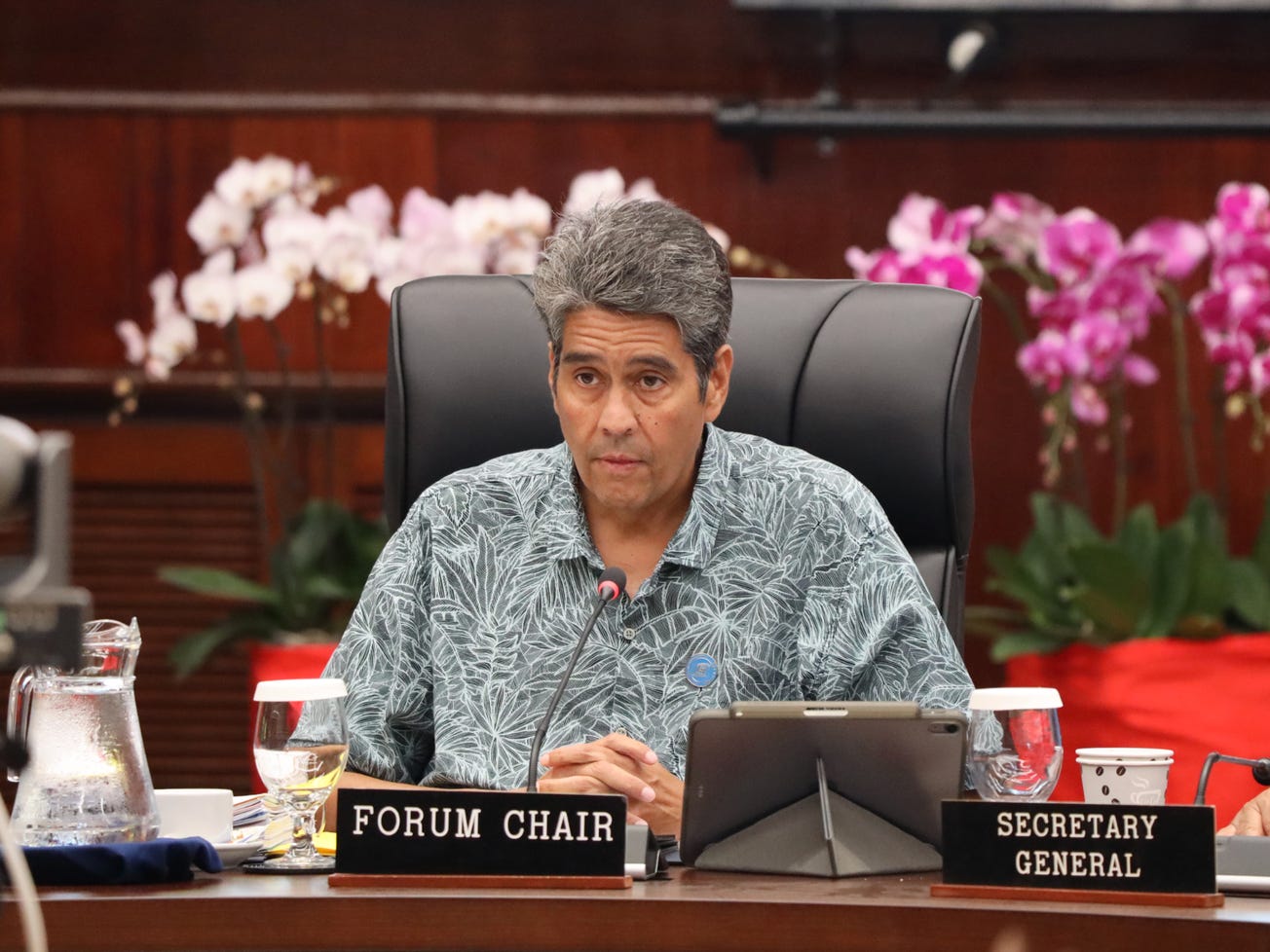
Pacific island nations have spent years pressing for a principle with enormous consequences for their future: rising seas should not shrink their established maritime zones or end their legal existence as nations.
That campaign is receiving renewed attention this week at the Pacific Islands Forum in Palau, where leaders are confronting sea-level rise alongside intensifying competition among larger powers for influence in the region.
Under the U.N. Convention on the Law of the Sea, maritime zones are generally measured from baselines drawn at the low-water line. Exclusive economic zones can extend as far as 200 nautical miles, giving coastal nations rights over fisheries and other natural resources.
But UNCLOS was negotiated without addressing what should happen when climate-driven sea-level rise moves the coastline itself. Pacific governments have been working to settle that question before their geography changes substantially.
In 2021, Pacific Islands Forum leaders declared that maritime zones established in accordance with the Law of the Sea should continue to apply despite climate change-related sea-level rise and should not have to be continually reviewed as coastlines change.
In 2023, they extended their position to statehood, declaring that international law supports a presumption of continuity of statehood and that the sovereignty of Forum members should continue despite the effects of sea-level rise.
A new report by U.N. Secretary-General António Guterres shows how far those positions have moved into international law.
Both the International Law Commission and the International Court of Justice support a presumption that statehood, once established, continues despite the physical loss or degradation of territory, according to the report. Nations and other parties have also called for interpretations of UNCLOS that would preserve established maritime zones and boundaries despite physical changes to coastlines, providing legal certainty and avoiding renewed disputes over maritime areas already settled.
The scientific pressure behind those efforts is accelerating.
Global sea level rose 5.9 millimeters in 2024, a record, after rising an average 4.7 millimeters a year between 2014 and 2023. The Secretary-General’s report says the rate is expected to continue increasing through 2050 because of warming already locked into the climate system.
Nearly 770 million people, or about 10% of the world’s population, live in coastal areas less than five meters above the high-tide line. Rising seas are already increasing coastal flooding, freshwater salinization and erosion and, in extreme cases, could result in permanent loss of land or even the territory of a nation.
Pacific island nations face particularly acute exposure. Relative sea levels in low-lying Pacific small island developing nations have risen more than twice the global average over the past three decades, according to the report. Rising seas and other climate impacts are already forcing relocations in Fiji, Vanuatu and the Solomon Islands.
“Sea level rise is increasingly recognized across intergovernmental processes as a global crisis,” the report says. “Leaders at meetings of the Pacific Islands Forum and the Alliance of Small Island States have repeatedly emphasized the need to scale up international cooperation, protect affected populations, strengthen adaptation finance and safeguard sovereignty, statehood and rights in the face of permanent territorial loss.”
Legal recognition of continuing statehood would not resolve what happens to the people of a country that becomes substantially uninhabitable.
The U.N. report says existing legal frameworks lack clear provisions for relocation caused by sea-level rise, including questions involving nationality, land tenure, compensation, livelihoods, cultural identity and social protections.
Nations could therefore retain their legal existence and maritime rights even while significant portions of their populations live elsewhere.
The legal questions have reached the International Court of Justice, the International Tribunal for the Law of the Sea, the International Law Commission, the U.N. General Assembly’s Sixth Committee and meetings of nations belonging to UNCLOS.
The Secretary-General’s report points to several possible next steps. Some nations have proposed a General Assembly declaration reaffirming relevant principles of international law. Others have suggested an international treaty on sea-level rise or new legal regimes designed to preserve the existence of affected nations.
The report recommends that legal solutions be based on stability, predictability, sovereign equality, self-determination and the protection of affected populations. It also suggests making sea-level rise a standing item on the General Assembly’s agenda.
The debate carries economic and geopolitical consequences because the maritime territory controlled by a Pacific island nation can be vastly larger than its land area.
Exclusive economic zones contain fisheries and other natural resources and cover waters of growing strategic interest to China, the United States and other powers.
That competition has been visible at this week’s Pacific Islands Forum. China warned of unspecified “consequences” over Taiwan’s presence at the meeting, while Australia and New Zealand rejected Beijing’s objections and said the Forum determines who participates. Taiwan attends as a development partner, and Palau, Tuvalu and the Marshall Islands maintain diplomatic relations with Taipei.
The dispute follows the failure of Pacific foreign ministers last month to agree on a collective response to a Chinese missile test in the region.
Palau President Surangel Whipps Jr., who is hosting the Forum, has sought to keep the focus on the region’s own priorities.
“The Pacific is our home,” he said, “not a theater for geopolitical competition.”