

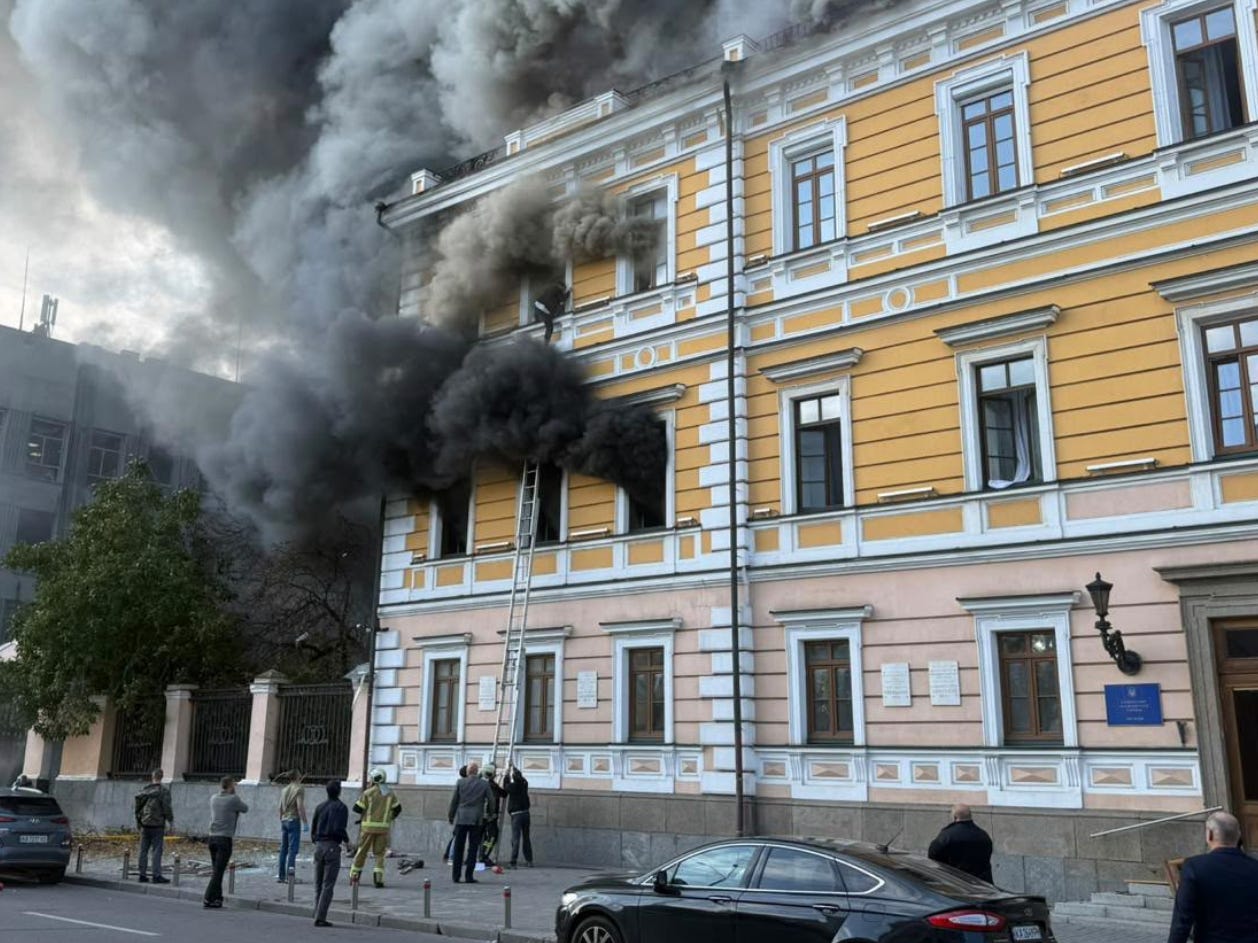
The Russian drone strike that severely damaged the headquarters of the National Academy of Sciences of Ukraine has drawn condemnation from the French government and scientific organizations across Europe, raising fresh concerns about the protection of scientific institutions during armed conflict.
Anatoly Zagorodny, president of the academy, said Tuesday that it had no connection to military activities and described the strike as “an attack on science.”
The academy condemned the attack in unusually stark terms, challenging the idea that scientific cooperation can remain separate from war. “Science has become a target. And the world has seen it,” the academy said. “There can be no ‘science is above politics’ when science is under armed attacks.”
Monday’s attack in Kyiv killed at least two people and injured several others, according to Ukrainian officials and international scientific organizations. Rescue operations continued after the strike amid ongoing aerial threats.
France’s ministers for foreign affairs and for higher education, research and space issued a joint statement condemning the attack and reaffirming their support for Ukraine’s scientific community.
Germany’s National Academy of Sciences Leopoldina expressed solidarity with its Ukrainian counterpart, saying it condemned the attack “in the strongest possible terms.”
“This attack is part of a series of Russian strikes on civilian targets in Ukraine, intended to terrorize the population. Since the start of the war, numerous scientific, university and cultural institutions have been hit by Russian missile and drone attacks,” it said. “Attacks on such institutions are attacks on the foundations of society and constitute a clear violation of international law.”
ALLEA, the European Federation of Academies of Sciences and Humanities, also described the strike as an attack on a place of learning and research.
A Western European science diplomacy official, who was not authorized to speak publicly and requested anonymity because of possible professional repercussions, said the strike is likely to deepen concern about the vulnerability of scientific institutions during war. Attacks on academies, universities and research facilities can damage national research capacity and disrupt the international networks connecting scientists across borders, the official said.
The statements pose a dilemma for a science diplomacy community that often presents scientific cooperation as a way to maintain dialogue during political conflict. Continued engagement may protect researchers, knowledge and communication across borders. But scientific institutions under attack may reject calls to place cooperation above the political and military circumstances threatening their work.
Since Russia’s full-scale invasion began in 2022, universities, laboratories, museums and other institutions of research, education and culture across Ukraine have suffered extensive damage.
Ukraine’s academy has remained involved in international research partnerships throughout the war, working with scientific institutions across Europe and beyond. Governments, academies and research funders have created support programs intended to preserve Ukraine’s research capacity, maintain collaborations and assist displaced scientists.
The Sept. 28 strike has focused attention on scientific institutions not only as centers of research and international exchange, but also as potential targets during war. The academy’s declaration that science can no longer stand “above politics” leaves scientific organizations with a difficult question: What does continued cooperation mean when one national scientific community says it is under attack?