PARIS — Science advisers must earn public trust through credible evidence and transparency while maintaining dialogue across geopolitical divisions, India’s principal scientific adviser told senior government science officials at UNESCO.
Ajay Sood’s appeal on Tuesday came after government advisers split a day earlier over whether scientific cooperation should be restricted as an instrument of geopolitical pressure.
“We have to realize that trust cannot be demanded. It has to be earned through credible evidence, transparency and rule of law,” Sood told the Fourth Chief Science Advisors Roundtable, which drew about 200 officials, academics and other experts in science diplomacy. Advisers do not make government decisions, he said, but should make the process behind them more transparent.
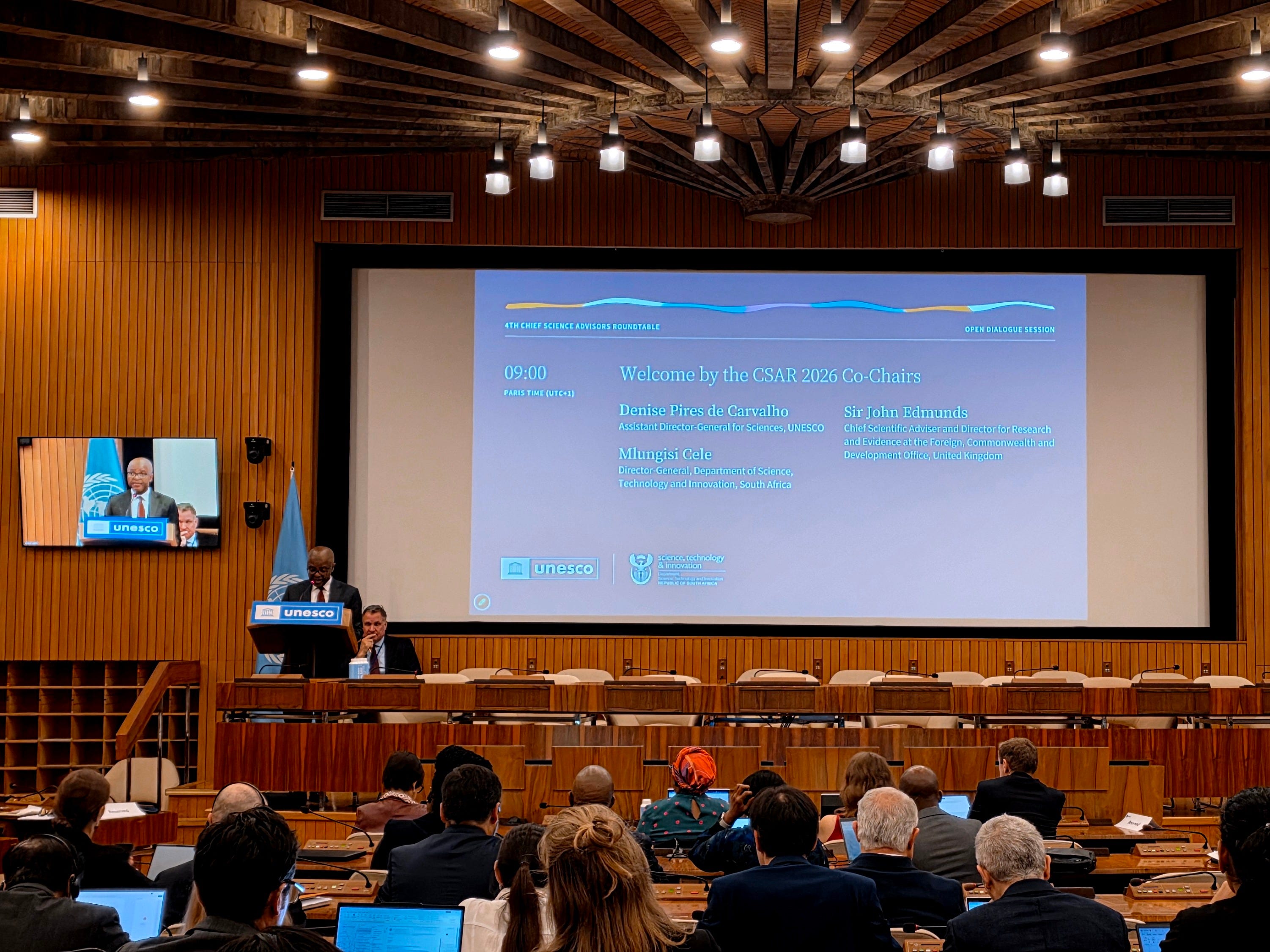
The roundtable, convened by UNESCO and South Africa with support from India, examined how advisers should incorporate different forms of knowledge without weakening scientific standards.
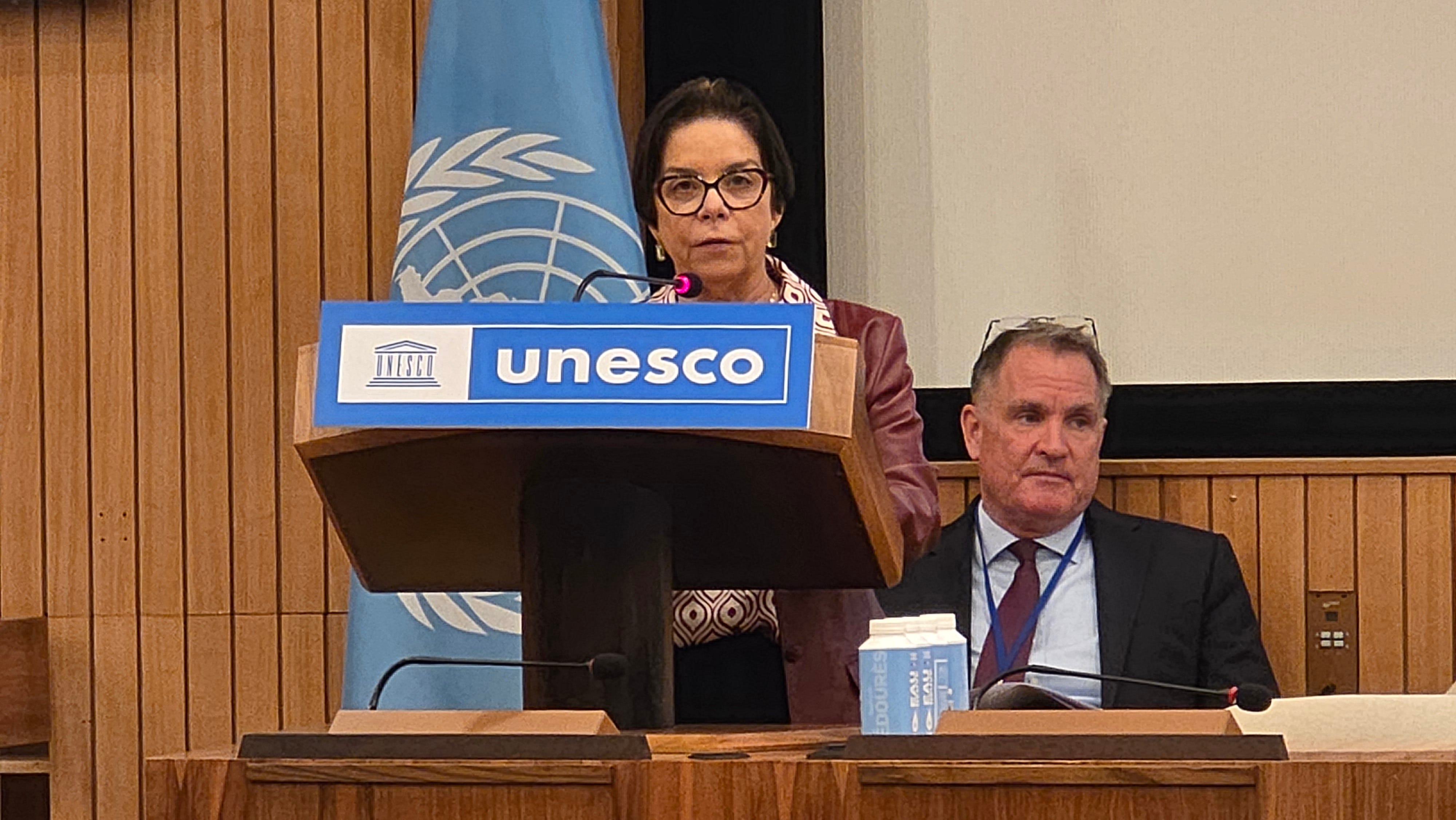
UNESCO Assistant Director-General for Sciences Denise Pires de Carvalho said broader participation brings more disagreement.
“People need to see what is known and what is uncertain,” she said in opening the roundtable. “When artificial intelligence summarizes research for advisers, people also need to know how advisers verified that summary against the original studies.”
Peter-Paul Verbeek, president of the Royal Netherlands Academy of Arts and Sciences, offered an example of how public participation can change expert advice.
During the pandemic, professional ethicists evaluating a contact-tracing application concentrated on protecting individual privacy. Citizens examining the same design wanted to share more information, including their locations and contacts, because they viewed doing so as an act of solidarity.
The contrasting conclusions showed the risk of developing ethical guidance without involving the people who will experience its consequences, he said.
Rémi Quirion, president of the International Network for Governmental Science Advice and former chief scientist of Quebec, said advisers must retain the confidence of elected officials, the scientific community and the public even as governments and their priorities change.
During his time in Quebec, he worked under five premiers from three political parties and dozens of ministers. The first requirement of the job, he said, was resilience.
Elected leaders sometimes accept scientific advice and sometimes choose another course, Quirion said. “As an adviser, you don’t decide anything,” he said.
The job depends on maintaining the trust of elected officials and the scientific community without simply telling political leaders what they want to hear, Quirion said. But trust cannot be limited to relationships inside government.
He proposed including members of the public in future chief science adviser meetings and said scientists need to become more visible outside their institutions.
“If we want to fight successfully against fake news, misinformation and all that, scientists need to be on the streets, in a sense,” he said.
World Health Organization Chief Scientist Sylvie Briand said the agency was launching a global effort that day to strengthen connections among science, policymaking and society.
Together for Science and Health brings more than 240 organizations into a movement focused on public engagement, the use of evidence in health policy and the communication of science.
“If a policymaker or society doesn’t trust evidence, then they won’t trust us on the guidance,” Briand said. Misinformation now spreads through social media faster than scientific evidence, she added.
Sood identified international data sharing as one test of whether advisers can turn those principles into policy. Publicly available internet data has largely been absorbed into existing artificial intelligence systems, he said, leaving personal, institutional and government data increasingly important for further development.
He called for a global framework that would allow countries and institutions to share data for AI without compromising privacy, security or human dignity.
“Unless we have global data sharing, AI will remain confined to a few places, which we may not like,” Sood said.
Mlungisi Cele, director-general of South Africa’s Department of Science, Technology and Innovation, urged the United Kingdom to continue the roundtable when it assumes the G20 presidency in 2027, saying sustained exchanges allow advisers working in different political and institutional systems to learn from one another.
“UNESCO plays a key role in all of this because you provide a neutral platform where these debates can happen, like the ones we had yesterday or are having today,” said Jan Marco Müller, FMSTAN’s chair and the European Commission official responsible for multilateral dialogue and science diplomacy.
Science advisers clash over restrictions on research ties
At the 10th anniversary symposium of the Foreign Ministries Science and Technology Advice Network, known as FMSTAN, officials from Germany and Estonia defended restrictions on institutional cooperation with Russia, arguing that scientific organizations cannot ignore military aggression or allow research partnerships to support repressive governments.
Canada’s chief science adviser, Mona Nemer, strongly objected. “I was actually a bit troubled by the answers of my colleagues,” Nemer told the gathering on Monday.
The panel was asked whether sanctions are a legitimate tool of science diplomacy as governments and universities reconsider international partnerships involving national security, academic freedom and human rights.
Christina Gehlsen, head of international science policy at Germany’s Federal Foreign Office, said scientific institutions cannot remain blind to violations of their fundamental values.
Each institution must consider whether cooperation expands space for academic freedom or begins to support organizations and political systems that repress it, she said.
Gehlsen pointed to German scientific organizations’ decision to suspend institutional cooperation with Russia after its full-scale invasion of Ukraine in February 2022. The decision was made within a day and came from the scientific community rather than being imposed by the federal government, she said.
“This is not something that the federal government did or could have imposed on our science, on our academic community,” Gehlsen said.
She distinguished between institutions and individual scientists who may work under political constraints they did not create. But when asked whether scientific sanctions can be legitimate, her answer was yes.
Imar Koutchoukali, science adviser at Estonia’s Ministry of Foreign Affairs, made a more categorical argument.
Science diplomacy remains a form of diplomacy, he said, and diplomacy is intended to advance national interests. He questioned why restrictions on scientific cooperation should be treated differently from economic sanctions or other diplomatic measures.
“Sanctions absolutely can be effective,” Koutchoukali said. “They are a legitimate tool.”
Science advisers working inside foreign ministries should help determine which restrictions on academic and research cooperation would be most effective, he said.
The positions challenged a longstanding premise of science diplomacy: that scientific relationships can preserve communication when official relations deteriorate.
During the Cold War, researchers continued to cooperate in areas including space, Antarctica and geophysics despite the rivalry between the United States and Soviet Union. But research and technology are increasingly treated as sources of military, economic and geopolitical power.
Australia’s chief scientist, Tony Haymet, said some conduct requires scientific institutions to draw a line. He recalled publishing research with colleagues in Ukraine and said he would not collaborate with institutions connected to a country attacking the places where those scientists work.
“It is a drastic thing to cut off the cooperation between institutions,” Haymet said. “But then there are some things where you just have to draw the line and say no.”
Nemer rejected the comparison between science and other instruments of statecraft.
“When we talk about science the same way we talk about economics or about military procurement, I think we’ve gone a bit too far,” she said.
Universities and scientific networks have traditionally provided places where people could exchange ideas and disagree without ending communication, she said.
“Universities used to be the safe spaces for debate, for disagreeing in a civil manner, for exchanging ideas,” Nemer said. “If we can’t do this on university campuses and throughout scientific networks, where are we going to do it? And the answer is nowhere.”
The disagreement unfolded against another sign of strain on multilateral scientific cooperation. The United States, whose State Department science adviser helped establish FMSTAN, is scheduled to withdraw from UNESCO on Dec. 31 under a decision by the Trump administration.
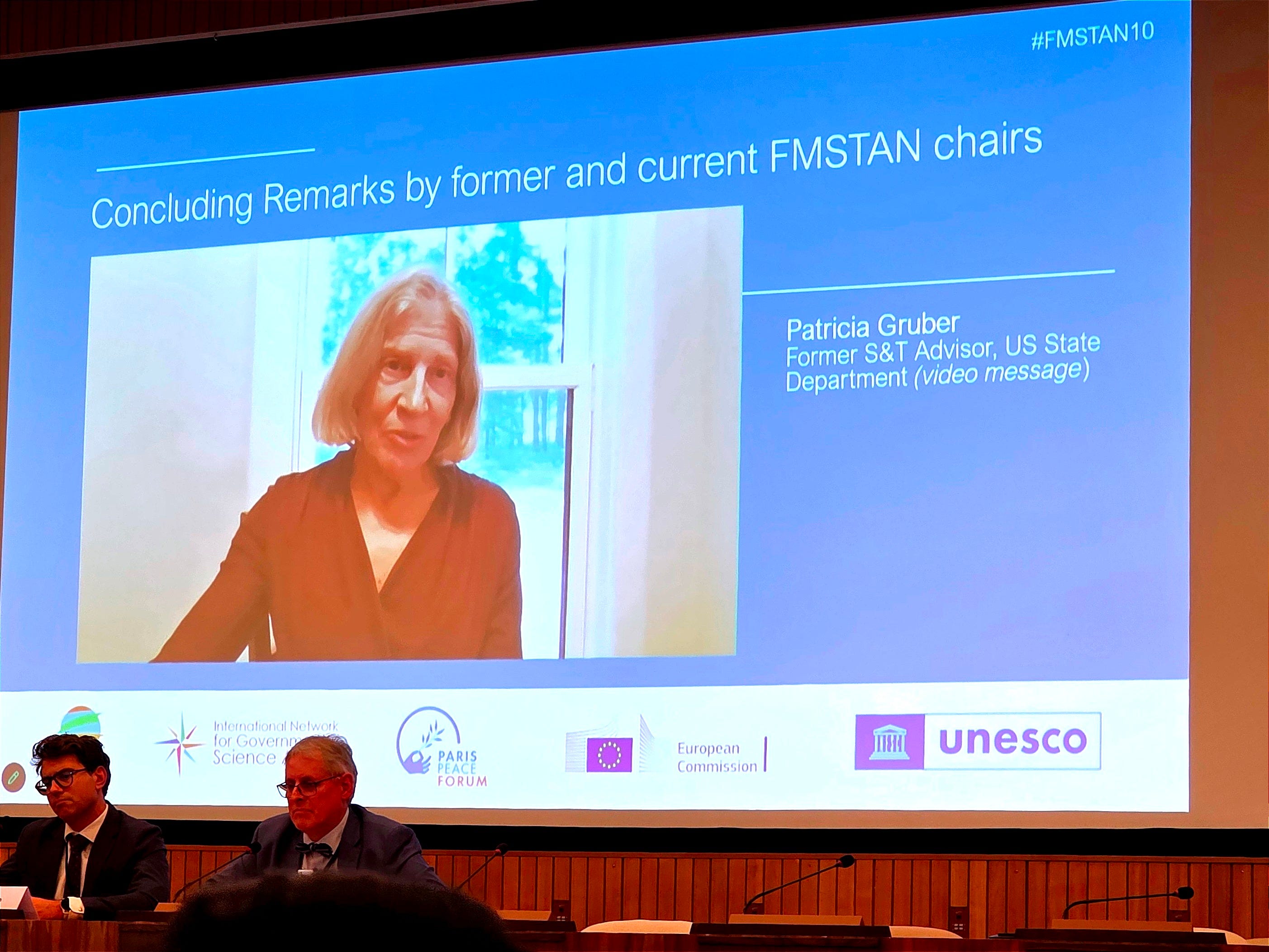
Patricia Gruber, who chaired FMSTAN while serving as science and technology adviser to the U.S. secretary of state during the Biden administration, delivered a brief video message.
“I hope you had the opportunity today to learn from each other,” Gruber said. “Happy anniversary to all of us.”