


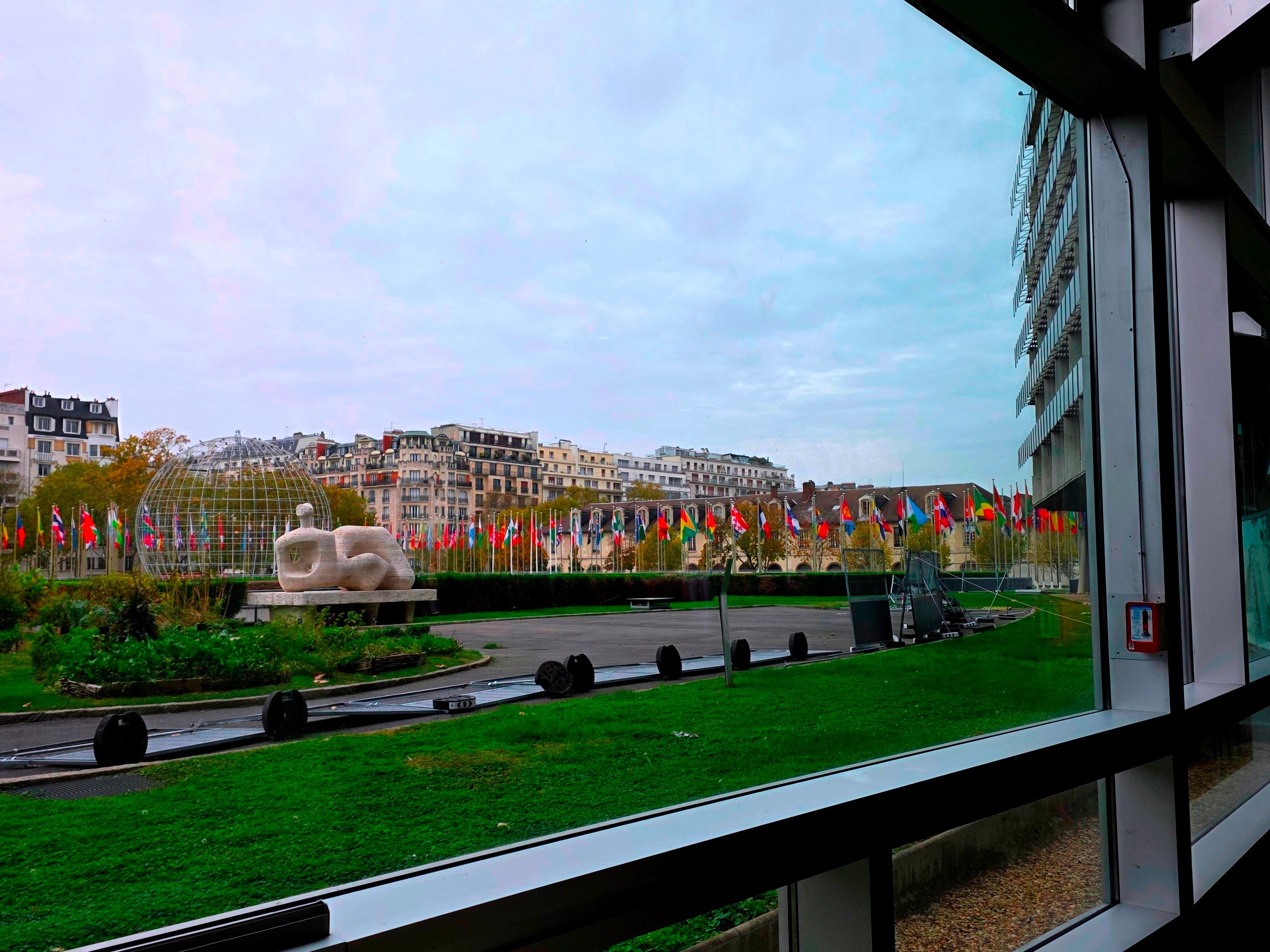
PARIS — Artificial intelligence moved quickly to the center of discussions as science advisers and diplomats gathered at UNESCO to consider how their work has changed over the past decade.
The Foreign Ministries Science & Technology Advice Network marked its 10th anniversary on Monday amid concern that emerging technologies are advancing faster than governments’ ability to understand or govern them.
Sir Peter Gluckman, who recently stepped down as president of the International Science Council and formerly served as New Zealand’s chief science adviser, described the United States and China as emerging “AI empires” in an increasingly multipolar and unstable international system.
Scientific cooperation has also become more transactional as governments place greater emphasis on national security, economic advantage and technological competition, he said.
Robin Grimes, a former chief scientific adviser in the United Kingdom’s Foreign, Commonwealth and Development Office, began his remarks by acknowledging the subject dominating the room.
“I’m going to get on to AI, obviously,” he said. “Who isn’t today?”
Grimes described AI, machine learning and robotics as “the elephant in the room.” Their rapid development, particularly for military and security applications, places growing demands on advisers expected to explain technologies and anticipate their consequences.
“The pace of development feels like it’s accelerating,” he said.
FMSTAN was created in 2016 by four government science advisers. It has since grown to more than 40 members worldwide, reflecting the increasing attention diplomatic services give to science and technology.
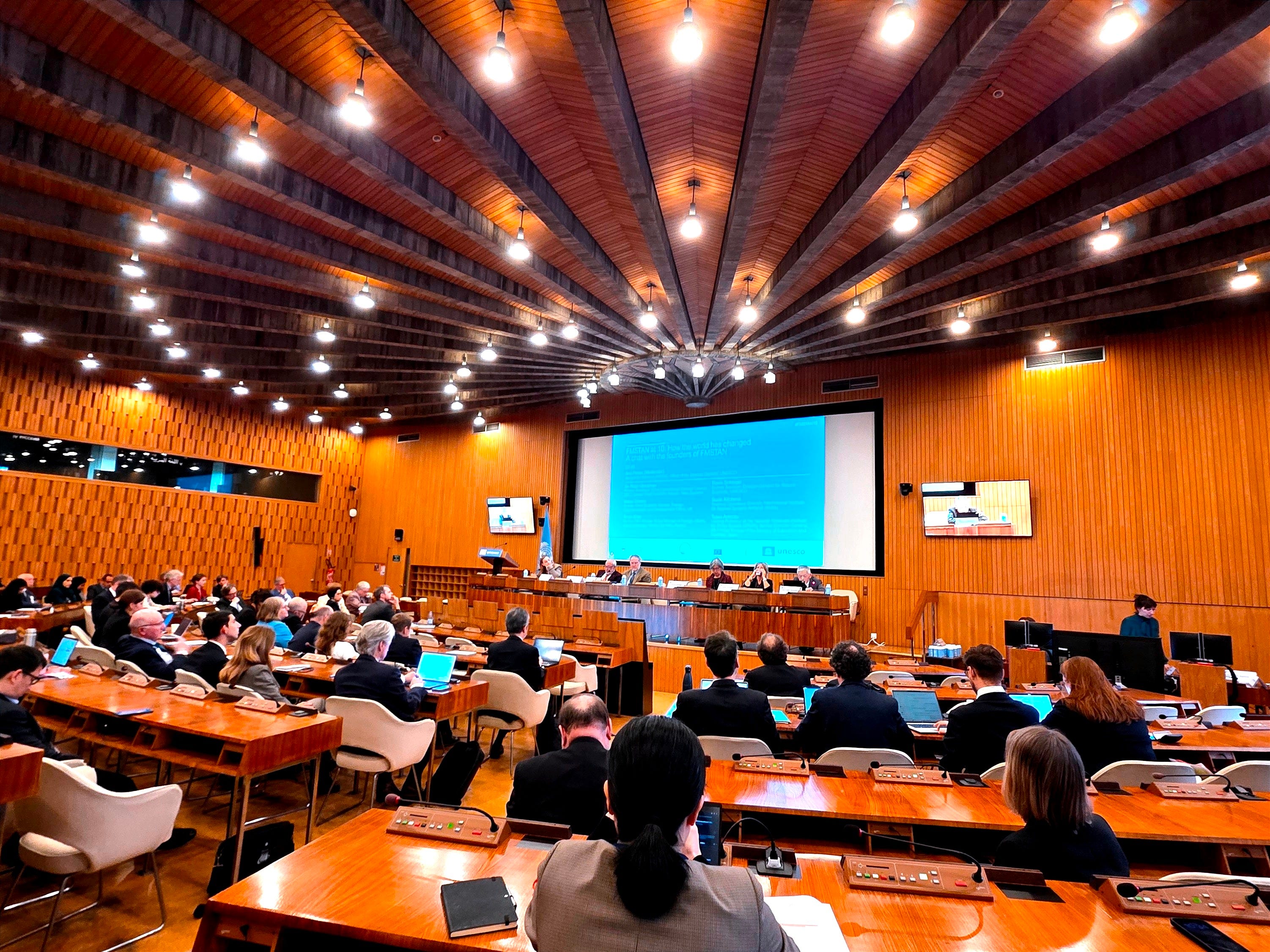
The anniversary symposium, held as a side event of the Paris Peace Forum, brought together science advisers, diplomats, researchers and representatives of international organizations.
Jan Marco Müller, FMSTAN’s chair and the European Commission official responsible for multilateral dialogue and science diplomacy, said the network gives advisers a place to exchange information and discuss common problems informally.
When it was created, governments had recently adopted the Sustainable Development Goals and the Paris climate agreement, and multilateral cooperation enjoyed broader political support, he said. Since then, mistrust, geopolitical competition and attacks on scientific institutions have made the network more important.
Research and innovation have become “powerful pieces on the geopolitical chessboard,” Müller said.
Ana Persic, an adviser for sciences and the Intergovernmental Oceanographic Commission at UNESCO, recalled the negotiations surrounding the major international agreements of 2015.
“It was really the moment where it was very clear that science was critical for these diplomatic negotiations,” she said.
FMSTAN was established the following year as governments increasingly recognized the need for scientific advice and stronger connections among advisers.
‘Overwhelmed’ by AI
Grimes said governments have often struggled to recognize the significance of technologies until their consequences become clear.
Transformer architecture, introduced in 2017, made possible many of the large language models now in widespread use. Its potential implications received little attention outside specialist communities at the time, he said.
The difficulty extends beyond individual technologies. Advances in computing, robotics, sensors, materials and energy systems can combine to produce capabilities governments did not anticipate. Drones provide one example of how several technologies can converge and rapidly alter security conditions.
“It feels like the amount we have to do is increasing really quite remarkably,” Grimes said.
Flavia Schlegel, a former UNESCO assistant director-general for natural sciences, said governments and scientific institutions had underestimated how quickly the environment would change.
She described the United States, where she once worked, as a country destroying its science sector with “a chainsaw-method killing machine.”
The speed of AI development and its convergence with synthetic biology and other fields had “overwhelmed us,” she said.
Schlegel said science diplomacy must now give greater attention to “sovereignty, security and solidarity.”
Digital sovereignty raises questions about who owns data centers, controls information and determines where data can move. At the same time, research partnerships are increasingly viewed through a security lens.
National governments, she said, are struggling to regulate technologies whose infrastructure and influence extend across borders.
The growing power of private companies further complicates that task.
Gluckman pointed to “the rise of the private company” as a major change in science diplomacy and a development “we’ve not yet worked out” how to manage.
Platform companies control essential infrastructure and exert growing influence over global affairs, while several governments now maintain diplomatic representation in Silicon Valley, he said.
Susie Kitchens, science diplomacy director at the International Institute for Applied Systems Analysis and a former British diplomat, warned that the focus on competition and emerging technology could deepen existing inequalities.
Science diplomacy had “slightly taken our eye off the ball” on global equity, she said.
Countries and regions without access to advanced computing, research infrastructure and investment risk falling further behind. Partnerships should therefore involve local design, investment and skills rather than researchers or programs being brought in temporarily from abroad, she said.
“We really face an increasing divide now around the haves and the have-nots in high-tech science,” Kitchens said.
The changes have not removed the importance of national interests from diplomacy.
“At the end of the day, all diplomacy is about advancing the national interest,” Gluckman said.
Science advisers must work within those interests while showing governments where international cooperation can also benefit them, he said.
That approach may be necessary as scientific organizations try to maintain international relationships during conflict and geopolitical competition. But it also places pressure on advisers to explain who benefits from cooperation, who controls its infrastructure and how security concerns affect the exchange of knowledge.
“Although trust in science among most people is high, it is fragile,” Gluckman said.