

Scientific organizations are advising governments and participating in international policy debates, but most have not built the staffing, budgets or institutional structures needed to sustain that work, according to an International Science Council report.
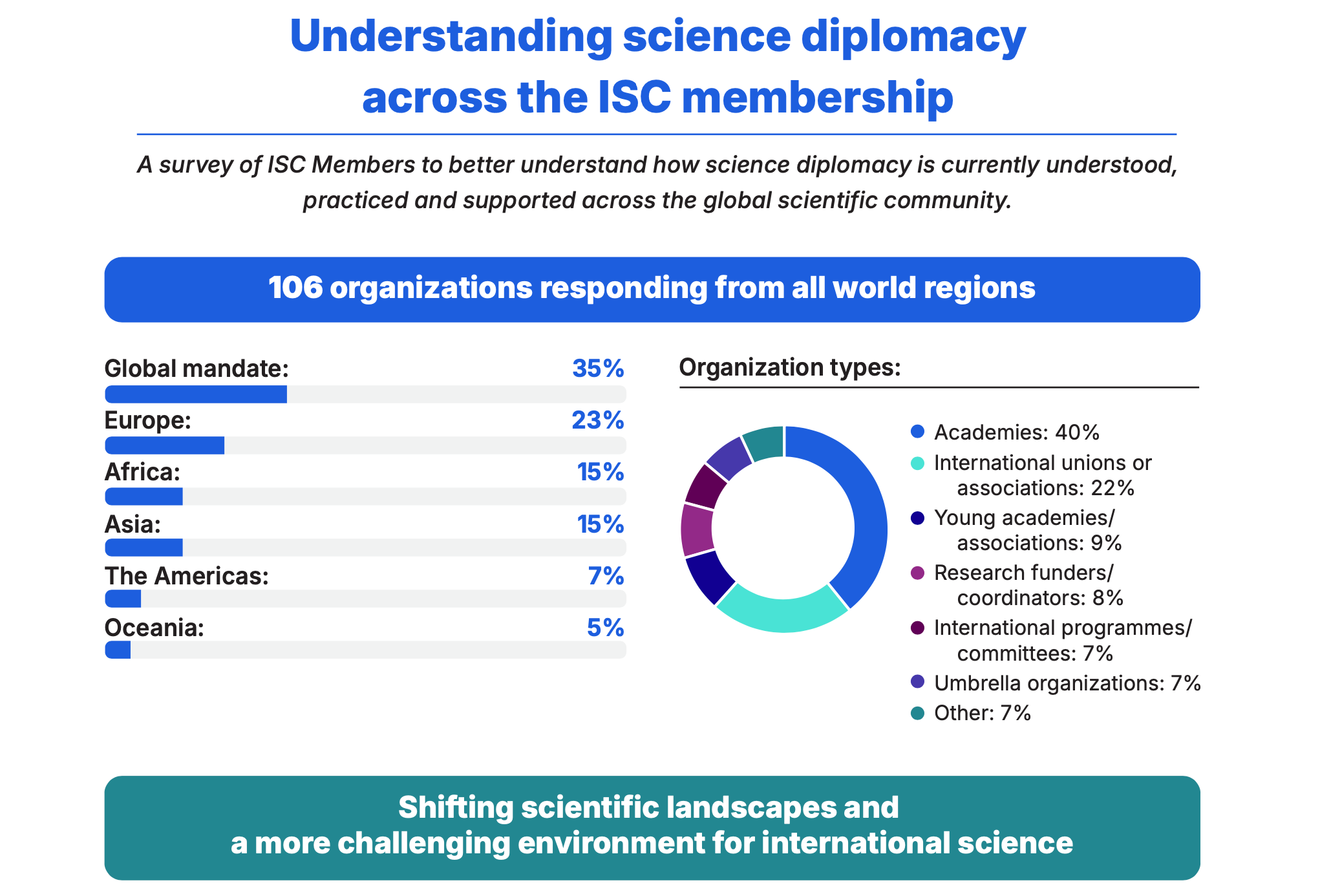
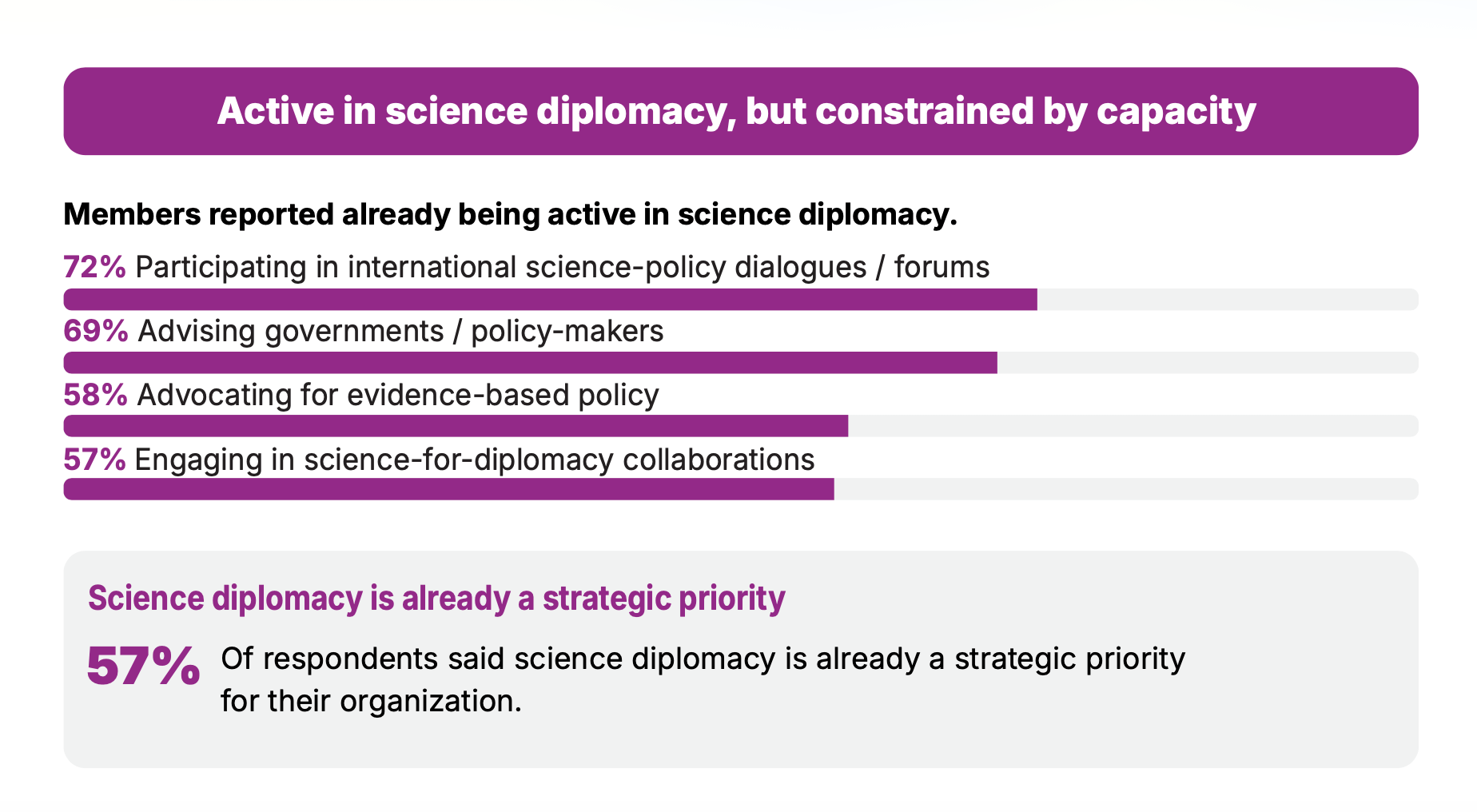
Fifty-seven percent of the 106 ISC members surveyed described science diplomacy as a strategic priority. Yet 63% had no dedicated unit, officer or team, and only 30% reported having a specific budget for the work.
The findings suggest the main obstacle is finding the money, staff and expertise needed to turn interest in science diplomacy into a sustained institutional practice.
“Science diplomacy is not an end in itself. It is a means of protecting and advancing the conditions in which science can contribute to the common good — and in which societies can work together to address challenges that no country can meet alone,” ISC’s CEO Salvatore Aricò and Policy Director Anne-Sophie Stevance wrote in the report.
Seventy-seven percent of respondents cited inadequate funding as a constraint and 73% reported insufficient staff. Half said they lacked expertise, while 44% pointed to the absence of an institutional strategy or mandate.
By comparison, 36% said they lacked sufficient access to diplomats or policymakers, making it the least frequently cited obstacle. The report examines how academies, scientific unions, research councils and other organizations contribute to international cooperation and global governance.
The survey reached about 42% of the ISC’s membership. Forty percent of respondents were academies, while international scientific unions and associations accounted for 22%. Other participants included young academies, research funders, international scientific programs and umbrella organizations.
Active but unevenly organized
Many respondents already perform work that the ISC identifies as science diplomacy, even when they lack a dedicated structure for it.
Seventy-two percent participate in international science and policy dialogues, 69% advise governments on international issues and 58% advocate for evidence-informed policy. Fifty-seven percent reported using scientific collaboration to support international relationships.
Organizations with dedicated science diplomacy capacity reported carrying out 1.7 times as many related activities as those without it.
But only 24% of respondents had established a formal science diplomacy structure. Another 13% relied on alternative arrangements. In many organizations, the responsibility was folded into the portfolios of senior leaders or policy departments, or carried by individual advisers and volunteers.
The strongest institutional capacity was reported among national academies, research councils and similar organizations. Fifty-eight percent of respondents in that category had staff whose role involved science diplomacy, and 42% had a dedicated budget.
International scientific unions and associations reported considerably less capacity, despite operating across national borders and often maintaining relationships with international organizations.
Geopolitical pressures
The capacity gap is emerging as scientific organizations face a more difficult international environment.
Thirty-one percent of respondents pointed to great-power rivalry, technological competition and the treatment of science as a security concern as having the greatest effect on their work. Twenty-one percent cited rising nationalism and the retreat from multilateralism and international aid, while 20% pointed to armed conflicts and heightened tensions.
Research security restrictions, sanctions, funding cuts and political pressure have complicated international cooperation. At the same time, governments view scientific knowledge, advanced technology and research infrastructure as sources of strategic and economic power.
The report argues that nongovernmental scientific organizations can operate across those divisions by providing technical expertise, maintaining professional networks and creating informal channels for dialogue when official relations are strained.
It cites scientific cooperation in Antarctica, global climate assessments, chemical weapons governance, space research and support for displaced scientists as examples of work that has influenced international institutions or continued across political divides.
The ISC defines nongovernmental scientific organizations broadly. The category includes independent scientific unions and associations as well as national academies and research councils that may have legal or financial ties to governments but retain authority over their scientific judgments and activities.
That independence, the report argues, allows such organizations to provide trusted expertise and convene researchers from countries whose governments may be unable or unwilling to cooperate directly.
“You need organizations such as the ISC to be there and recall the fundamentals or be the guardian, so to speak, of global science in times of competition and fragmentation,” Laurent Bochereau, a European Union science counselor to the African Union, said in the report.
Public engagement trails policy access
The survey also identified areas receiving considerably less attention.
Only 42% of respondents said they worked to promote public awareness of science diplomacy. Forty percent advised scientists on geopolitical risks, and 39% contributed to science diplomacy training or capacity building.
Those findings suggest that organizations have concentrated more heavily on participating in policy discussions and advising governments than on helping researchers navigate the consequences of geopolitical competition or explaining science diplomacy beyond specialist communities.
The report calls on scientific organizations to protect international cooperation, develop more equitable partnerships, strengthen scientific advice, invest in shared infrastructure and expand science diplomacy capacity. It also urges governments, international organizations and philanthropic funders to support those efforts.
Khotso Mokhele, an ISC fellow, described the global scientific community itself as a resource for diplomacy: “No other form of diplomacy has the benefit of a global community out there that works with the same principles and the scientific method.”