Before It Was a Strategy, Science Was Already Diplomatic
Part 1 of a two-part field note on how science diplomacy evolved before it had a name — and why that history matters now.

In August 1955, scientists from East and West gathered in Geneva for the first Atoms for Peace conference. The Cold War was entrenched. Nuclear weapons defined global power.
Yet physicists from rival blocs sat in the same hall exchanging data about reactor design, radiation measurement, and atomic theory. They may not have called it science diplomacy, but that is what it was.
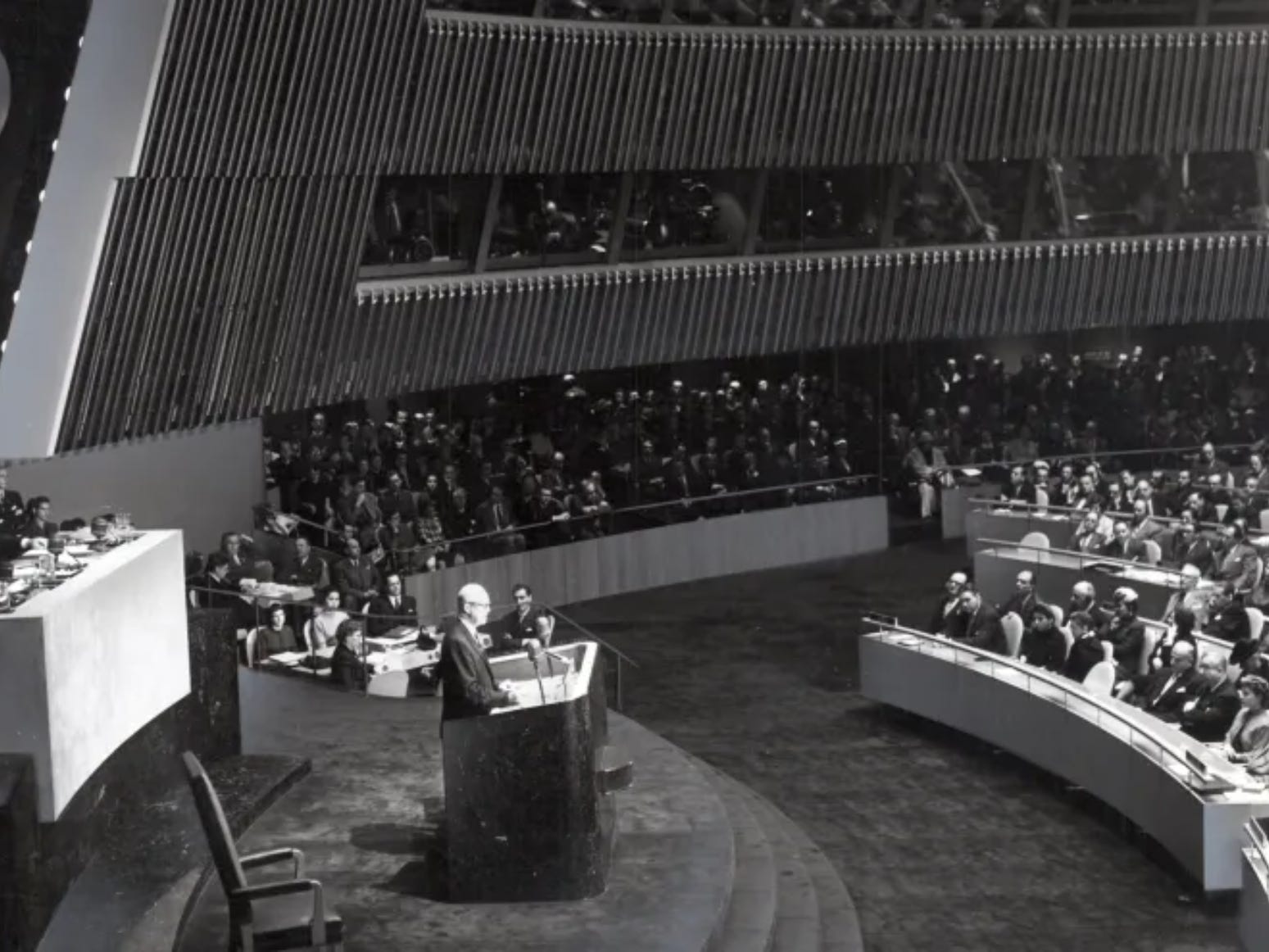
In December 1953, U.S. President Dwight D. Eisenhower addressed the United Nations and proposed “Atoms for Peace,” arguing that “the miraculous inventiveness of man shall not be dedicated to his death, but consecrated to his life.”
The speech was both strategic and idealistic, acknowledging nuclear danger while proposing scientific cooperation as partial antidote. What followed reflected an insistence on discipline more than harmony.
Science diplomacy during the Cold War was about containment of risk, escalation and misunderstanding. Scientific exchange functioned as a controlled channel of communication between rival blocs. It allowed limited transparency without requiring political alignment. The restraint was deliberate. Science could cross borders precisely because it did not pretend to dissolve them.
The idea that science diplomacy began in 2010 — when the American Association for the Advancement of Science and the Royal Society published their influential report defining “science in diplomacy,” “diplomacy for science,” and “science for diplomacy” — obscures a much longer history.
By the time that framework appeared, scientific knowledge had already shaped relations among nations for centuries. Long before the label, there was the practice.
In the seventeenth and eighteenth centuries, scholars exchanged manuscripts and observations across borders that were politically hostile but intellectually porous. Astronomers compared measurements from different latitudes to refine navigation. Physicians shared accounts of epidemics that ignored territorial sovereignty. These networks — often described as the Republic of Letters — created shared reference points that no single court or crown controlled.
Science was transnational before diplomacy learned to manage it.
The nineteenth century formalized that reality. International commissions were established to regulate rivers, telegraphs, postal systems, and standards of measurement. Coordination was practical. Railway gauges had to align. Telegraph codes had to interoperate. Cholera outbreaks demanded shared reporting systems.
What bound these efforts together was measurement: Shared standards reduced friction where politics alone could not.
Scientific collaboration between the United States and Cuba illustrates how technical cooperation can persist even amid political rupture. Institutional ties date back to the mid-19th century, including specimen exchanges beginning in 1857 between the American Museum of Natural History and Cuban researchers. In 1900, the U.S. Army Yellow Fever Commission worked with Cuban scientist Carlos Finlay to confirm mosquitoes as the vector for yellow fever, reshaping global public health.
Even after formal diplomatic relations were severed in 1961, scientific engagement continued through nongovernmental channels and federal licensing. Organizations such as AAAS facilitated joint research in hurricane tracking, marine biology, and biotechnology. The pattern is consistent: technical exchange can endure where formal diplomacy freezes.
Science also operated in less benign contexts. Imperial expeditions mapped territories, catalogued resources, and gathered medical intelligence that enabled extraction and administration. Knowledge consolidated power. Yet even in asymmetrical settings, scientific data often outlasted empires, becoming part of global baselines later generations inherited.
The moral dimension of science as a diplomatic channel emerged most clearly in humanitarian medicine. The founding of the International Committee of the Red Cross in 1863 embedded medical expertise within wartime conduct. Scientific knowledge created minimal spaces of cooperation in contexts otherwise defined by violence. Wounded soldiers were patients before they were combatants. Disease was indiscriminate.
Science constrained brutality by authority grounded in method. That logic hardened under existential threat.
On August 5, 1963, the United States, the Soviet Union, and the United Kingdom signed the Partial Test Ban Treaty in Moscow. The treaty prohibited nuclear tests in the atmosphere, outer space, and underwater. Its viability depended on verification. Atmospheric radionuclides could be measured. Seismic disturbances could be detected. Compliance could be inferred from physics.
Scientific method imposed discipline where diplomacy alone would have faltered. This was the Cold War’s discipline of restraint. Scientific cooperation made rivalry survivable.
Seismic monitoring networks, satellite observation, and inspection protocols created shared baselines. Data could be contested; if it was fabricated, that could have consequence. Verification anchored fragile agreements in measurable reality.
Scientific institutions built in this era reflected that logic. CERN, founded in 1954, was part of postwar Europe’s reconstruction. Cooperation was intentional. Shared infrastructure signaled that knowledge production could bind former adversaries.
Swiss writer and cultural theorist Denis de Rougemont, who directed the Centre Européen de la Culture, saw that linkage clearly. “I understood,” he wrote, “that one should absolutely link the ideas of a European union and of control of nuclear energy: two things that in this particular moment were as striking in their novelty as in their mutual utility.”
None of this was described as science diplomacy at the time. The term had not yet crystallized. But the essential pattern was clear: scientific knowledge became diplomatically consequential when it created reference points political systems could not ignore. By the late twentieth century, the driver began to change.
As nuclear confrontation receded and globalization accelerated, the central scientific risks confronting countries became increasingly transnational. Ozone depletion, climate change, biodiversity loss, and emerging infectious diseases did not respect ideological blocs. The logic shifted from deterrence to interdependence.
The Cold War had demonstrated that scientific cooperation could function under pressure — bounded, technical, and insulated enough to survive ideological division. What changed after 1990 was the scope of science diplomacy; the discipline of restraint would give way to something broader and less contained.
Next: When science stopped merely managing danger and began structuring globalization itself.

