Science Diplomacy Is No Longer Just About Cooperation, E.U. Official Says
The European Commission official who drafted the new E.U. science diplomacy framework says the field is becoming a strategic tool for sovereignty, security and foreign policy.

Science diplomacy is no longer only about keeping channels open between researchers across borders. In Europe, it is becoming a strategic instrument of foreign policy. That shift is central to the European Union’s new Framework for Science Diplomacy, according to Jan Marco Müller, the European Commission official who helped draft it.
“Science diplomacy is not about being nice to each other,” Müller said in an interview on The Science Diplomat podcast. “Yes, the building bridges and keeping channels open is, and continues to be, an important part of science diplomacy. But science diplomacy is also about defending your interests or defending sovereignty. It is about your values.”
Müller, team leader for Global Approach, Multilateral Dialogue and Science Diplomacy at the European Commission’s Directorate-General for Research and Innovation, said the challenge was to define science diplomacy for a world that has changed since the field’s most widely cited formulation more than a decade ago.
Many practitioners still refer to the 2010 definition developed by the American Association for the Advancement of Science and the Royal Society, which distinguished between science in diplomacy, diplomacy for science, and science for diplomacy. Müller said that framework was “designed for a world that doesn’t exist anymore.”
“Today’s world is different, where we see a lot of trust being eroded between nations, where we see groundbreaking technology driving international relations,” he said. “And this, of course, has changed also science diplomacy and what is regarded as science diplomacy.”
The European Commission proposal, Müller said, required a more operational definition because it is intended to function as a policy instrument. It defines science diplomacy as “the direct or indirect use of science, scientific evidence, scientific cooperation, to support diplomatic objectives at different levels — so global, European, national — as well as deployment of diplomacy to support scientific progress.”
“What you very clearly see there, it’s defined as an instrument in the diplomatic toolkit,” he said. “And it serves the diplomatic purposes, first and foremost.”
This framing reflects a broader shift in Europe’s approach to research and international relations. The framework is being developed at a time of war in Europe, strategic competition over emerging technologies, strained multilateral institutions and new constraints on scientific cooperation. “In fact, it has to be a strategic tool, otherwise there’s no point in doing it,” Müller said.
He pointed to sanctions, institutional restrictions and decisions by universities about whether to cooperate with partners in countries involved in conflict as evidence that science is already operating inside geopolitical constraints. “It is not just in the diplomatic sphere, but also in the scientific sphere,” he said.
For Müller, that is precisely why scientists need to be part of diplomatic discussions rather than remain outside them, he said, “because otherwise the decisions will be taken without you.”
Scientists and diplomats in the same room
The process of drafting the framework exposed one of science diplomacy’s core tensions: scientists and diplomats do not necessarily begin from the same assumptions.
“For diplomats, it’s the E.U. 27, the common foreign security policy,” Müller said. “For scientists, it’s the European Research Area, with everybody between Iceland and Israel.”
That mismatch affected not only institutional boundaries but language itself. Müller noted that English treats “science diplomacy” as two nouns, while French renders the phrase as diplomatie scientifique, a noun and adjective — a distinction that can carry different implications. “Just by translation, you get already a different notion into it,” he said.
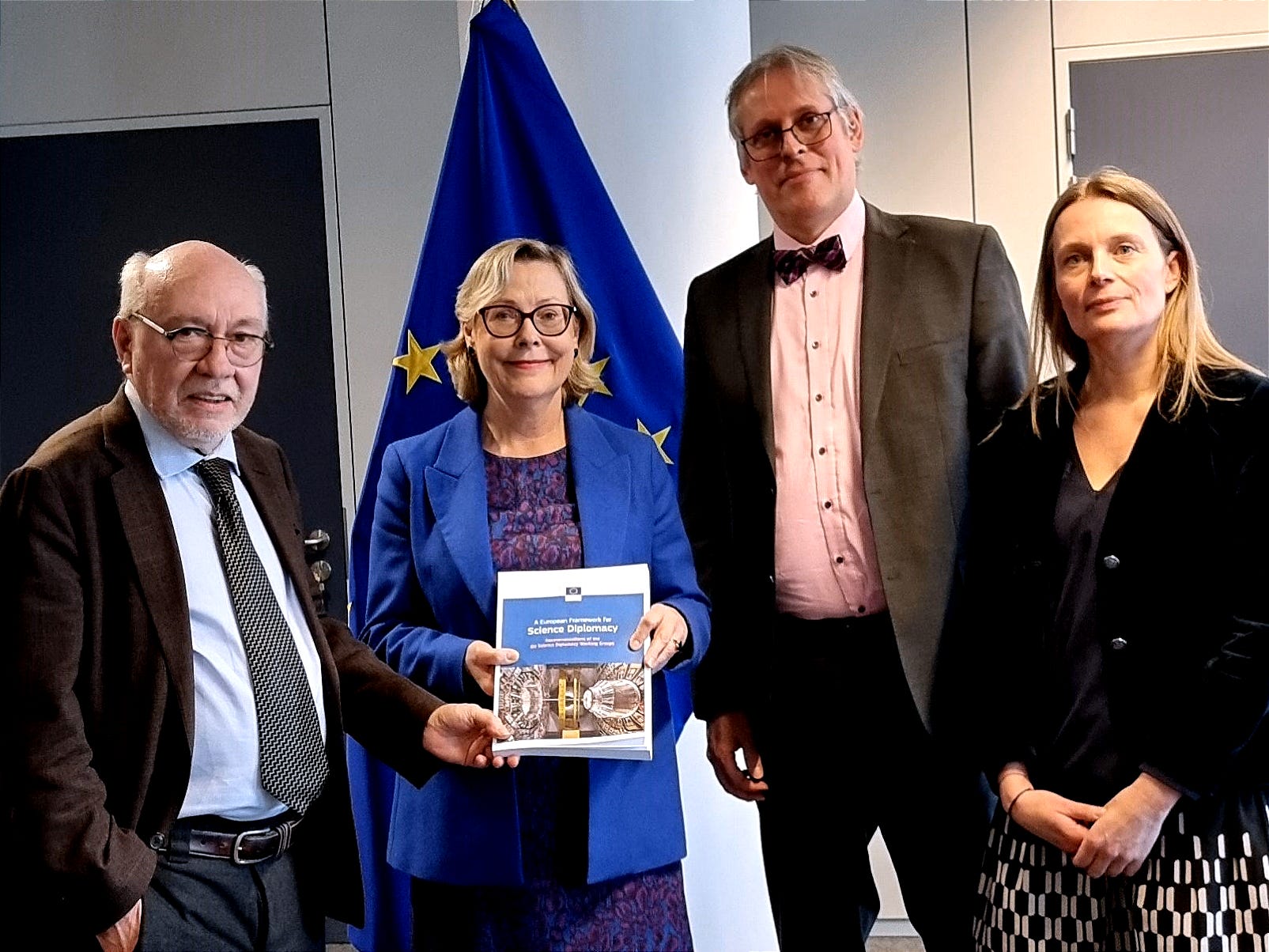
To avoid producing a framework owned by only one community, the Commission organized working groups through an open call, bringing scientists and diplomats together as experts rather than national representatives. Each group was co-chaired by a scientist and a diplomat, with roughly equal representation from both communities.
“The diplomats were missing at the table,” Müller said, describing earlier science diplomacy discussions. “So actually, we need to force the two camps to come in equal numbers together, and then we basically locked them into a room and told them, please talk to each other, understand each other.”
The result was an expert report that informed the Commission’s legal proposal. For Müller, the process mattered as much as the document. “I always said much more important than the end result was actually the process. It was getting the scientists and diplomats into a room to talk to each other.”
The proposal now moves through the Council of the European Union. Müller said a Council recommendation was chosen because foreign and security policy remain national competences, and member countries must own the framework.
“It’s forward looking. But I think that as we are evolving, we need to get all the member states on the same page,” he said. Although non-binding, the recommendation would become part of the body of European soft law if adopted by the Council.

Science diplomacy beyond Europe
The changing context has expanded science diplomacy beyond traditional environmental or technical domains. Müller said science and technology now increasingly affect trade, security, standards and foreign policy.
“Science has a lot to do with trade. And an actual lot of disagreements on trade issues are around food safety standards, environmental standards, or very technical issues,” which, he said, means a need for science and technology to be “permeating” more areas of foreign and security policy.
The shift is also visible beyond Europe. “The Global South actually has developed very strongly in the area of science diplomacy,” he said. “And actually, many countries in the South see science diplomacy as a way to leverage their geopolitical influence.”
He cited Costa Rica, India, Rwanda and South Africa as examples of countries investing in the field. That wider participation creates opportunities, he said, but also raises questions about values, equity and the risk of Eurocentrism.
At the same time, he defended academic freedom and the scientific method as universal values rather than Western preferences. “It’s universal values of science,” he said. “And in a way, I see here the European Union as the custodian of the legacy of the Enlightenment, if I may put it like this.”
The interview also returned to a familiar dilemma in science advice: evidence can be clear and still fail to determine policy outcomes. Müller pointed to global negotiations over plastic pollution as a current example.
“I think the evidence is clear, everybody knows, plastics harm marine ecosystems, harm marine organisms, harm marine livelihoods of fishermen,” he said. “The evidence is very clear. Still it is painstakingly difficult to come to some global agreement on plastics pollution in the ocean.”
The problem, he said, is not lack of evidence alone, but the collision of evidence with economic interests and national positions. “At the end of the day, we should always be clear it’s diplomats who negotiate international agreements, not scientists,” he said. “But they will depend on us and the evidence they deliver.”
Müller argued that science has improved its handling of uncertainty, pointing to the Intergovernmental Panel on Climate Change as an example of how evidence can be communicated using degrees of confidence. But scientific evidence is “increasingly being regarded as a partisan issue, and scientific evidence being seen as an opinion,” he warned. “And that’s, I think, the real challenge in science advice and science diplomacy right now.”
His advice to scientists was blunt: do not spend time trying to persuade political leaders who are committed to rejecting evidence. “Don’t waste your time with lunatic politicians,” Müller said. “Spend your time with the people who vote for them. They are the ones you need to convince.”
That means scientists must communicate not only through facts, but through empathy and public engagement, he said. “We are scientists, we talk, we are rational. We talk from brain to brain. And the populist politicians, they talk to gut feelings. They talk from gut to gut.”
Science, he said, must find ways to speak to public concerns without abandoning evidence. “Nobody forbids us to talk to people’s hearts, to win people’s hearts, to show empathy for public concerns,” he said. For Müller, the broader stakes extend beyond science. Diplomacy itself, he argued, is also under pressure.
“If you do foreign policy by launching missiles, or by launching social media posts in capital letters, you don’t need diplomats anymore,” he said. That creates a possible common cause between scientific and diplomatic communities.
“The scientists and diplomats can actually be allies, because we both have an interest that the rules-based international order is working,” Müller said. “So I think there is common ground for both camps to come together and work together for a better world.”

