
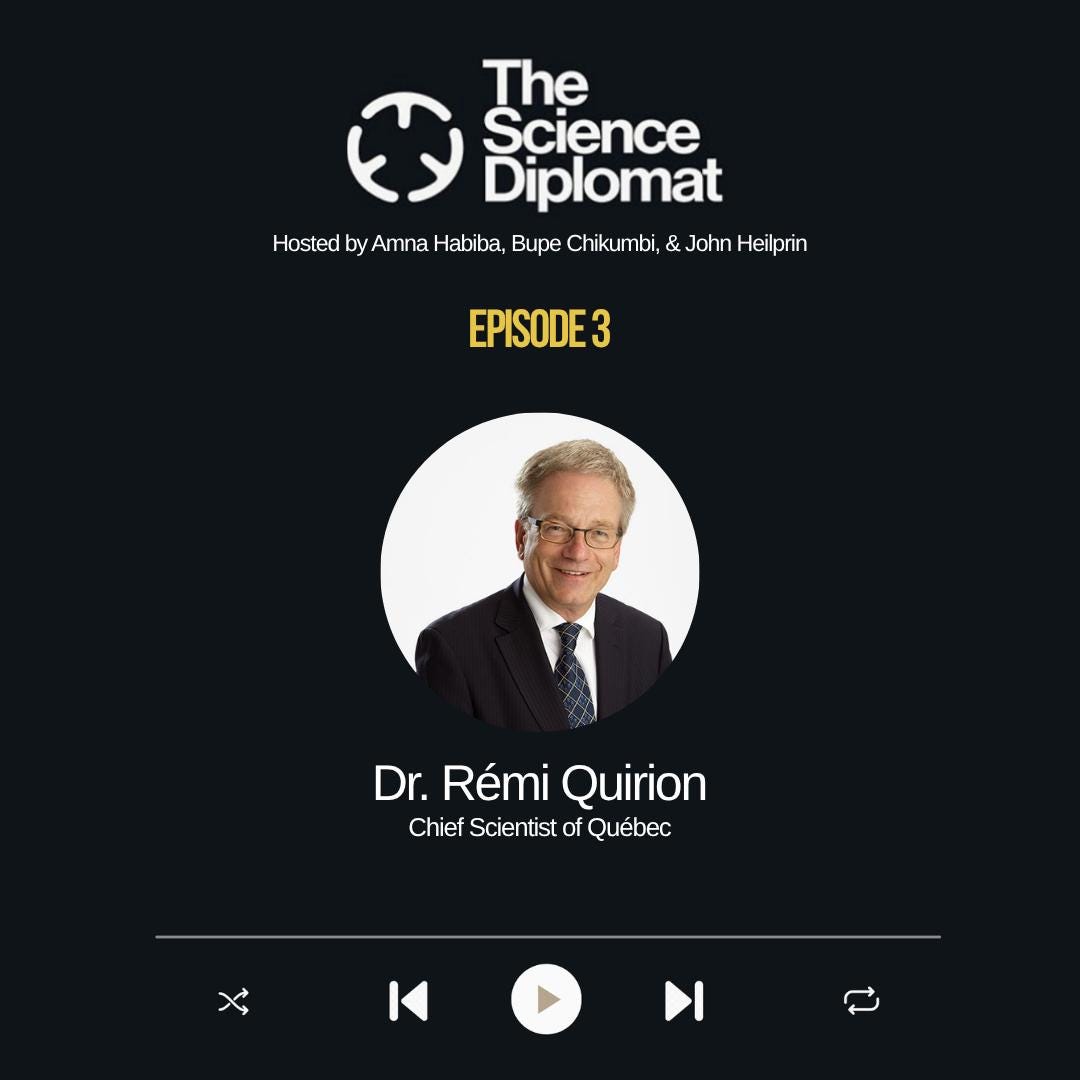
S1E3: Rémi Quirion on science advice, trust, and building systems that last
Scientific advice is often described as a bridge between knowledge and policy. In practice, it depends on networks of institutions, funding structures, and relationships that must be built and maintained over time.
In this conversation, Rémi Quirion, Québec’s chief scientist, head of the Fonds de recherche du Québec (FRQ), and president of the International Network for Governmental Science Advice (INGSA), reflects on what it takes to construct those systems and make them function under political pressure.
Drawing on his experience in government and a career in neuroscience, Quirion describes science advice not as a single intervention but as a continuous process of translation, repetition, and trust-building. Scientific evidence, he emphasizes, does not determine decisions; it informs choices made by elected officials balancing competing priorities. Maintaining credibility in that environment requires clarity about what is known, what is uncertain, and where evidence remains incomplete.
The discussion returns repeatedly to the role of trust — between scientists and policymakers, across institutions, and within international collaborations. That trust, Quirion argues, cannot be assumed. It must be established through consistency, independence, and an ability to adapt to different political and cultural contexts.
The conversation also examines structural features of Québec’s model, including the institutional independence of the chief scientist role and its integration with research funding through the FRQ. That dual position, Quirion suggests, enables both strategic coordination and rapid response, particularly during crises such as the COVID-19 pandemic.
Beyond the national level, Quirion reflects on the expansion of science advice systems globally through INGSA, now spanning more than 130 countries. He highlights the absence of a single model, noting that effective systems must be adapted to local conditions rather than exported wholesale. Efforts to build capacity, particularly in the Global South, are framed less as transfer than as partnership.
The episode also addresses mounting pressures on scientific collaboration, including geopolitical fragmentation, shifting U.S. engagement in research, and the need to build new partnerships across regions. In that context, Quirion positions science diplomacy as a practical mechanism for sustaining cooperation where traditional diplomatic channels are under strain.
Finally, the conversation turns to technological change, including the growing role of artificial intelligence in shaping how advice is generated and used. While acknowledging its potential, Quirion cautions against overreliance on algorithmic outputs, emphasizing the continued importance of human judgment, institutional context, and ethics in decision-making.
Themes covered:
Science advice as institutional infrastructure
Trust, credibility, and repetition in policymaking
The boundary between scientific evidence and political decision-making
Designing and sustaining science advice systems
Global variation in science advice and capacity-building
Science diplomacy under geopolitical strain
Artificial intelligence and the future of scientific advice
Recorded on April 6, 2026.
Co-hosted by Amna Habiba, Bupe Chikumbi and John Heilprin.