

Opening the doors of an international research facility does not necessarily make it accessible to scientists working through war, damaged laboratories and restrictions on movement.
That gap emerged at SESAME, the Middle East’s regional synchrotron facility in Jordan, where researchers and officials examined how shared scientific infrastructure can sustain cooperation across political divisions.
“Access is not about opening a physical or a virtual door,” Kherieh Rassas, president of the Union of Mediterranean Universities, told the gathering on Wednesday.
Researchers seeking time at facilities such as SESAME generally need preliminary data and prepared samples before their proposals can be evaluated. But scientists in conflict zones may lack functioning laboratories, equipment, reliable electricity and internet connections. They can also struggle to obtain travel permits or move samples across borders.
Rassas described those disadvantages as a “pre-access deficit” that can exclude researchers before they submit an application.
She proposed sample-shipping arrangements, remote data collection, assistance with research proposals and small grants for equipment needed to characterize samples before they reach a major facility. SESAME could also consider expedited assessments or dedicated access opportunities for researchers working under crisis conditions, she said.
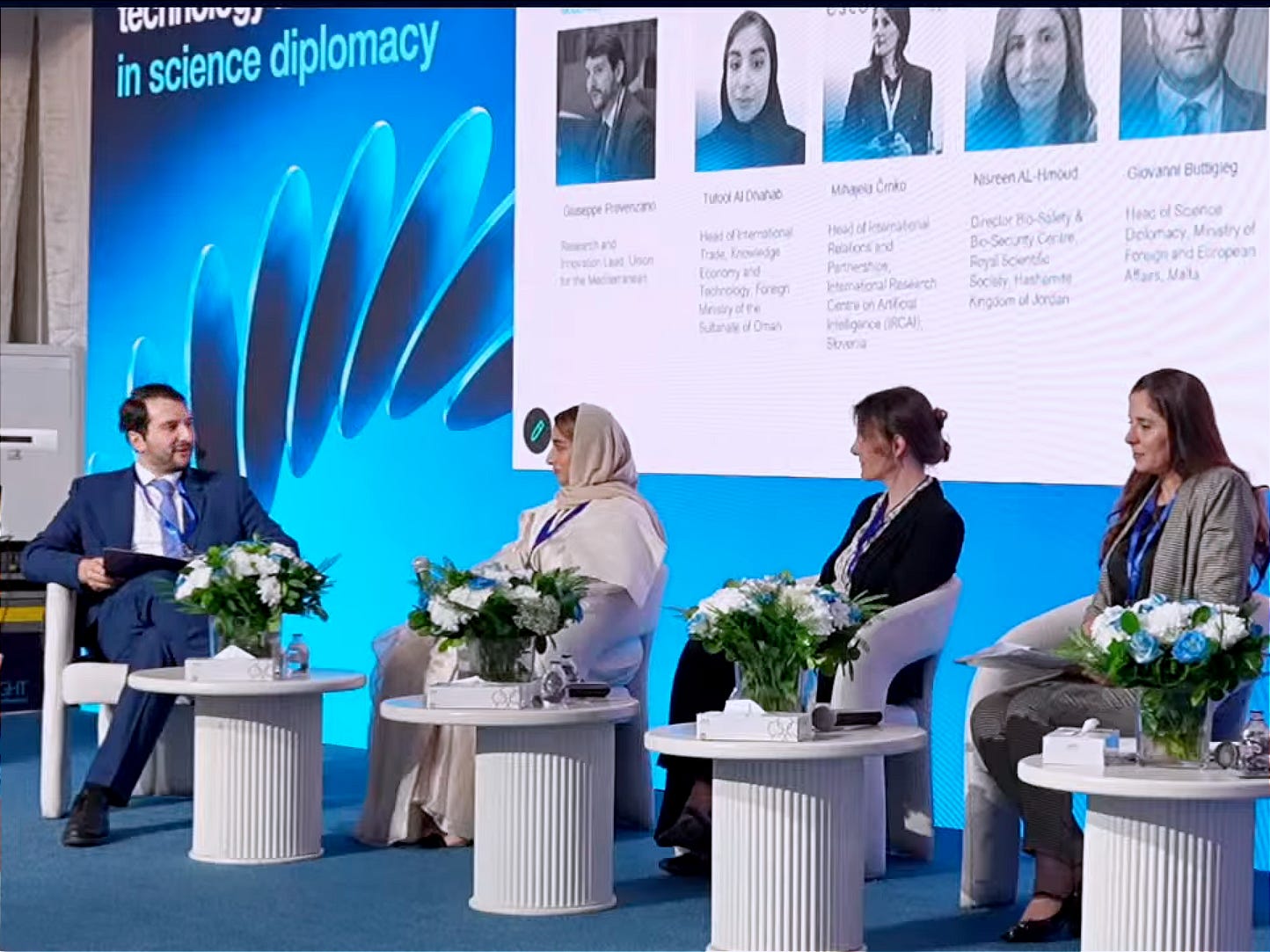
The discussion formed part of a symposium on the role of research and technology infrastructure in science diplomacy, organized at SESAME with the European Commission, UNESCO and the Union for the Mediterranean.
Jan Marco Müller, who leads the European Commission’s work on multilateral dialogue and science diplomacy, described SESAME as “living and thriving against all odds.”
The gathering included participants from countries separated by war, diplomatic rupture and longstanding political conflict. Speakers from Israel and Syria joined some sessions online, while Palestinian, Lebanese, Jordanian and other regional researchers and officials participated at the facility.
Several resisted portraying scientific cooperation as a substitute for political diplomacy.
“Science does not eliminate differences between countries or the different interests they pursue,” said Shani Edri, director of international relations at Israel’s Ministry of Innovation, Science and Technology. “What it can do is create a space for a shared goal, help build connections and enable cooperation to continue despite the disagreements.”
SESAME, formally the Synchrotron-light for Experimental Science and Applications in the Middle East, was established as a regional research center modeled partly on CERN. Its synchrotron allows researchers to use intense beams of light to study materials in fields including biology, medicine, physics, chemistry, archaeology and environmental science.
Unlike a temporary research project, a facility of that scale depends on long-term investment, governance and relationships among participating countries.
Robbert Dijkgraaf, president of the International Science Council, said such infrastructure requires governments and scientists to plan across decades rather than political terms.
“The fact that you plan and that you create also the governance structure around that creates a kind of stability and a way to think and collaborate that I think is absolutely unique,” he said.
But maintaining an institution does not ensure equal participation in its research.
Rassas pointed to H-Gaza, a virtual collaboration program connecting researchers in Gaza and members of its scientific diaspora with counterparts, principally in Europe. The program received 388 applications despite airstrikes, electricity failures and disrupted communications. It selected 76 researchers for its first group.
Remote participation alone does not remove the barriers, she said. Researchers may still be unable to ship samples, obtain permits or maintain the connections needed to work with laboratories elsewhere.
Scientists in Syria face related problems after years of isolation and depleted research capacity.
Mustafa Saem El Daher, president of Damascus University, said much of the country’s research is conducted by small groups working with limited infrastructure. Access to SESAME could expose young Syrian researchers to advanced equipment, international collaborators and scientific practices that are difficult to sustain at home.
He proposed formal arrangements for beam time, short research visits, technical workshops and training in sample preparation, instrumentation and data processing. Damascus is about 200 kilometers from SESAME, he said, making short visits feasible if institutional arrangements and travel conditions permit them.
Other participants described how local scientific capacity can help researchers cross the threshold into a major international facility.
At the Cyprus Institute, the BioMERA platform allows researchers to conduct preliminary imaging and chemical analysis before applying to use SESAME. Anis Fatima, a researcher at the institute, said training, preliminary experiments and outreach to universities and industry helped produce new research proposals for SESAME beamlines.
The facility has also provided an entry into international science for young Palestinian researchers.
Ahmed Bassalat of An-Najah National University recalled bringing three female students, then about 21 years old, to work at SESAME. He said the experience was their first sustained contact with the international research community and required them to cross difficult borders. The three later advanced into research positions in Germany and France.
Those experiences show why access involves more than allocating time on an instrument. Researchers need preparation, mentoring, mobility and institutions capable of supporting them before and after an experiment.
Abdelhamid El-Zoheiry, co-chair of the Partnership for Research and Innovation in the Mediterranean Area, said scientific institutions must be protected from political upheaval through durable financial, legal and governance arrangements.
“We all know that projects end with a cycle of three to four years,” he said. “But investing in networks of cooperating researchers and scientists and policymakers outlives the project timeline and also builds a community of trust.”
Putting the proposals into practice would require decisions about eligibility, financing, sample transport, remote operations and partnerships with universities and donors.
For Rassas, those practical arrangements determine whether an international facility offers meaningful participation or access principally in name.
“Access is not the starting point of cooperation,” she said, “but co-design, inclusion and shared responsibility are what make cooperation sustainable.”