

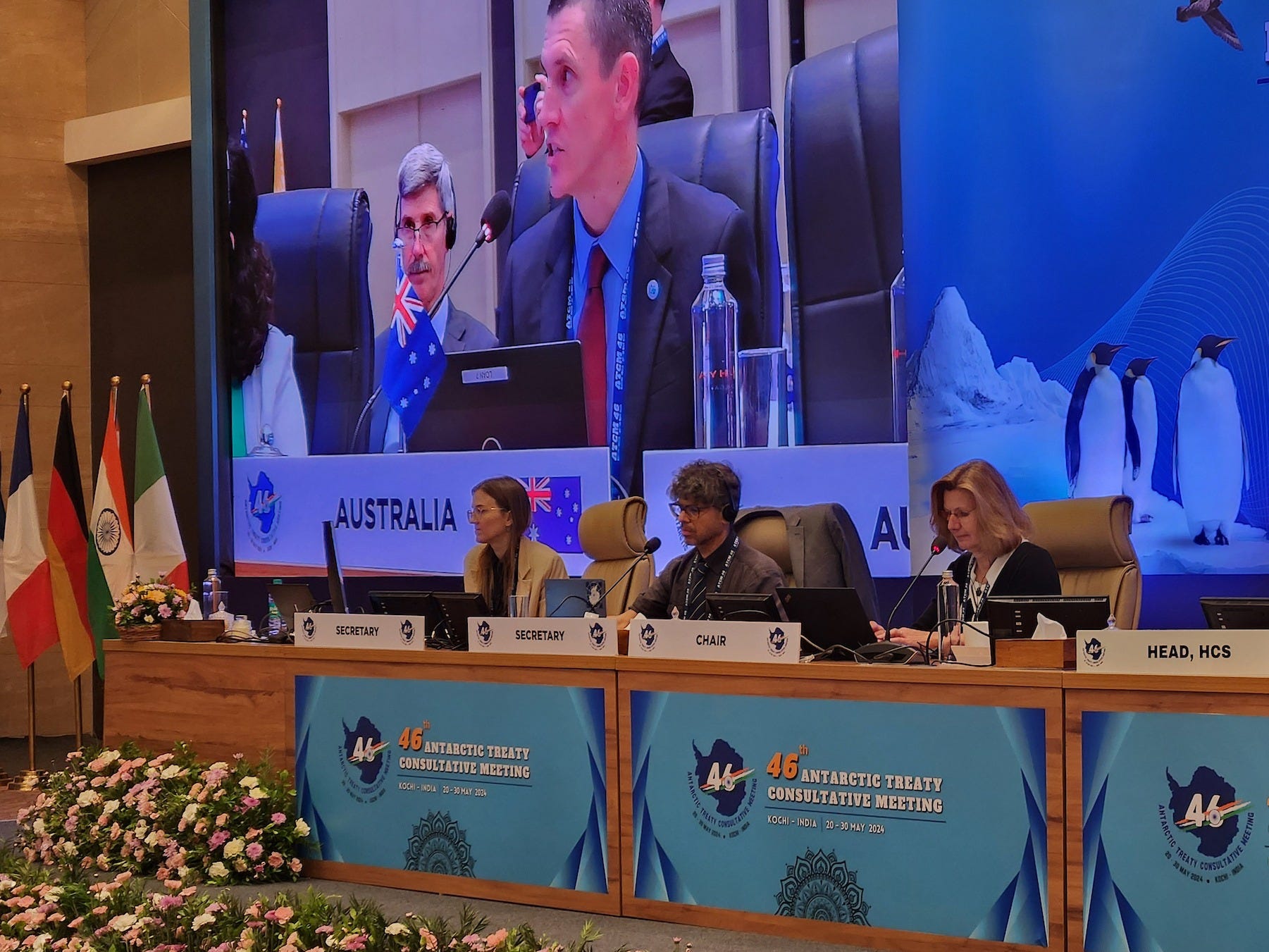
When delegates gathered in Hiroshima for the 48th Antarctic Treaty Consultative Meeting in May, one issue concerned applications from Canada, Belarus, and Turkey for Consultative Party status. All three were already parties to the Antarctic Treaty. The question was whether they had demonstrated sufficient scientific activity in Antarctica to qualify for a different role within the system.
The distinction is easy to overlook. The Antarctic Treaty has 58 parties, but only 29 “consultative parties” who can participate directly in the treaty’s decision-making process. Others can attend meetings and participate in discussions but do not occupy the same position. Scientific activity serves as one of the criteria for moving from one category to another.
The arrangement reflects a feature of international institutions that often receives less attention than budgets, voting procedures, or geopolitics. Participation is rarely a simple matter of being present or absent. Most institutions create different categories of participants, each carrying different rights, responsibilities, and expectations.
The Arctic Council provides another example. Its members are the eight countries that border the Arctic, yet membership is only one part of its structure. Six Indigenous organizations are considered “permanent participants” with consultation rights built into the institution itself.
Other countries, including China, participate as “observers.” China has invested heavily in Arctic research and diplomacy and has held observer status since 2013, but observer status is not membership. The council recognizes different kinds of relationships to the Arctic and assigns different forms of participation accordingly.
The International Seabed Authority approaches the issue differently. Created under the U.N. Convention on the Law of the Sea to govern mineral resources beyond national jurisdiction, the authority is often described as administering part of the “common heritage of mankind.” The phrase suggests universal ownership. The institution itself is more structured.
Governments participate as members. Mining companies participate through contracts and sponsoring countries. Scientific experts contribute assessments. Environmental organizations advocate for conservation and precaution. They do not enter the process in the same way or exercise the same functions.
In the Antarctic Treaty system, scientific activity can elevate a country’s standing. In the International Seabed Authority, participation is organized around legal relationships: membership, sponsorship, contracting, expertise, and observation. The sorting happens before any negotiation begins.
Space governance presents a different challenge. The United Nations Committee on the Peaceful Uses of Outer Space brings together more than 100 countries to discuss the legal, technical, and policy dimensions of space activities. Yet not all participants arrive with the same relationship to space.
Some operate launch vehicles, satellite constellations, or planetary missions. Others are building their first space agencies or developing their first satellites. The Philippines recently described signing the Artemis Accords and joining additional international initiatives as part of its effort to become a more active stakeholder in global space governance.
At the same time, Philippine officials emphasized the importance of ensuring that developing countries are not only present in discussions but able to participate meaningfully and share in the benefits of emerging space activities.
That concern extends beyond any single country. U.N. Office for Outer Space Affairs Director Aarti Holla-Maini has warned against the assumption that space governance belongs only to nations with satellites or space agencies.
“Many countries around the world do not have the capacity to do this kind of work,” Holla-Maini said. A “critical mass” of countries, she argued, remains outside meaningful participation in discussions that affect the future of space activities.
Large scientific enterprises create their own categories. Recent decisions surrounding participation by Russia and Belarus at CERN highlighted questions that usually remain in the background. The CERN Council decided to conclude its cooperation agreements with Russian and Belarusian institutions in 2024 following Russia’s invasion of Ukraine.
Scientific cooperation is often presented as borderless, yet even highly international research institutions depend on rules governing membership, association, collaboration, and access. CERN noted that while institutional relationships would end, relations could continue with individual scientists of Russian or Belarusian nationality affiliated through other organizations.
For scientists entering such systems, those distinctions are often encountered long before they become visible from the outside. CERN physicist Archana Sharma has described arriving at the laboratory as entering “a structure which has its own rhythm and its own norms and hierarchies.” Participation, she noted in an interview, involves learning how decisions are made, how credibility is established, and how influence is earned within an existing system.
The answers vary from one institution to another. Geography matters in the Arctic Council. Scientific activity matters in the Antarctic Treaty system. Legal standing matters in the International Seabed Authority. Capability shapes participation in space governance. Membership and institutional affiliation matter at CERN.
What unites these systems is that participation is rarely treated as a single status. Institutions create categories: members, observers, consultative parties, non-consultative parties, permanent participants and sponsoring countries. Each category reflects a judgment about who belongs and what role they are expected to play.
The result is that participation often begins long before anyone enters a meeting room. By the time discussions start, institutions have already decided not only who can participate, but what kind of participant they will be.