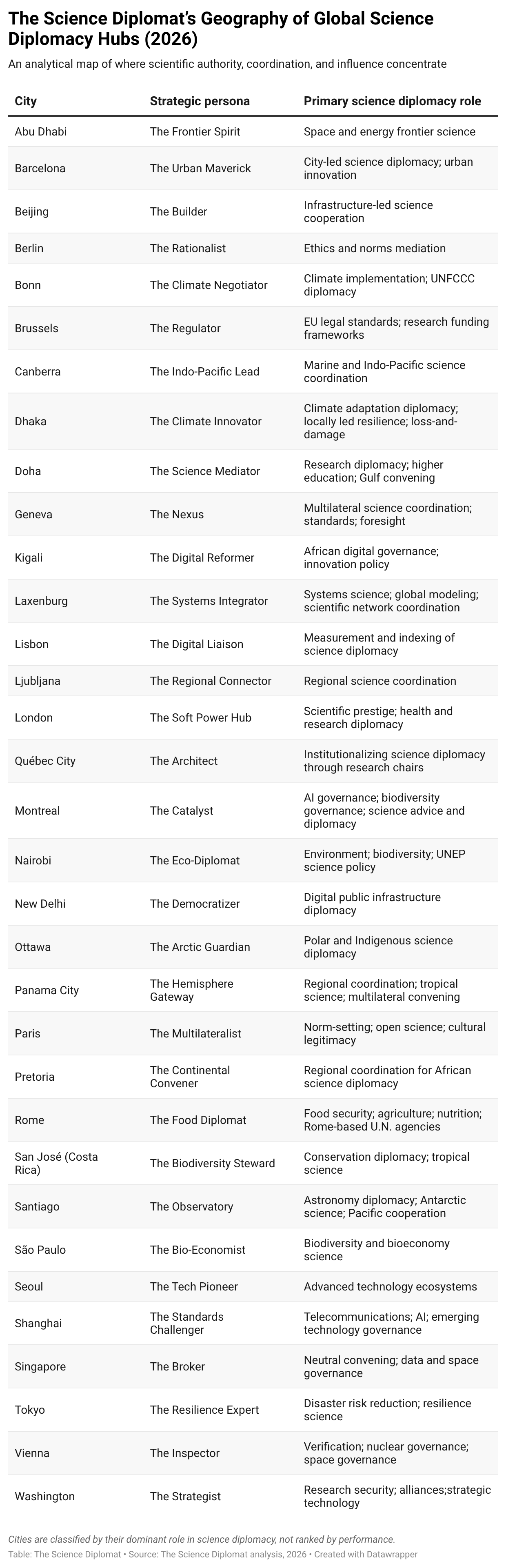
Open any atlas and science diplomacy is invisible. Unlike political, economic or military charts, the new science diplomacy map would reveal the places where scientific authority, technical expertise and diplomatic networks are concentrated.
The modern concept was developed through work led by the American Association for the Advancement of Science in Washington and the Royal Society in London. Over time, other cities have become important hubs where governments convene scientists and diplomats, negotiate agreements and assess emerging technologies.
Still other cities serve more specialized roles as regional gateways or bridges between governments, universities and industry, creating a landscape of expertise and interests that looks very different from a map of political power.
The International Institute for Applied Systems Analysis offers one example. Headquartered in Laxenburg outside Vienna, IIASA joins member organizations from Europe, North America, Asia, Africa and the Middle East. Its influence derives more from the global scientific network it organizes than from Austria’s diplomatic weight.
Institutional geography can change when authority moves between organizations.
Earlier this year, the European Commission began transferring the secretariat of a multilateral dialogue on international research cooperation to the International Science Council, shifting the initiative from a Europe-led process to an organization representing over 250 scientific unions, associations and national academies.
The agreement was signed in Brussels, but the stated aim was to expand participation across Africa, Latin America and Asia and move beyond mainly European frameworks.
“Modern science is not Western science. It’s global science,” the ISC’s then-president, Sir Peter Gluckman, said. The transfer illustrates how a hub can retain convening power while ceding some control to a more geographically distributed network.
Geneva concentrates international organizations for global health, telecommunications, meteorology, intellectual property, trade and disaster risk reduction. Brussels is a center for regulatory science through the European Union.
Pretoria hosts the Science Diplomacy Capital for Africa, which promotes cross-border scientific collaboration for the continent. Brando Okolo, who leads science, technology and innovation work at the African Union, points to another advantage: Pretoria combines a relatively mature scientific environment with an unusually dense diplomatic community. The combination, he said, creates “an opportunity for those that drive science in different parts of the world to come and engage with Africa.”
Panama City is a rising science diplomacy gateway due to an influx of major multilateral institutions. Singapore combines financial capital and technology infrastructure to shape the international rules governing advanced science.
New Delhi approaches science diplomacy as a tool for geopolitical leadership, strategic autonomy, and championing the interests of the Global South, while Dhaka sees it through the lens of survival, global climate advocacy, and trailblazing locally led adaptation techniques.
Québec City and Montreal offer more examples. Québec has funded a network of university research chairs intended to train scientists as advisers, negotiators and intermediaries between governments, research institutions and international organizations. Québec City supplies much of the institutional architecture, while Montreal concentrates many of the universities, researchers and international partnerships through which it operates.
The chairs connect Montreal with partners across Europe, Africa, Asia and the Americas, turning a provincial investment into a distributed international network. Geography here is being built through funding, universities and personnel rather than simply inherited through the presence of established institutions.
A 2025 bibliometric analysis published in Scientometrics by lead author Anna-Lena Rüland and five co-authors found that scholarship on science diplomacy remains dominated by Europe and the United States. “Much of it has an explicit or implicit geographical focus,” they wrote. The literature, they concluded, shows science diplomacy’s relevance “at different geographical levels.”
Other researchers have reached similar conclusions. In a paper published by ETH Zürich’s Center for Security Studies in 2023, Leo Eigner said science diplomacy has become “a catch-all concept” for a wide range of people, institutions and practices.
Looking back to the decades after the Second World War, Eigner identified research infrastructures such as CERN and the European Southern Observatory as institutions that united scientists and diplomats “around a common, peaceful enterprise with long-term commitments.”
Those institutions also anchored international scientific communities in particular places, creating networks that still shape the geography today.
In a 2025 update to their 2010 definition of science diplomacy, the AAAS and the Royal Society said today’s environment is “increasingly adversarial, power is more widely distributed, and relationships among leading powers have become more competitive.”
One consequence, they note, is the emergence of diverse public-private regional centers of power and influence as scientific capacity expands in new forms and finds new homes beyond its traditional concentration in Europe and North America.
“We are living in a complicated world where diplomatic efforts by nation-states and private companies are becoming intertwined. Companies have representational offices at the U.N. and countries have embassies and offices in technology and innovation hubs, such as Silicon Valley,” the report notes.
“Nations and industries will continue to be connected, but the dynamics of their relationship, and whether countries and multilateral organizations will start treating supranational companies as de facto nation-states is less clear.”
Governments also compete over where scientific governance takes place. In 2025, China defeated bids from the United States and India to host the ITU’s 2027 World Radiocommunication Conference in Shanghai.
The meeting will revise the treaty governing radio frequencies and satellite orbits, with consequences for technologies ranging from mobile communications to satellite internet. The geography of hosting places governments, companies and technical communities inside the negotiations that shape global infrastructure.
The same logic is visible in Silicon Valley, where Denmark established a technology embassy and the European Union later opened an office. Diplomatic representation has begun following private scientific and technological power rather than remaining concentrated only in national capitals and multilateral centers.
The map is also altered by withdrawal. When the United States began leaving dozens of international scientific and technical bodies in 2026, the immediate effects were concentrated in cities such as Geneva, Bonn, Nairobi and Rome, where those institutions are headquartered.
But the longer-term consequence was a shift in who would shape methodologies, reporting frameworks and research priorities. Geography records absence as well as presence: when one country leaves an institution, influence moves toward the governments and organizations that remain.
That redistribution is especially visible in Africa-Europe relations. At a 2026 forum in Brussels, African officials described a shift from participation toward agenda-setting.
“Africa is not waiting to be invited into the global scientific governance,” South African official Eudy Mabuza said. “Africa is changing it.”
The geography that emerges is neither random nor hierarchical. Different cities have accumulated different forms of scientific authority over decades. Understanding why helps explain not only where science diplomacy happens today, but how it is changing.