

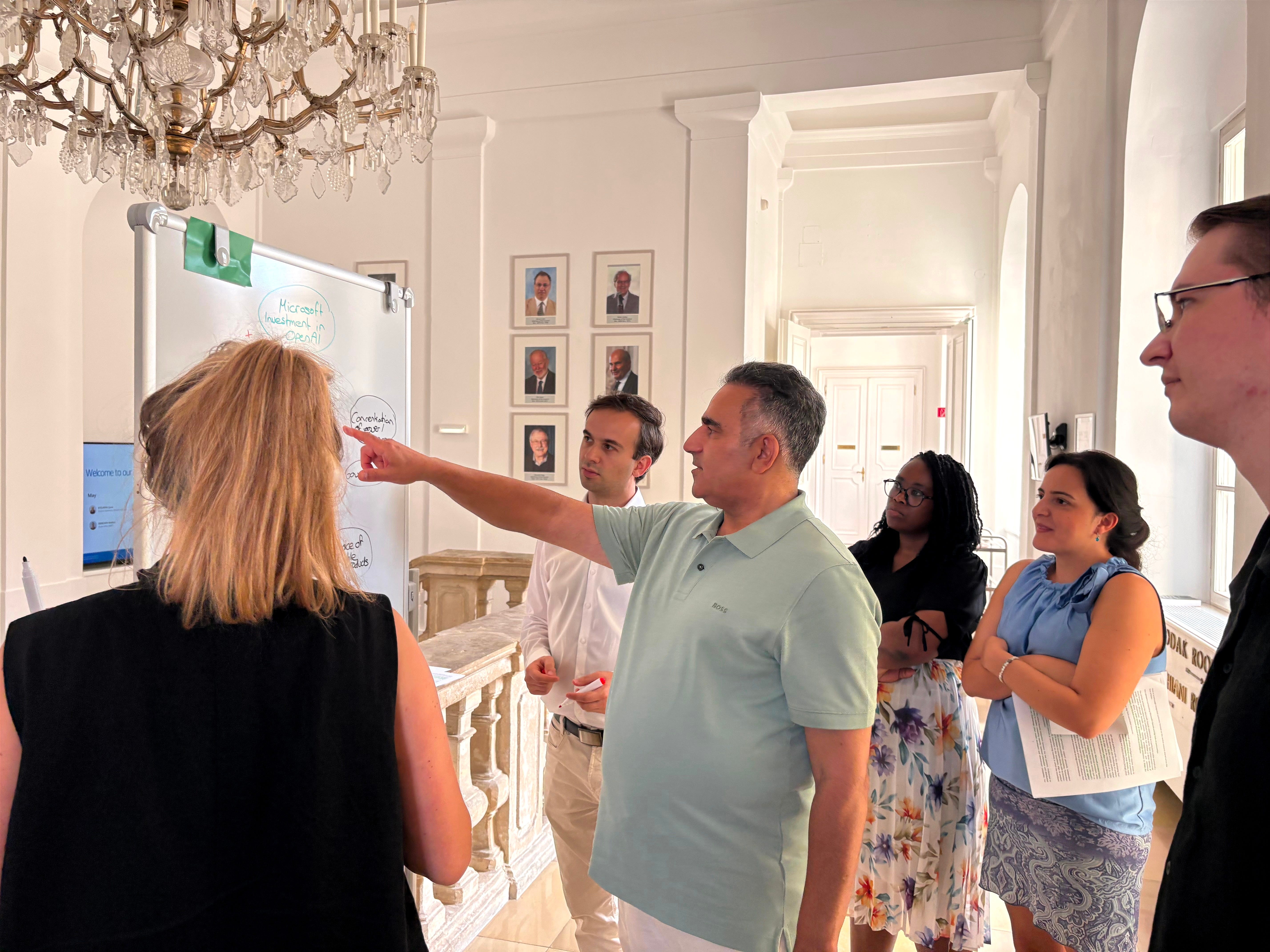
LAXENBURG, Austria — By the final day of the inaugural Raiffa Academy, participants were already thinking beyond the classroom.
A governance scholar from South Africa envisioned using systems mapping to better understand the country’s informal taxi industry and its links to illicit networks. A researcher working on water diplomacy was planning conversations about applying the academy’s methods to transboundary river basins stretching from the Nile to South Asia. A competition law expert saw new opportunities to help regulators navigate increasingly complex global markets.
Although they came from different disciplines and countries, participants shared a common goal as the first Raiffa Academy Short Course wrapped up on Thursday. The third day of the course immersed participants in two case studies that demonstrated how systems analysis and robust decision-making can help leaders examine complex problems under tight timelines and incomplete information.
During the morning session, participants explored Microsoft’s multibillion-dollar partnership with OpenAI through systems mapping and network analysis. Led by Elena Rovenskaya, program director of IIASA’s Advancing Systems Analysis Program, the exercise examined how partnerships can reshape competition, innovation and consumer welfare while challenging traditional regulatory frameworks.
The afternoon shifted from technology markets to one of North America’s most contested natural resources. Led by Princeton University professor Elke Weber, participants developed strategies for managing water allocations in the Colorado River Basin after key provisions of the century-old compact expire, weighing uncertain hydrology, competing political interests and the needs of multiple stakeholders.
For many participants, the value of the exercises extended well beyond the individual cases.
Rekgotsofetse Chikane, director of the Tayarisha Centre for Digital Governance at the Wits School of Governance at the University of the Witwatersrand in South Africa, said he immediately recognized how systems mapping could strengthen research underway at home.
“I was thinking about one of my Ph.D. students who’s trying to map up what we call the taxi industry in South Africa,” he said. “I think the systems map would help us have a better understanding about how this system functions.”
He said the academy also demonstrated how decision analysis could be adapted to governance environments where institutions are less predictable.
“I think what I would push them towards is thinking about the rationality of actors, not kind of informed by a Western lens,” he said. “How do you handle decision making in contexts in which corruption runs rampant?”
Beyond the coursework, Chikane said the academy’s multidisciplinary environment created unexpected opportunities to learn from colleagues working in different fields.
“The multidisciplinary aspect of things caught me off guard, but it’s been a pleasant surprise,” he said.
Emma Zajdela, a postdoctoral research associate at Princeton University and a research fellow at the Santa Fe Institute who also works with the Malta Conferences Foundation on science diplomacy, saw opportunities to build new international collaborations.
She said conversations during the course had already sparked plans to explore how decision analysis could support cooperation on shared water challenges involving researchers working in the Nile Basin, Pakistan and the Middle East.
“I think it’s the connections that we make outside of the actual course,” she said.
Moloko Mathipa Mdakane, an information scientist at South Africa’s Council for Scientific and Industrial Research and a policy fellow at the National Research Foundation, said the academy expanded her understanding of systems thinking and reinforced the importance of connecting researchers with policymakers.
“I got the bigger picture,” she said. “How everything fits together, how the systems work, the analysis, the loops back, and all of that.”
She said she plans to continue applying the approaches introduced during the course and hopes future academies allow even more time for participants to practice them together.
Alexey Ivanov, director of the BRICS Competition Law and Policy Centre, based in Moscow, said the methods complement his ongoing collaboration with Rovenskaya to bring systems analysis into competition law.
Competition authorities, he said, increasingly face markets whose complexity exceeds traditional analytical approaches. “We want to equip them with better tools,” he said.
The academy also introduced him to new ideas outside his own discipline. “I just enjoyed being here, talking to people who were quite from different fields than mine,” he said.
Mohammad Reza Yeganegi, a research scholar in IIASA’s Advancing Systems Analysis Program, said the discussions reinforced his interest in developing decision frameworks that are more inclusive and adaptable.
He said future decision processes should better reflect changing communities while helping negotiators manage conflict without sacrificing scientific neutrality.
Amir Albadvi, a professor at University Canada West in Vancouver with a joint affiliation with Tarbiat Modares University (TMU) in Tehran, whose research focuses on complexity science and network analysis, said the academy’s collaborative format stood out even for someone already familiar with many of the concepts.
“I think the way that they arrange it, that the participation part, it was quite interesting,” he said, and working through case studies in small groups created “quite a good learning environment.”
Looking ahead, Albadvi said he hopes future academies build on the relationships formed during the course by creating opportunities for participants to continue collaborating after they return home.
“I see different people in the area that at least I see that we can have joint paper together,” he said. “Each one has some sort of opportunity in terms of resources and also the possibilities of grants and research support.”