The rise of regional science diplomacy
The Geography Series — Part 3 of a five-part series about where scientific authority, coordination and influence concentrate in world affairs.

For much of the modern history of international science, African researchers looking for major partners abroad were likely to look north or west. Europe and North America supplied much of the funding, laboratory capacity and institutional infrastructure behind international research partnerships.
Brando Okolo has watched that geography change from the African Union.
African researchers continue to work extensively with European and North American institutions, but their collaborations increasingly extend toward China, India, South Korea and Japan. Okolo, who leads science, technology and innovation work at the A.U., points to growing co-authorship with Asian researchers as evidence of a scientific system developing relationships in several directions.
“The epicenter has shifted to the east,” he said, but emphasizes that does not mean Africa is exchanging one dependency for another. “Africa has more options.”
Those options are helping create a more regional geography for science diplomacy. Geneva, Brussels and Washington remain important, but they coexist with institutions and networks through which countries coordinate priorities closer to home and negotiate collectively with partners elsewhere.
Africa provides one of the clearest examples. The African Union makes science, technology and innovation part of its development strategy, while initiatives in areas such as artificial intelligence seek to build governance around African priorities.
At the Africa Forward Summit in Nairobi in May, U.N. Secretary-General António Guterres called for “developing African capacity in artificial intelligence so that AI is shaped by African data, African languages, African researchers and African leadership.”
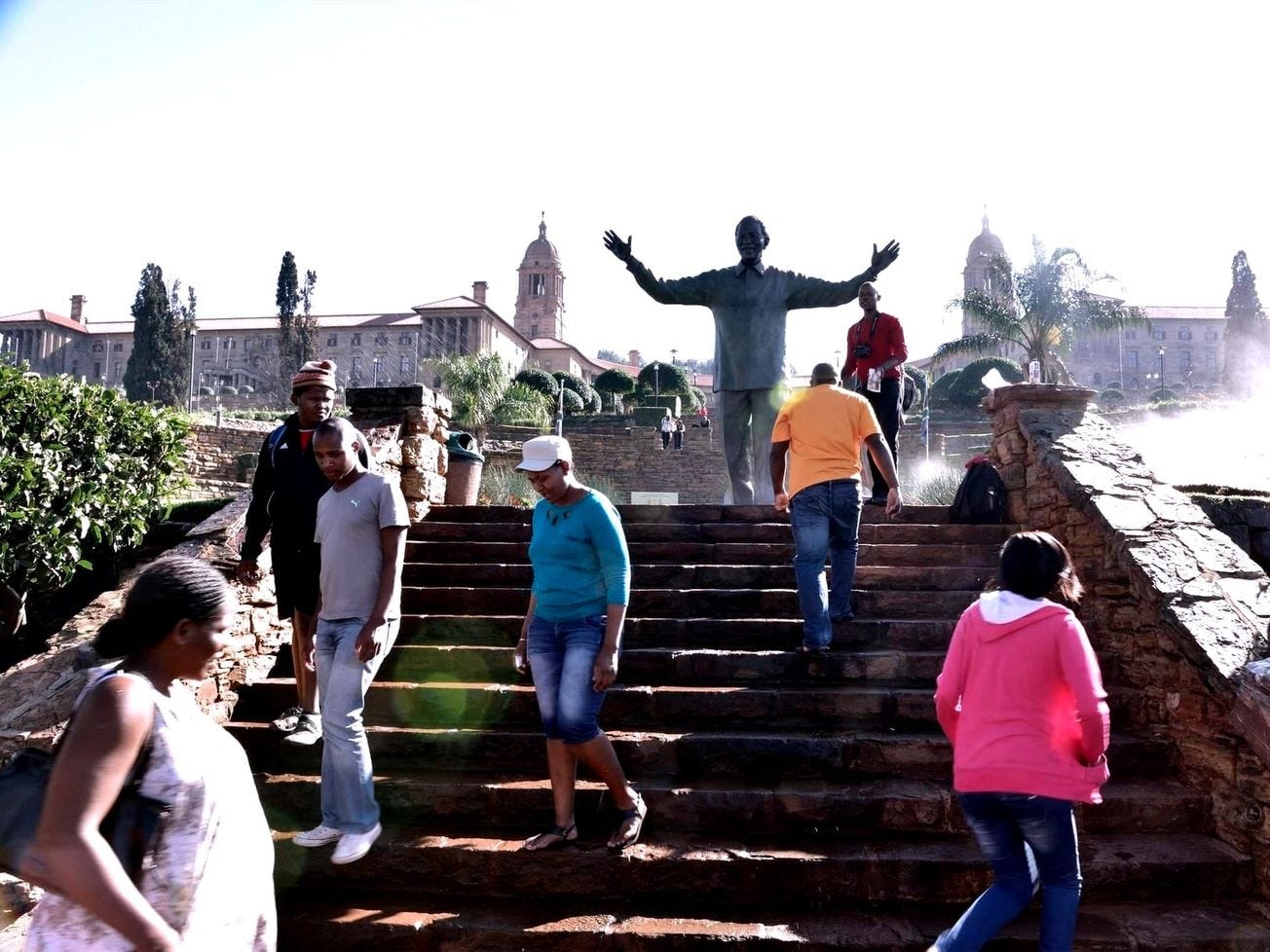
Pretoria is part of that emerging system through South Africa’s Science Diplomacy Capital for Africa. Addis Ababa is another through the African Union, while Nairobi developed its own concentration around environmental governance and U.N. institutions. Rather than coalescing around a single continental capital, African science diplomacy is developing through several centers with different functions.
That geography is beginning to shape Africa’s relationships with other regions. The African Union and European Union have been building a joint innovation agenda around public health, green transition, innovation and technology, and officials are now developing a more explicit science diplomacy component.
Vincenzo Lorusso, a European Commission policy officer working on international science and technology cooperation, described a process distributed between institutions on both continents. Ministerial engagement has taken place in Addis Ababa, while additional work has been organized around South Africa’s Science Forum and a dedicated science diplomacy dialogue.
African officials describe the objective as moving beyond participation in programs whose priorities have already been established. “Africa is not waiting to be invited into the global scientific governance,” South African official Eudy Mabuza said at a 2026 Africa-Europe forum in Brussels. “Africa is changing it.”
The same discussions exposed persistent disparities in funding, research ownership and implementation. Participants called for African institutions to have greater control over research priorities and the knowledge they produce, while large infrastructures such as the Square Kilometre Array were cited as examples of African countries seeking not simply to host international science but to influence how major projects are designed.
New Delhi illustrates another route toward regional influence.
In March, about 80 scientists, diplomats and policy leaders gathered there for the inaugural Raisina Science Diplomacy Initiative alongside the Raisina Dialogue, India’s flagship conference on geopolitics and international affairs. Organized by the Office of India’s Principal Scientific Adviser and the Observer Research Foundation, the closed-door meeting brought Indian officials together with leaders from the International Science Council, GESDA and other institutions.
Their agenda was explicitly geopolitical. Participants discussed how scientific cooperation can continue as artificial intelligence, biotechnology and advanced computing become strategic assets, and how governments seeking technological autonomy can balance open collaboration against control over critical capabilities. India’s principal scientific adviser, Ajay Kumar Sood, argued that science diplomacy must evolve as research becomes more closely connected to national development, economic competitiveness and security.
India’s reach extends well beyond South Asia. At an India-E.U. summit in New Delhi in January, the two sides brought digital public infrastructure, artificial intelligence, data governance, trusted connectivity and scientific research into a broader strategic agreement covering trade, sustainability and security.
India and the E.U. continue to differ over data, intellectual property and regulation, but their cooperation is meant to strengthen both sides in international forums where technical standards and regulatory models are contested. The relationship shows how the map can develop connections between regional systems rather than directing scientific cooperation primarily toward a handful of established global centers.
Latin America and the Caribbean present a less centralized geography. Panama City has developed a particularly clear gateway function. The United Nations Development Program established its regional hub there in 2008 to bring policy advice, technical support and expertise closer to the countries it serves. Today the hub works across 26 countries, providing technical expertise, knowledge-sharing and capacity development while promoting South-South cooperation within the region and beyond.
That regional function was visible in April, when representatives from 21 countries gathered in Panama City for a meeting on food systems transformation. More than 90 participants included national food systems convenors, U.N. officials, regional and international organizations, development banks, financial institutions, academics, Indigenous peoples, civil society and private sector representatives.
Their discussions encompassed agriculture, climate, nutrition, biodiversity, social protection and financing, with coordination among governments and institutions emerging as a prerequisite for turning national plans into implementation.
“Progress is driven by countries, and leadership from this region continues to shape that momentum,” said Stefanos Fotiou, director of the U.N. Food Systems Coordination Hub.
Santiago’s international reach comes from different assets. Chile developed scientific relationships in fields where geography creates an advantage, particularly astronomy, Antarctic research and climate science. Those strengths connect Chilean institutions with researchers and governments outside the region and give Santiago a role in international cooperation around scientific infrastructure and environmental systems.
Regional priorities can also enter older global institutions. Colombia spent a quarter-century seeking World Intellectual Property Organization protections for genetic resources and traditional knowledge. In 2024, governments meeting in Geneva adopted the first WIPO treaty addressing genetic resources and associated traditional knowledge held by Indigenous peoples and local communities.
Southeast Asia is developing through several centers rather than one. Singapore combines scientific, technological and financial capacity with an established role as an international meeting point. Malaysia has taken another route, institutionalizing the field through its International Institute for Science Diplomacy and Sustainability.
Its founding director, Zakri Abdul Hamid, came to science diplomacy through a less formal education. Decades ago, as a junior scientific adviser to Malaysia’s delegation at a U.N. biodiversity conference, he found himself uncomfortable with the diplomatic process and wanted to leave. An ambassador persuaded him to stay.
What he learned was that possessing scientific knowledge and knowing how to exercise influence inside an international negotiation were different skills.
“It was in the delegates lounge where deals were made. I’m from a developing country. I’ve never felt so lonely in those negotiations. We have knowledge of science, but not of diplomacy,” Zakri said.
“I learned 30 years ago how to be a negotiator. I learned it is more important to be working from the inside,” he said. “The Global South needs to have that exposure so we can develop a level playing field.”
Discussion about this post