

Issue No. 23 | Monday, September 21, 2026
Good morning,
Welcome to The Science Diplomat Playbook, your Monday morning guide to what’s shaping the week ahead in global science diplomacy.
The lead
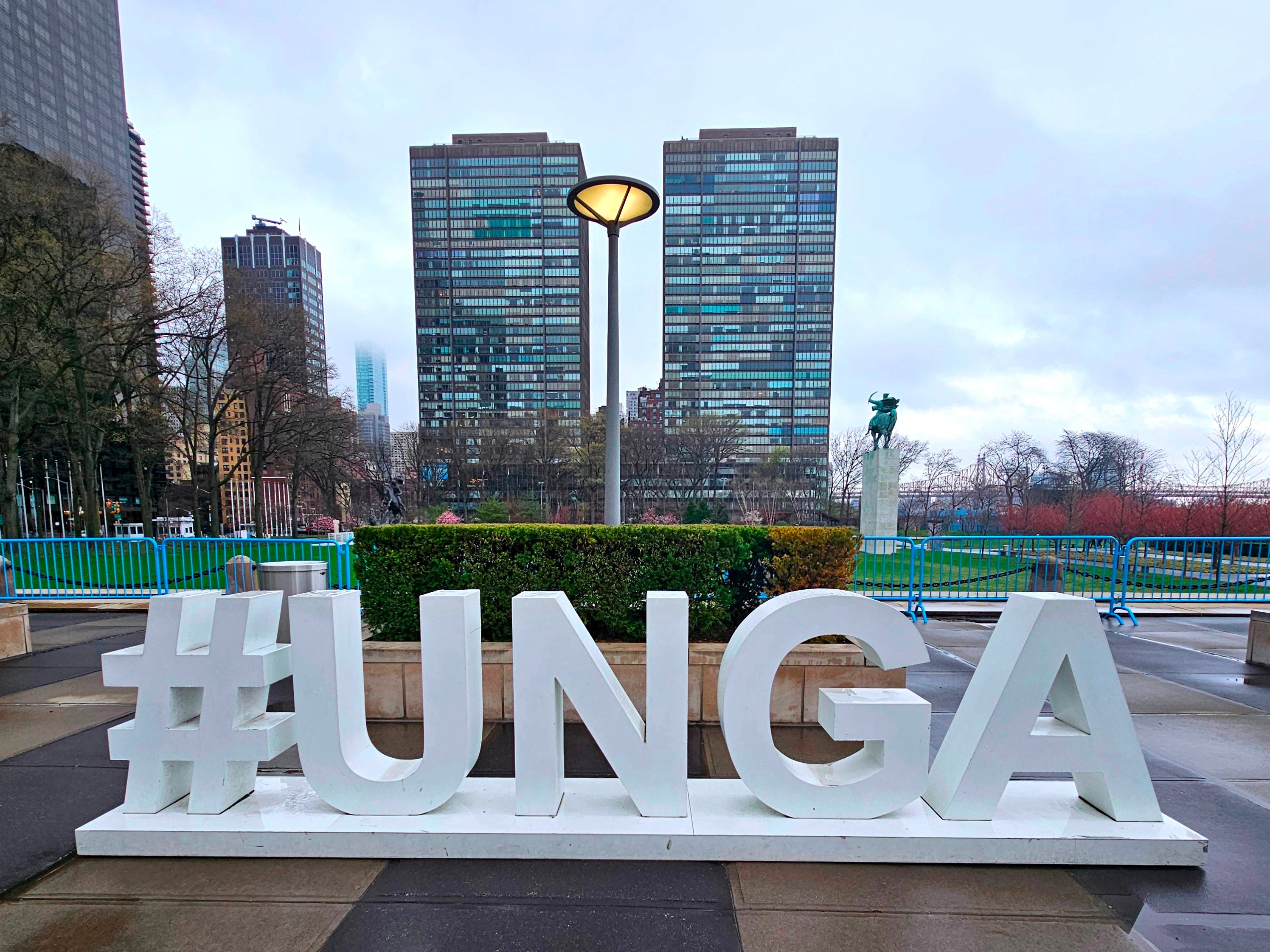
World leaders arrive in New York this week for the United Nations’ largest annual diplomatic gathering. Along with wars, economic pressures and strains on the multilateral system, they will confront a set of problems that depend heavily on science and technology to find solutions.
The General Debate begins Tuesday under the theme, “Restoring Trust, Managing Transformation: A United Nations That Delivers for All.” Artificial intelligence, climate change, sea level rise and pandemic preparedness feature across the week’s formal meetings and the wider network of ministerial gatherings and side events.
On Monday, the U.N. Office for Digital and Emerging Technologies convenes Digital Cooperation Day, with discussions on AI governance, scientific assessment, digital infrastructure, financing and national capacity. Wednesday brings a high-level event on climate action and a just transition. On Thursday, governments are expected to adopt a declaration on sea level rise covering science and data, infrastructure, finance, maritime boundaries and statehood. Friday brings the second U.N. high-level meeting on pandemic prevention, preparedness and response.
Running alongside the official U.N. program is the New York portion of the Science Summit, with sessions on science diplomacy, food security, AI, research financing, One Health, climate resilience, geoengineering, environmental governance, open science and Earth observation. Monday includes a high-level dialogue devoted specifically to science diplomacy and global cooperation amid geopolitical divisions.
The subjects differ, but they raise some of the same practical questions. Who produces the evidence governments rely on? Who has the technical capacity to participate? Who pays? What happens when scientific cooperation runs into disputes over sovereignty, security or access?
Those questions are particularly visible this week. AI discussions will address the capacity of countries outside the major technology powers to help write the rules. The sea level declaration relies on global observation systems while addressing maritime zones and the survival of nations. Pandemic negotiators are still trying to reconcile rapid sharing of pathogen information with equitable access to vaccines, therapeutics and diagnostics.
High-Level Week offers a concentrated view of science diplomacy in practice: governments using scientific evidence, institutions and technical cooperation to negotiate problems they cannot manage alone.
Elsewhere this week: WTO members begin a new round of fisheries subsidy discussions in Geneva; the Geneva Center for Multilateral Journalism launches a new index measuring global governance reporting; candidates for the next ILO director-general appear together publicly; and a proposal for an international scientific panel on inequality gets a hearing in New York.
Major processes to watch
AI — The U.N. takes up the machinery of global AI governance
The U.N. Office for Digital and Emerging Technologies convenes its second Digital Cooperation Day on Monday with a practical agenda: implementing the Global Digital Compact, narrowing gaps in AI capacity and strengthening international cooperation on artificial intelligence.
This year’s theme, “Shaping A Global AI Future Through Science, Policy, and Capacity,” divides the work into three areas. Scientific research is meant to inform governance; governments will discuss policy, interoperability and digital public infrastructure; and capacity building sessions will cover national AI strategies, skills, financing, disaster resilience and international partnerships.
The political issue underneath that agenda is participation. Countries without large AI industries still need infrastructure, expertise and regulatory capacity if they are to have a meaningful role in writing international rules for the technologies they use.
The program also features the Independent International Scientific Panel on AI, alongside governments, industry, academia, civil society and technical experts. Organizers say partnership announcements are expected during the day.
Sea level rise — A declaration reaches beyond the shoreline
Governments are expected to adopt a U.N. Declaration on Sea Level Rise on Thursday covering scientific observation, infrastructure, finance, maritime boundaries and the continuity of nations threatened by rising seas. The provisional program includes its expected approval during the opening segment.
The declaration begins with science. Governments commit to stronger research collaboration and national scientific capacity, better data sharing and coordinated observations, and the text specifically recognizes WMO and UNESCO’s Intergovernmental Oceanographic Commission and calls for interoperable global systems.
The declaration also calls for sea level projections to be incorporated into ports, energy and water systems, health facilities, telecommunications and other coastal infrastructure. Developing countries, particularly small island developing nations and least developed countries, are promised greater financial, technical and policy support.
The legal provisions go further. Governments would affirm that maritime zones established under the U.N. Convention on the Law of the Sea can be maintained despite physical changes caused by sea level rise. The text also states a presumption in favor of continued statehood and calls for support to countries that lose territory but must continue to maintain governmental functions.
The declaration calls for another high-level meeting before the end of the General Assembly’s 84th session, giving governments a mechanism for returning to the issue.
Pandemics — PABS remains unfinished as leaders meet in New York
WHO members ended five days of negotiations in Geneva on Friday without completing the Pathogen Access and Benefit Sharing system at the center of the Pandemic Agreement.
The proposed system would pair rapid sharing of materials and sequence information from pathogens with pandemic potential with fair and timely access to vaccines, therapeutics and diagnostics developed from their use. WHO said governments made progress toward an equitable and workable system, but negotiations continue.
That unfinished business now follows governments to New York. Heads of state and government meet Friday for the second U.N. high-level meeting on pandemic prevention, preparedness and response. Its expected political declaration calls for timely completion of the PABS annex. Finalizing the annex is also needed so countries can proceed to signing and considering ratification of the Pandemic Agreement.
The high-level meeting has a broader agenda as well: surveillance and early warning, access to vaccines and diagnostics, financing, resilient health systems and One Health. Since the first such meeting in 2023, governments have adopted the Pandemic Agreement, strengthened the International Health Regulations and established or expanded several preparedness institutions. WHO nevertheless says gaps persist in financing, surveillance, laboratory capacity and equitable access to health products.
The PABS dispute remains the clearest test. Countries agree that pathogens and sequence information must travel quickly during an emergency. The harder negotiation concerns what countries receive in return when shared pathogen materials and sequence information contribute to vaccines, therapeutics and diagnostics.
UNGA watch
This is António Guterres’s final General Assembly High-Level Week as U.N. secretary-general. His second five-year term ends Dec. 31, and the process to choose his successor is under way.
Several declared candidates are scheduled to appear Wednesday at an Open Society Foundations event on democracy and human rights. The next secretary-general will inherit an institution under financial pressure while governments ask the U.N. to handle a widening range of technological, environmental and health problems.
Security Council watch — AI returns to the Security Council
The Security Council holds a high-level briefing Wednesday on artificial intelligence and international security, one of several meetings scheduled alongside the General Assembly’s General Debate.
France, which holds the Council presidency this month, is organizing the meeting. French Foreign Minister Jean-Noël Barrot will chair, with Yoshua Bengio, co-chair of the U.N.’s Independent International Scientific Panel on AI, expected to brief alongside private sector representatives, including OpenAI CEO Sam Altman.
The Council has discussed AI before, but its role is unsettled. Diplomats have considered its potential uses in conflict prevention, mediation, peace operations and sanctions monitoring alongside risks from cyber operations, disinformation and increasingly autonomous systems. They differ over how the Council should fit into the wider international architecture for AI governance.
The meeting follows Monday’s Digital Cooperation Day, which addresses AI governance, capacity and implementation across the wider U.N. system. The Council’s discussion will focus on international peace and security.
Signals
A new index measures how the media cover global governance. The Geneva Center for Multilateral Journalism launches its Multilateral Journalism Index on Monday, based on a six-week pilot covering 247 records from 71 media outlets and 27 multilateral events. Reporting scored highest for substantive information and lowest for source diversity, while the study found that technically important negotiations and governance processes did not always receive attention proportional to their institutional significance. Future editions are expected to expand the observation period and examine additional institutions and centers of multilateral governance.
An IPCC for inequality? Advocates will use a Thursday UNGA side event to make the case for an International Panel on Inequality, modeled on the Intergovernmental Panel on Climate Change. The proposal came from an inequality report commissioned by South Africa’s G20 presidency. Its backers argue that a standing international expert body could provide governments with a common evidence base for inequality policy.
The ILO leadership contest goes public. All three candidates for the next director-general appear Wednesday in Geneva before representatives of governments, employers and workers. The candidates are incumbent Gilbert F. Houngbo of Togo, Yolanda Díaz Pérez of Spain and Javier González-Olaechea Franco of Peru. Private hearings follow Nov. 9, with the election slated for Nov. 16.
On the calendar
Sept. 7–Oct. 7 — Human Rights Council, 63rd session, Geneva. The month-long session continues. → Meeting information
Sept. 21 — Multilateral Journalism Index launched, Geneva. The Geneva Center for Multilateral Journalism publishes the first MJI pilot, measuring substance, public understanding, governance literacy and source diversity in coverage of international organizations. → News and New Index
Sept. 21 — Digital Cooperation Day, New York. The U.N. Office for Digital and Emerging Technologies convenes governments and other stakeholders on AI science, governance, capacity, infrastructure and financing. → Program
Sept. 21–25 — Science Summit 2026, New York. The New York program runs alongside High-Level Week, with sessions spanning science diplomacy, AI, health, food systems, research financing and environmental governance. → Program
Sept. 21–25 — WTO fisheries subsidies “Fish Week,” Geneva. Members begin the first of three planned negotiating weeks intended to identify common ground for additional fisheries-subsidy disciplines. The chair has explicitly said this round is for discussion rather than decisions. → Meeting information
Sept. 22 — U.N. General Debate begins, New York. Heads of state and government begin the annual General Assembly debate. → Meeting information
Sept. 22 — AU–EU–Med Innovation Fair application deadline. Science-based and deep-tech startups and SMEs working on food and nutrition security and sustainable agriculture have until Tuesday to apply for the Nov. 25 fair in Bari. → Registration
Sept. 23 — High-Level Event on Climate Action and the Just Transition, New York. Leaders address climate action, transition and financing during High-Level Week. → Overview
Sept. 23 — ILO Director-General candidate dialogue, Geneva. The three candidates appear publicly before the organization’s tripartite constituency ahead of private hearings and the November election. → Program
Sept. 24 — U.N. High-Level Meeting on Sea Level Rise, New York. Governments are scheduled to approve the political declaration during the opening segment. → Documents
Sept. 25 — U.N. High-Level Meeting on Pandemic Prevention, Preparedness and Response, New York. Governments review progress since 2023 and are expected to renew commitments on preparedness, financing, equitable access and completion of the PABS annex. → Program
Closing
You’re reading The Science Diplomat Playbook, a weekly briefing mapping the institutions, technologies and governance systems shaping international cooperation.