The Science Diplomat Playbook
The global conversation about artificial intelligence moves from scientific assessment to political negotiation this week in Geneva.

Issue No. 12 | Monday, July 6, 2026
Good morning,
Welcome to The Science Diplomat Playbook, your Monday morning guide to what’s shaping the week ahead in global science diplomacy.
The lead
The global conversation about artificial intelligence moves from scientific assessment to political negotiation this week as governments, technology companies, researchers and international organizations converge on Geneva for a series of meetings that are helping define the emerging architecture of international AI governance.
More than 1,500 participants are expected for the inaugural Global Dialogue on AI Governance, a new United Nations process established by the General Assembly to provide a forum where governments and stakeholders can discuss international cooperation on artificial intelligence. The meeting follows last week’s release of the preliminary report of the Independent International Scientific Panel on Artificial Intelligence, which warned that access to AI technologies does not necessarily translate into influence over the infrastructure, expertise, standards and governance systems shaping their development.
Now the political conversation begins.
The Global Dialogue takes place alongside the World Summit on the Information Society (WSIS) Forum and the AI for Good Global Summit, bringing together many of the institutions, governments and organizations shaping the future of digital cooperation, technology governance and artificial intelligence.
Together, the three gatherings illustrate how the international system is beginning to organize itself around AI. WSIS provides the broader framework for digital cooperation and development. The Global Dialogue creates a new political forum for governments to discuss AI governance. AI for Good focuses on practical applications and implementation ranging from health and education to climate and development.
The week also follows the launch of the AI for Good Global Commission, a new high-level initiative bringing together heads of government, business leaders and U.N. officials under the co-chairmanship of Rwandan President Paul Kagame and Salesforce CEO Marc Benioff. The commission aims to identify practical pathways for expanding access to AI while addressing questions of trust, governance and digital inequality.
The coming days will provide an early indication of how governments respond to the scientific panel’s findings, whether the Global Dialogue develops into a recurring intergovernmental process, and how the various institutions emerging around AI begin to relate to one another.

Major Processes to Watch
Global Dialogue on AI Governance — Governments enter the conversation
The inaugural Global Dialogue on AI Governance opens Monday in Geneva as governments, international organizations, companies, researchers and civil society groups gather to discuss international cooperation on artificial intelligence.
Established by the U.N. General Assembly, the Dialogue is intended to provide a dedicated forum where countries can exchange views on AI opportunities and risks, capacity-building, AI divides, human rights and governance. The meeting follows last week’s release of the preliminary report of the Independent International Scientific Panel on Artificial Intelligence and represents the first opportunity for governments to collectively respond to its findings.
The Dialogue will provide an early indication of whether countries can begin building common approaches to AI governance despite differing national priorities, levels of technological development and regulatory philosophies.
AI for Good Global Summit — From governance to implementation
The AI for Good Global Summit opens Tuesday in Geneva, bringing together governments, technology companies, researchers and international organizations to examine how artificial intelligence can be applied to challenges ranging from health and education to climate change and sustainable development.
The summit follows last week’s launch of the AI for Good Global Commission, a new initiative co-chaired by Rwandan President Paul Kagame and Salesforce CEO Marc Benioff that brings together heads of government, business leaders and U.N. officials to identify practical pathways for expanding access to AI while addressing questions of trust, governance and digital inequality.
The Commission’s creation reflects growing efforts to move beyond discussions of AI risks and regulation toward questions of implementation, access and governance at scale.
WSIS Forum — Twenty years of digital cooperation
The World Summit on the Information Society Forum convenes governments, U.N. agencies, technical organizations, companies and civil society groups to assess progress on digital cooperation and the information society.
Established following the original WSIS process, the forum addresses issues including connectivity, digital inclusion, cybersecurity, digital development and internet governance. While artificial intelligence dominates many discussions this year, the forum provides the broader institutional framework linking digital development, technology governance and international cooperation.
Together with the Global Dialogue and AI for Good, the gathering helps illustrate how a broader ecosystem of AI and digital governance institutions is taking shape.
ICRC Digital Emblem Project — Humanitarian law enters cyberspace
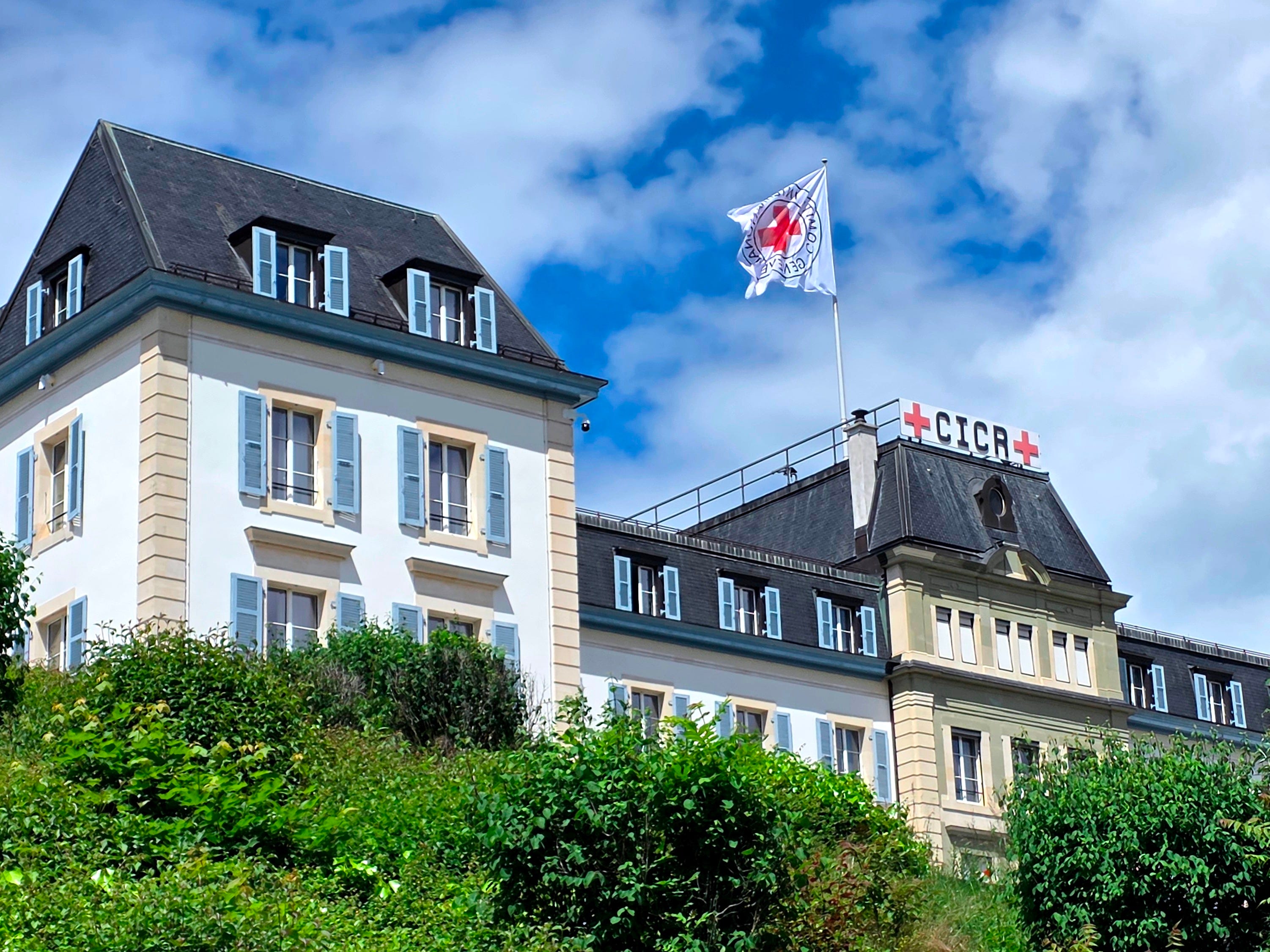
The International Committee of the Red Cross launches the second phase of its Digital Emblem Project on Thursday at CERN’s Globe of Science and Innovation, moving an effort to protect humanitarian and medical services in cyberspace from concept development toward operational implementation.
The project seeks to translate the protective function of the Red Cross, Red Crescent and Red Crystal emblems into the digital environment. The goal is to create a technical means for hospitals, humanitarian organizations and other protected entities to signal their protected status during cyber operations and armed conflict.
The next phase will focus on testing, adoption pathways and implementation. Participants include representatives from the ICRC, Switzerland, the International Telecommunication Union, Microsoft, Cloudflare, UNESCO and other organizations working on humanitarian law, cybersecurity and technology governance.
The initiative highlights a broader challenge confronting international institutions: how legal protections developed for the physical world can be adapted to digital forms of conflict.
High-Level Political Forum — The U.N. takes stock of the Sustainable Development Goals
The High-Level Political Forum on Sustainable Development opens Tuesday at U.N. headquarters in New York as governments assess progress toward the 2030 Agenda with less than five years remaining before the deadline.
This year’s forum will review water and sanitation, energy, infrastructure and innovation, sustainable cities, and international partnerships. Thirty-six countries, including Switzerland, Brazil, Italy, Norway and the United Arab Emirates, will present Voluntary National Reviews outlining their progress, challenges and lessons learned in implementing the Sustainable Development Goals.
The forum also will feature the release of the Sustainable Development Goals Report 2026, providing an updated assessment of global progress.
As with many U.N. processes this year, the central challenge remains implementation. With 2030 approaching, discussions are focused on how to accelerate progress rather than simply measuring it.
Inside Institutions
Human Rights Council — Decisions and conclusions
The Human Rights Council resumes consideration of draft resolutions on Monday as its sixty-second session moves through a crowded agenda covering Sudan, Eritrea, Myanmar, humanitarian access in armed conflict, business and human rights, disability rights, education, disinformation, freedom of expression, judicial independence, gender equality and climate change.
Several items intersect directly with this week’s broader technology and governance agenda, including draft texts on disinformation, freedom of expression, business and human rights, and climate change.
The session’s final decisions will provide an indication of how human rights institutions are adapting to interconnected challenges involving conflict, information integrity, humanitarian access, climate impacts and emerging technologies.
UN Trade and Development — Following the investment flows
UN Trade and Development releases its World Investment Report 2026 on Tuesday, offering one of the year’s most comprehensive assessments of global investment patterns.
The report arrives as governments link economic resilience, technological competitiveness, industrial policy and national security. Particular attention is likely to focus on the distribution of investment between developed and developing economies, the concentration of capital in strategic sectors, and whether foreign direct investment is helping countries participate in emerging technological and industrial systems.
The findings will provide another measure of a question that runs through many international debates this year: who benefits from technological transformation, and who risks being left behind.
Security Council Watch — Accountability, resources and the causes of conflict
Congo assumes the Security Council presidency this month with an agenda that links accountability, protection and resource governance—three issues that sit at the center of international security debates.
The Council’s work begins this week with a briefing on the International Criminal Court’s Darfur-related activities in Sudan and its annual open debate on conflict-related sexual violence under the theme, “Honouring the promise of international law to survivors of conflict-related sexual violence.”
Later in the month, Congolese President Félix Tshisekedi is expected to chair a high-level debate on “Natural resource governance: the foundation of peace, security and prosperity,” while Secretary-General António Guterres is expected to brief. The Council will also discuss recommendations for strengthening mechanisms for the peaceful settlement of disputes under a report requested through Resolution 2788.
The agenda reflects a broader question confronting the Council: whether addressing conflict requires not only responding to violence and violations of international law, but also tackling governance failures, resource competition and institutional weaknesses that contribute to instability in the first place.
Across regions
Brussels — Europe’s regions prepare for the post-2027 era
Officials, regional authorities and policy experts gather in Brussels this week for the Macro-regional and Sea Basin Strategies Days, an annual meeting focused on cross-border cooperation in eight European regional and maritime frameworks, including the Alpine, Danube, Baltic Sea, Adriatic-Ionian and Atlantic regions.
This year’s discussions are expected to focus heavily on the European Union’s next budget cycle and the shape of regional policy after 2027.
Organizers point to growing emphasis on security, resilience, competitiveness, enlargement and place-based implementation amid geopolitical tensions, climate pressures and economic transformation.
Workshops will examine issues ranging from enlargement and support for candidate countries to resilience, civil preparedness, green and digital transitions, and regional cooperation in Europe’s maritime basins.
House of Commons — Britain examines science diplomacy
The Foundation for Science and Technology, the Science, Innovation and Technology Committee and Sense about Science host a discussion on science diplomacy on Tuesday as Parliament considers recommendations from a recent inquiry into the role of science in foreign policy.
The event follows a parliamentary inquiry examining how scientific research, international partnerships and foreign policy can be aligned to advance national interests and strengthen international relationships. Participants include committee chair Dame Chi Onwurah, former science minister George Freeman, Wellcome Trust Executive Director Charlotte Watts and former universities minister David Willetts.
It reflects growing interest among governments in treating scientific cooperation not only as a tool for addressing shared challenges but also as an instrument of foreign policy, technological competitiveness and alliance-building.
Signals
• AI governance is entering its political phase.
• Infrastructure is becoming the new source of influence.
• Implementation is replacing aspiration as the dominant theme of multilateral governance.
• Institutions are adapting existing rules to digital realities rather than building entirely new systems.
• Resource governance is emerging as a central security issue.
On the calendar
July 6-7 — Global Dialogue on AI Governance (Geneva)
The inaugural U.N. forum created by the General Assembly to enable governments and stakeholders to discuss international cooperation on artificial intelligence. → Information → Closing Sessions
July 6-10 — WSIS Forum 2026 (Geneva)
The annual World Summit on the Information Society gathering focused on digital cooperation, connectivity, development and technology governance. → Overview
July 7-10 — AI for Good Global Summit (Geneva)
ITU’s flagship event bringing together governments, companies and researchers to explore practical applications of AI for global challenges. → Program
July 7 — Launch of the Sustainable Development Goals Report 2026 (New York)
The United Nations releases its annual assessment of global progress toward the Sustainable Development Goals. → Information
July 7 — U.K. science diplomacy discussion (London)
A House of Commons event exploring how science diplomacy can support international cooperation, alliances and technological competitiveness as Parliament considers recommendations from a recent inquiry. → Program
July 7-15 — High-Level Political Forum on Sustainable Development (New York)
The U.N.’s principal annual review of implementation of the 2030 Agenda and the Sustainable Development Goals. → Overview
July 7 — Security Council briefing on ICC Sudan (New York)
The International Criminal Court updates the Security Council on investigations and accountability efforts related to crimes in Darfur. → Information
July 8 — Security Council open debate on conflict-related sexual violence (New York)
A high-level discussion examining implementation of international law and protections for survivors of conflict-related sexual violence. → Overview
July 9 — Global Launch of the Digital Emblem Project, Phase II (CERN, Geneva)
The ICRC unveils the next phase of its effort to extend the protective function of humanitarian emblems into cyberspace. → Program
July 9 — HLPF Science Day 2026 (New York)
A special forum exploring the role of science, technology and innovation in accelerating progress toward the Sustainable Development Goals. → Program
Closing
You’re reading The Science Diplomat Playbook, a weekly briefing mapping the institutions, technologies and governance systems shaping international cooperation.

