

Issue No. 22 | Monday, September 14, 2026
Good morning,
Welcome to The Science Diplomat Playbook, your Monday morning guide to what’s shaping the week ahead in global science diplomacy.
The lead
The world’s nuclear agency confronts the widening demands on its mandate.
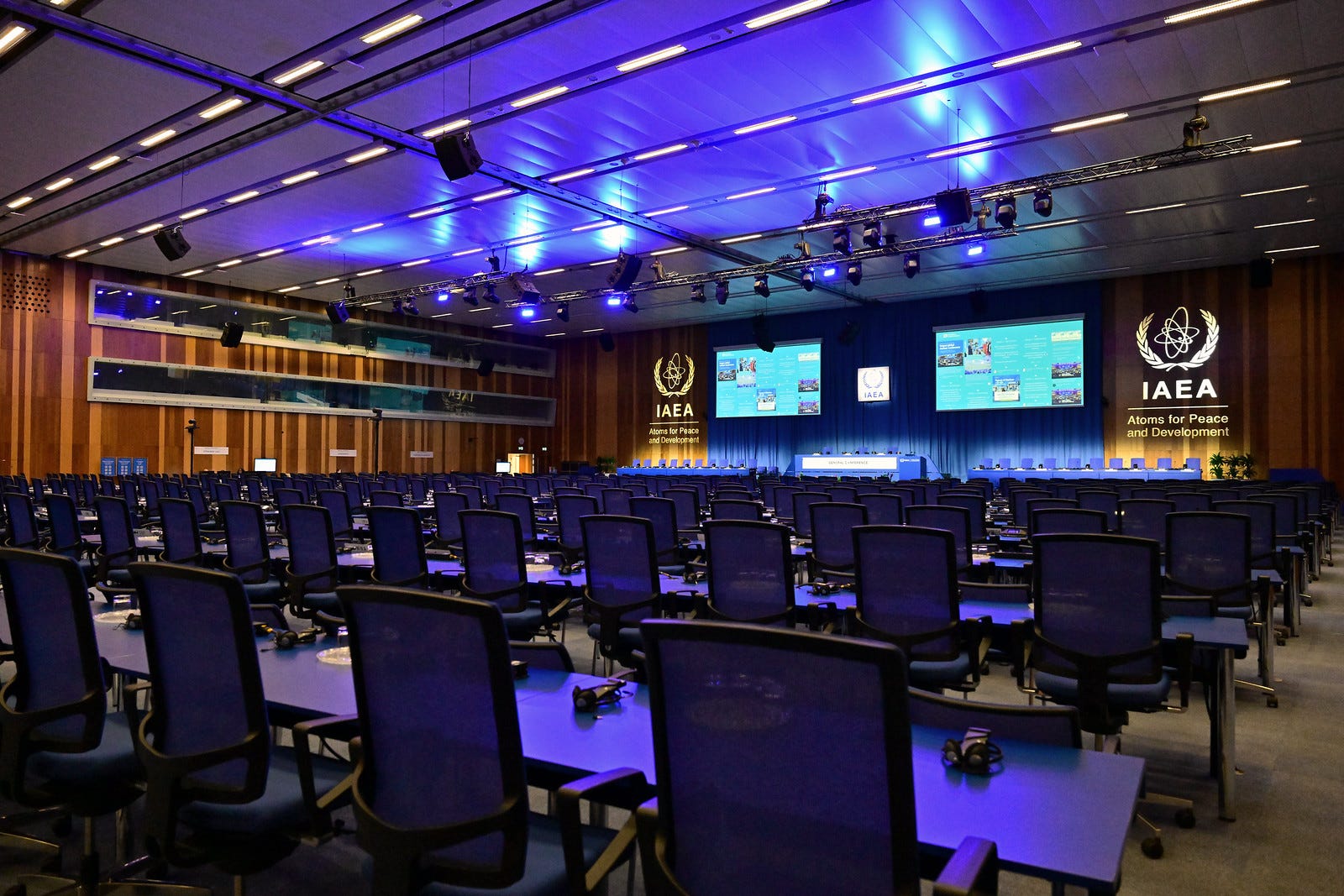
Representatives of 181 countries gather in Vienna on Monday for the 70th General Conference of the International Atomic Energy Agency, opening a week that brings some of the most consequential uses — and risks — of nuclear science under the same roof.
The IAEA is best known internationally for its role in nuclear safeguards and nonproliferation. But its mandate extends much further, encompassing nuclear energy, safety and security, cancer treatment, food security, water management and other peaceful applications of nuclear science and technology.
The General Conference is where countries collectively set priorities across that unusually broad mandate. Representatives review the agency’s work and consider resolutions covering nuclear science and applications, technical cooperation, safeguards, safety, security and nonproliferation. Decisions taken during the week help shape the IAEA’s program of work for the year ahead.
This year’s meeting opens against a difficult geopolitical backdrop. Iran is scheduled to be the first country to address Monday’s general debate, with Russia, the United States and China also speaking during the opening session. The European Union, Japan and France are among the other speakers scheduled for the first morning.
That lineup puts nuclear diplomacy immediately alongside the agency’s technical work. The IAEA’s ability to verify nuclear activities depends on access, scientific measurement and cooperation from governments — conditions that become harder to sustain when the countries whose activities it monitors are themselves locked in wider geopolitical disputes.
At the same time, governments are asking nuclear science to do more. Interest in nuclear power is growing alongside efforts to decarbonize energy systems, while nuclear technologies are being deployed in medicine, agriculture, food security and water management.
That second side of the agency’s mandate will be prominent Tuesday and Wednesday, when the IAEA’s annual Scientific Forum focuses on Rays of Hope, its initiative to expand access to cancer care. Scientists, policymakers and ministers will examine partnerships, financing and ways to make radiotherapy and other nuclear-medicine capabilities available where access remains limited.
The juxtaposition captures something fundamental about nuclear diplomacy. The same international institution is expected to verify nuclear materials, reduce proliferation risks and strengthen nuclear safety while helping countries use nuclear science to produce electricity, manage water, improve food security and treat cancer.
As the IAEA enters its 70th General Conference, the question is how an institution built to promote the peaceful uses of nuclear science while guarding against its misuse adapts as both sides of that mandate become more demanding.
Elsewhere, the Science Summit 2026 opens Monday, beginning an online program that will move to New York during U.N. high-level week and then Nairobi at the end of the month.
Countries also return to Geneva for another round of negotiations on the unfinished Pathogen Access and Benefit Sharing system under the WHO Pandemic Agreement, while UNESCO brings governments and experts to Riyadh to examine how international AI ethics principles can be turned into functioning national governance systems.
The U.N. Human Rights Council continues its month-long session in Geneva, while experts worldwide remain engaged in the first review of the physical-science contribution to the IPCC’s Seventh Assessment Report.
Major processes to watch
Global — Science Summit connects research with international decision-making
The Science Summit 2026 opens Monday, beginning more than two weeks of discussions intended to connect science, technology and innovation more directly with international policymaking, financing and implementation.
Running online from Sept. 14–30, the summit moves into an in-person New York program Sept. 21–25 alongside U.N. high-level week before concluding with its first Nairobi program Sept. 28–30.
The agenda spans artificial intelligence, health, food security, climate, biodiversity, sustainable finance and science diplomacy. Organizers are also seeking to connect researchers with development banks, philanthropies, technology companies and investors — actors that increasingly influence which scientific work is financed and whether emerging technologies move from research into deployment.
The geographic expansion is also significant. Taking part of the summit to Nairobi explicitly seeks to give African scientific leadership a larger role in discussions that have historically concentrated around New York and other established centers of international policymaking.
The process is therefore testing a broader proposition: whether international science diplomacy can build stronger connections not only between science and government, but among research, policy and the institutions that finance implementation.
WHO — Countries return to the unfinished business of the Pandemic Agreement
Countries meet in Geneva through Friday for another round of negotiations on the Pathogen Access and Benefit Sharing system, the major component of the WHO Pandemic Agreement that remained unfinished when governments adopted the agreement in 2025.
The proposed system is intended to establish how participating laboratories and manufacturers share pathogens and related information while ensuring that benefits derived from their use — including vaccines, therapeutics and diagnostics — are distributed more equitably.
This week’s negotiations move directly into the architecture of that system. Governments discuss implementation Monday and Tuesday, scope and definitions Wednesday, and governance and review Thursday before returning to implementation Friday. The program also includes discussions of a coordinating financial mechanism and lessons from COVID-19 procurement.
The question is whether countries can narrow the remaining differences sufficiently to put PABS on a path toward agreement. The draft annex is the central substantive item on the formal agenda.
Riyadh — AI governance moves from principles toward implementation
Governments and experts gather in Riyadh for UNESCO’s fourth Global Forum on the Ethics of Artificial Intelligence, with this year’s meeting focused less on establishing new principles than on putting existing ones into practice.
Five years after UNESCO adopted its Recommendation on the Ethics of Artificial Intelligence, more than 75 countries have engaged with its Readiness Assessment Methodology, which examines national institutions and policies for governing AI. The forum will take stock of that implementation and launch a meta-analysis of more than 55 national assessments alongside a new version of the methodology intended to move countries from diagnosis toward policy action.
The agenda also moves into the institutional machinery required for AI oversight: cross-border cooperation among supervisory authorities, government capacity to procure and use AI responsibly, and financing for regulatory systems and public-sector preparedness. Ministers and regulators will separately examine how multilateral processes can bridge increasingly fragmented approaches to AI governance.
The question to watch is whether UNESCO’s global ethics framework is beginning to develop an implementation architecture capable of influencing how governments actually regulate and deploy AI.
Global — New survey finds demand for economic change outpacing trust in governments
A new multinational survey released Monday finds broad agreement that economic systems need substantial change — alongside declining confidence that governments can deliver it.
Across 17 major economies surveyed by Ipsos for Earth4All, 70% of respondents say inequality in their country is too high, 65% believe the economic system is rigged to benefit the rich and powerful, and 69% want major changes to that system. But only 31% believe their government will make decisions benefiting the majority 20 or 30 years from now, down from 39% in 2024.
The survey also finds 67% believe their country is more divided than a decade ago. Support for democracy remains substantial, with 68% calling it the best way to govern, but 40% say their country would be better off with a strong leader unconstrained by parliament and elections.
Released as governments prepare for U.N. high-level week, the findings expose a governance problem extending across many issues on the international agenda: public demand for large-scale change is running well ahead of confidence in the institutions expected to deliver it.
UNGA watch — High-level week begins to take shape
The General Assembly moves closer to its annual high-level meetings this week, with the U.N. beginning the transition from the opening of its 81st session toward the arrival of world leaders in New York.
On Friday, the General Assembly holds its annual SDG Moment, intended to focus political attention on progress toward the Sustainable Development Goals ahead of high-level week. Secretary-General António Guterres is expected to address the meeting.
The general debate begins Sept. 22, alongside a series of high-level meetings addressing climate action and the just transition, sea-level rise, pandemic preparedness and other international priorities.
The timing also overlaps with the Science Summit’s transition from its online program to its in-person New York meetings beginning Sept. 21, bringing the science-policy community into the same institutional ecosystem as the year’s most concentrated period of global diplomacy.
Security Council watch — Iran sanctions dispute moves to a vote
The Security Council is scheduled to vote Thursday on extending the mandate of the Panel of Experts supporting the 1737 sanctions committee on Iran.
The vote brings the institutional dispute surrounding Iran’s nuclear file back before the Council one week after members publicly disagreed over whether the sanctions committee itself legally exists. Western members maintain that U.N. sanctions were restored through the JCPOA’s snapback mechanism, while China and Russia reject that interpretation.
That disagreement has prevented the committee from functioning normally, making the vote a test of whether Council members can maintain an expert-monitoring mechanism even while disputing the legal foundation on which it operates.
The Council also turns to the security of international shipping on Thursday in an informal meeting on protecting freedom of navigation, as members continue to follow disruptions in the Strait of Hormuz. On Friday, members hold a debate on peacekeeping reform and conduct their third straw poll on candidates for the next U.N. secretary-general.
Signals
The IAEA’s dual mandate is becoming more demanding in both directions as geopolitical tensions complicate nuclear verification while governments seek wider access to peaceful nuclear technologies.
AI governance is moving beyond general principles toward the institutional machinery of implementation, including national assessments, supervisory cooperation, regulatory capacity and financing.
The PABS negotiations show that scientific cooperation and equity are increasingly inseparable: access to biological materials is being negotiated alongside access to the products and benefits that science produces from them.
Public demand for large-scale economic change is running well ahead of confidence that governments can deliver it, creating a trust problem for institutions trying to manage long-term challenges.
On the calendar
Aug. 10–Oct. 2 — IPCC Working Group I First Order Draft expert review (Global)
Experts continue reviewing the first draft of the physical science contribution to the IPCC Seventh Assessment Report. → Review information
Sept. 7–Oct. 7 — U.N. Human Rights Council, 63rd session (Geneva)
The Council continues its month-long session spanning global human rights crises alongside issues including hazardous substances and wastes, water and sanitation, climate finance and the human rights consequences of nuclear legacies. → Meeting information
Sept. 8 onward — U.N. General Assembly 81st session (New York)
The General Assembly continues its annual session, with Friday’s SDG Moment beginning the transition toward high-level week and the general debate starting Sept. 22. → Meeting information
Sept. 14 — Earth4All Global Survey 2026 released (Global)
A 17-country survey examines attitudes toward inequality, economic-system change, political trust and social cohesion. → Report
Sept. 14–17 — UNESCO Global Forum on the Ethics of AI (Riyadh)
Governments and experts meet on international approaches to ethical AI governance and implementation. → Forum
Sept. 14–18 — IAEA General Conference, 70th session (Vienna)
Representatives of 181 countries set priorities across nuclear safeguards, safety, security, technical cooperation and the peaceful uses of nuclear science and technology. → Conference
Sept. 14–18 — Convention on Cluster Munitions Third Review Conference (Vientiane)
Countries review implementation of the Convention on Cluster Munitions and consider priorities for the next review cycle. → Conference
Sept. 14–18 — WHO Pandemic Agreement negotiations (Geneva)
Countries continue negotiating the Pathogen Access and Benefit Sharing annex, including its scope, implementation, governance and financing. → Agenda
Sept. 14–30 — Science Summit 2026 (Online; New York; Nairobi)
Scientists, policymakers, international organizations, funders and industry examine how science and technology can support global governance, sustainable development and international cooperation. The summit begins online before moving to New York and Nairobi. → Program
Sept. 15 — WMO State of Global Water Resources 2025 released (Geneva)
The World Meteorological Organization releases its latest assessment of global water resources, with senior officials briefing on hydrology and the cryosphere. → Reports
Closing
You’re reading The Science Diplomat Playbook, a weekly briefing mapping the institutions, technologies and governance systems shaping international cooperation.