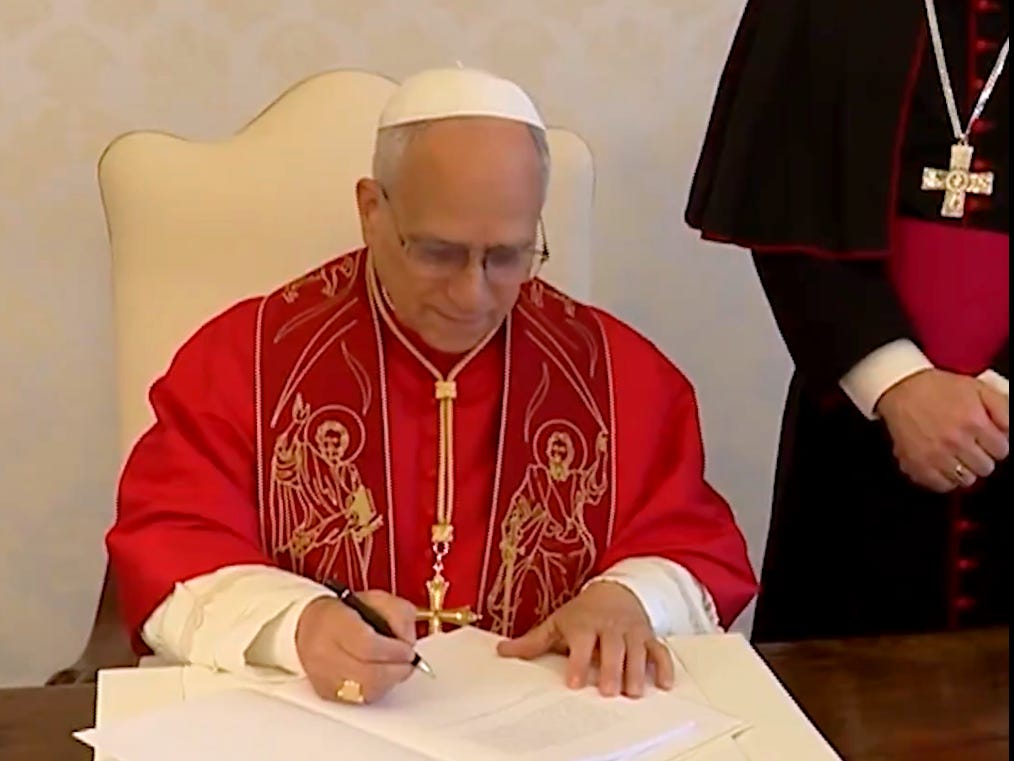
The Vatican moves into AI diplomacy
Pope Leo XIV’s first AI encyclical positions the Catholic Church inside a widening international struggle over how artificial intelligence should be governed, regulated and constrained.

The Vatican is attempting to shape the moral language surrounding artificial intelligence before the international rules harden.
In Magnifica Humanitas, the first encyclical of his papacy, Pope Leo XIV warned on Monday that artificial intelligence risks concentrating economic and political power, normalizing warfare and undermining human dignity if governments fail to establish stronger international oversight.
The document places the Catholic Church directly inside one of the central geopolitical and scientific disputes now unfolding around artificial intelligence: who gets to shape the rules governing systems increasingly embedded in economies, militaries and public life.
“Artificial intelligence now demands to be disarmed, freed from logics that turn it into an instrument of domination, exclusion and death,” the pope said.
The timing is notable. In early July, the United Nations will convene the first Global Dialogue on AI Governance in Geneva, where diplomats, researchers and technology companies are expected to debate questions ranging from safety standards and interoperability to human rights and military applications. The meeting will also feature the first annual report from the U.N.’s Independent International Scientific Panel on Artificial Intelligence, created last year by the General Assembly as part of a broader effort to coordinate international oversight of AI.
The Vatican’s intervention arrives as governments themselves remain divided over how AI should be governed internationally. The European Union has focused heavily on regulation and risk management. The United States increasingly frames AI through strategic competition with China and national security. China emphasizes state sovereignty and centralized control.
Meanwhile, the broader U.N. system is still attempting to build common structures for scientific assessment and international dialogue before diplomatic and regulatory institutions fall further behind the technology. That helps explain why the Vatican’s move matters diplomatically.
Historically, papal encyclicals have often appeared at moments when technological or economic transformations outpaced existing political institutions. Leo XIV explicitly tied Magnifica Humanitas to Pope Leo XIII’s 1891 encyclical Rerum Novarum, which addressed labor exploitation and social upheaval during the Industrial Revolution.
Now the Vatican appears to be attempting something similar for the age of artificial intelligence. The encyclical also received unusually direct engagement from parts of the AI industry itself. At the Vatican press conference presenting the encyclical, Anthropic co-founder Christopher Olah sat on the panel a few seats away from Pope Leo XIV and called for stronger outside scrutiny of AI development.
“We need more of the world — religious communities, civil society, scholars, governments — to do what His Holiness has done here: to take this seriously, to look closely, and to push events in a better direction,” Olah said.
“We need informed critics who will tell the labs when we are failing,” he added. “We need moral voices that the incentives cannot bend.”
The appearance of a leading AI researcher alongside the pope underscored how rapidly the debate over artificial intelligence is expanding beyond governments and technology firms alone.
The Vatican’s intervention also immediately drew support from UNESCO, which said the encyclical “resonates deeply” with the agency’s own work on AI ethics and international coordination.
In a statement released after publication of Magnifica Humanitas, UNESCO linked the pope’s warnings about human dignity and concentration of power directly to its 2021 Recommendation on the Ethics of Artificial Intelligence, the first global framework of its kind, which now informs policy discussions in more than 80 countries.
“At a time of rapid change and disruption, our position is clear: technology must advance human rights — not erode human dignity,” UNESCO said.
Alongside the July dialogue in Geneva, the U.N. and International Telecommunication Union will host the annual AI for Good summit, while the scientific panel’s first report is expected to help shape future international discussions on AI safety, standards and governance.

