U.N. advances autonomous weapons rules without committing to a treaty
Governments gave experts two more years to develop an international instrument as AI-assisted targeting spreads on battlefields, but left its legal force undecided.

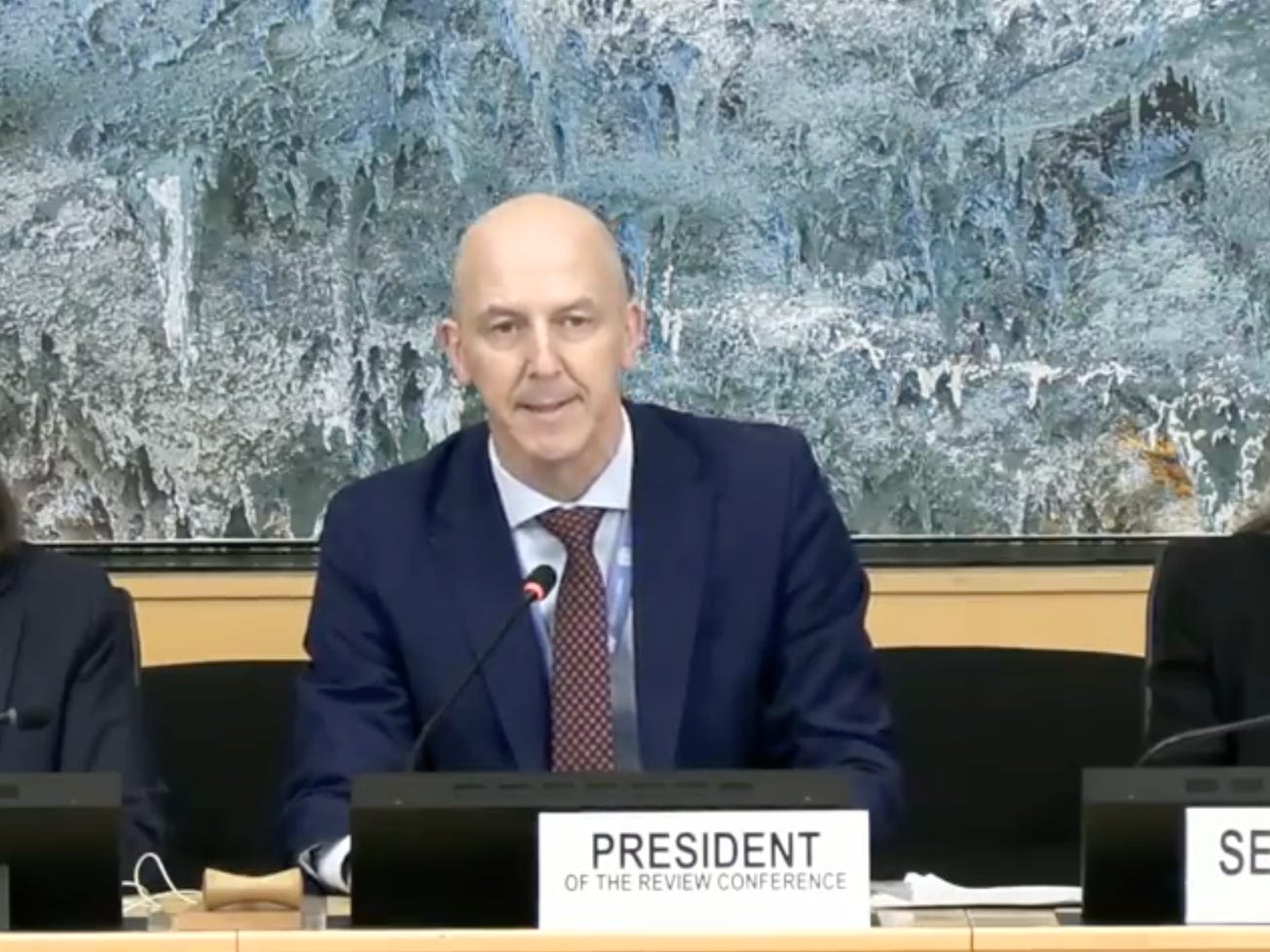
Governments have agreed to begin developing international rules for autonomous weapons after 13 years of discussions, but stopped short of launching negotiations on a legally binding treaty.
The compromise adopted early Saturday at a major United Nations disarmament conference gives a group of government experts two years to elaborate an international instrument on lethal autonomous weapons systems. It leaves the instrument’s legal status undecided.
That leaves the central question facing autonomous-weapons diplomacy for the next phase of the process: whether governments will accept binding prohibitions and restrictions on military technologies whose development is being accelerated by advances in artificial intelligence, sensors and automated targeting.
The agreement concluded the Seventh Review Conference of the Convention on Certain Conventional Weapons, or CCW, in Geneva. The United States, Russia, China and other major military powers participate in the convention, making it an important venue for negotiating weapons rules but also one in which agreement can be difficult.
Conference President Julien Thöni of Switzerland described the autonomous-weapons mandate as significant progress. U.N. disarmament chief Izumi Nakamitsu said a treaty remained possible.
“The path to, or possibility to have a legally binding instrument is still open,” she said at a concluding press briefing.
Rules without a settled legal form
Under the agreement, the CCW’s Group of Governmental Experts will develop an international instrument based on elements identified in its September report.
The group is expected to recommend the instrument’s legal nature and form, including whether governments should adopt it as a binding protocol to the convention. Meetings are scheduled for March 1–5 and Aug. 30–Sept. 3, 2027.
The mandate allows governments to begin drafting substantive rules without first resolving whether the eventual agreement will be legally enforceable. That ambiguity helped bridge differences among countries but deferred a dispute that has shaped the talks for years.
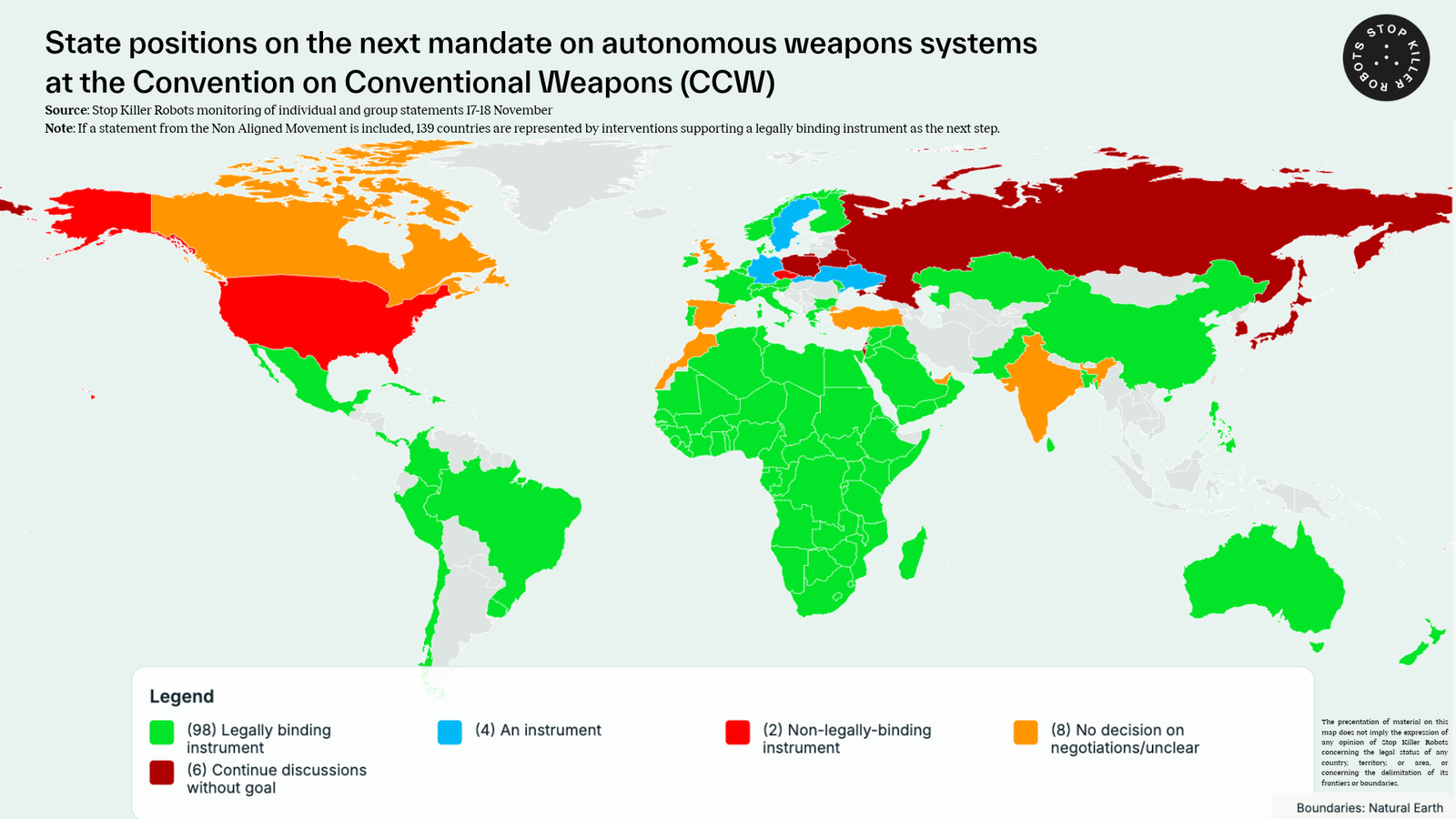
Peru advocated a two-year process explicitly aimed at a binding protocol. Britain, France and Germany supported negotiations without deciding the outcome’s legal status in advance.
The United States proposed a five-year process leading toward a nonbinding agreement. Russia has also resisted binding restrictions.
The International Committee of the Red Cross said the conference had failed to provide a clear and immediate mandate to negotiate a legally binding instrument.
The ICRC has called for prohibitions on autonomous weapons whose effects cannot be sufficiently understood, predicted and explained. It also wants systems designed or used to target human beings prohibited, with restrictions imposed on other autonomous weapons.
Support for some form of binding regulation extends well beyond the countries participating in the CCW. The ICRC pointed to 163 countries that supported an October resolution in the U.N. General Assembly’s First Committee addressing the need for legally binding rules.
The Campaign to Stop Killer Robots, a coalition of more than 300 nongovernmental organizations, said interventions during the Geneva conference indicated that 98 countries supported or were open to negotiating a binding protocol. Group statements represented a larger number, although some of those countries are not parties to the CCW.
Diplomacy trails deployment
The debate is taking place as artificial intelligence assumes a growing role in military surveillance, target identification and decisions about the use of force.
“Autonomous weapons technology, including AI in the targeting cycle, is being deployed on the battlefield—delaying the creation of a legally binding instrument puts civilians and humanity at risk,” said Nicole van Rooijen, executive director of the Campaign to Stop Killer Robots.
Autonomous weapons do not constitute a single technology. Their operation can depend on combinations of sensors, software, machine learning, communications networks and weapons platforms. The degree of human involvement can also vary considerably.
That makes the diplomatic problem partly one of definition. Governments must determine which systems require prohibition, which can be permitted under restrictions and what level of human judgment must be retained over targeting and attacks.
The scientific and technical questions are inseparable from legal ones. A system may operate as designed while still producing consequences its developers or operators did not anticipate. Machine-learning systems can also behave differently when conditions diverge from the data on which they were developed and tested.
Responsibility becomes harder to assign when targeting decisions are distributed among software developers, commanders, operators and machines. Governments have not agreed on how existing international humanitarian law applies to all such circumstances or whether new law is required.
The two-year mandate creates a forum for converting those concerns into proposed rules, but it does not guarantee that governments will accept them.
Can consensus govern the technology?
The conference also demonstrated the institutional obstacles surrounding the negotiations.
Russia’s objections over observer participation prevented governments from agreeing on the conference agenda and rules of procedure. As a result, the meeting did not complete the comprehensive review of the CCW and its protocols that normally takes place every five years.
Russia sought to restrict when the European Union and other observers could address the conference. The United States, Britain, Ireland, Norway, Austria and other governments argued that the proposal would undermine established practice and meaningful participation.
The dispute continued throughout the week and expanded into a broader disagreement over whether the CCW’s tradition of reaching decisions by consensus gives individual governments an effective veto.
Austria cited a 1995 U.N. legal opinion indicating that the convention’s practice of deciding without votes did not necessarily create a binding consensus rule. Russia rejected that interpretation.
The conference ultimately adopted a narrower final document recording decisions and future work without conducting its scheduled assessment of the convention.
The disagreement also prevented progress on incendiary weapons, mines other than anti-personnel mines and other conventional weapons involving emerging technologies.
The CCW entered into force in 1983 and has 128 contracting parties. Its structure keeps major military powers involved in discussions about weapons restrictions. The same reliance on consensus can enable those governments to prevent or dilute rules they oppose.
U.N. Secretary-General António Guterres has urged governments to negotiate a legally binding autonomous-weapons instrument containing clear prohibitions and restrictions.
The agreement reached in Geneva keeps that possibility alive and begins a more focused drafting process. But it also leaves governments trying to regulate military technologies that are continuing to develop while they debate the form—and force—of the rules.
An earlier version of this reporting appeared in Arete News.
Discussion about this post