The U.N.'s AI governance vision relies on coordination rather than global regulation
Discussions in Geneva revealed growing concern over fragmented regulation, unequal access to computing power and the need for safeguards that can evolve alongside AI.

GENEVA — The United Nations concluded its first Global Dialogue on AI Governance by outlining an emerging approach to governing artificial intelligence built around scientific assessment, regulatory interoperability, capacity-building and oversight for increasingly autonomous AI systems.
The Dialogue built on the preliminary report released last week by the Independent International Scientific Panel on Artificial Intelligence, the first global body created to assess the technology's opportunities, risks and societal impacts.
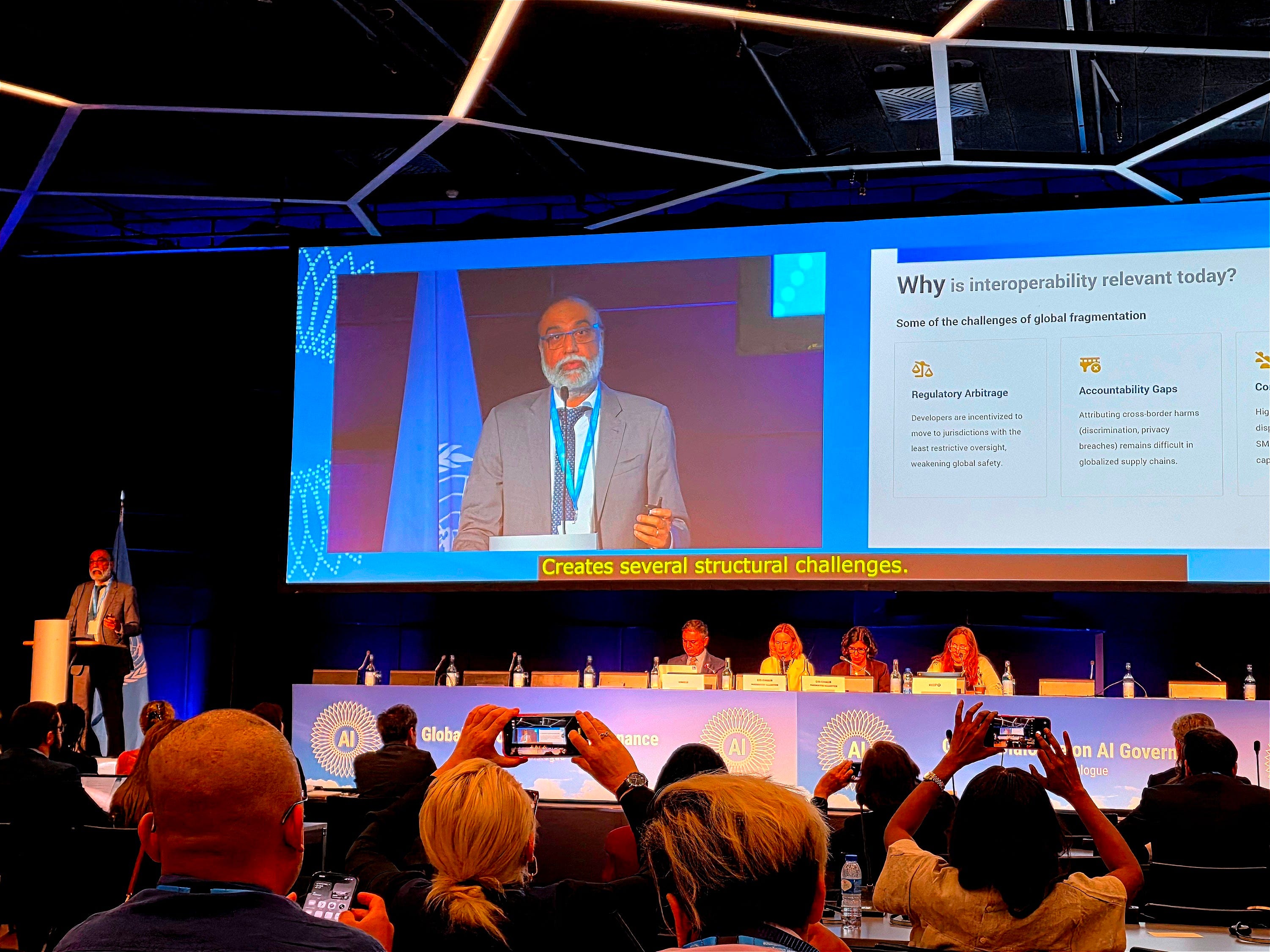
“The scientific panel emphasized the shift from static to dynamic system governance,” U.N. technology envoy Amandeep Singh Gill said on Tuesday. As AI systems become more autonomous and capable of interacting with other systems, he argued, governance must evolve from overseeing individual models toward managing continuously changing AI ecosystems.
Gill said governments face growing risks from fragmented regulation, including regulatory arbitrage, accountability gaps, rising compliance costs and widening inequalities between countries with different levels of technical capacity. Rather than pursuing a single global regulatory framework, he argued, countries should develop interoperable approaches that allow different systems to work together while sharing evidence, testing methods and governance tools.
Secretary-General António Guterres opened the Dialogue by warning that AI was advancing “at runaway speed” and announced several initiatives, including an AI Child Safety Pledge, an AI Environmental Transparency Initiative, recommendations for a Global Fund for AI and a Global Network for Exchange and Cooperation on AI Capacity Building.
A debate over fragmentation
If there was a recurring theme during the second day of discussions, it was fragmentation.
Speakers warned that artificial intelligence is developing through a patchwork of national regulations, technical standards and voluntary frameworks that often struggle to communicate with one another. The concern was not simply legal complexity. Participants argued that fragmentation could shape who benefits from AI and who is left behind.
Gill described fragmentation as one of the central governance risks facing governments. Divergent regulatory systems, he said, can encourage companies to shift activities to jurisdictions with weaker oversight, complicate accountability when harms occur across borders and increase compliance costs for smaller firms and researchers. For lower-capacity countries, fragmentation can create a different challenge altogether: dependence on governance frameworks developed elsewhere.
Paula Bogantes Zamora, Costa Rica’s minister of science, innovation, technology and telecommunications, framed the issue in terms of influence. Citing data showing that advanced AI models and computing infrastructure remain concentrated in a handful of countries, she argued that technical concentration increasingly translates into governance concentration.
She proposed what she called “minimum viable interoperability” — shared terminology, comparable risk classifications, documentation standards and incident reporting systems that would allow countries to cooperate without requiring identical regulations.
Several speakers rejected the idea that interoperability should mean regulatory uniformity. Instead, a recurring theme was that countries would continue to pursue different legal and policy approaches to AI, while developing common mechanisms for information-sharing, testing, standards and cooperation across borders.

Who gets to govern AI?
Beneath the technical discussions about standards and interoperability lay a deeper concern about power.
Throughout the Dialogue, participants repeatedly returned to the concentration of computing resources, technical expertise and AI development capacity in a relatively small number of countries and companies.
According to figures cited during the discussions, institutions in the United States produced 59 notable AI models in 2025, while Chinese institutions produced 35. The rest of the world produced 13. Speakers also pointed to the concentration of advanced computing infrastructure and data center investment, particularly outside Africa and much of the Global South.
Members of the Scientific Panel warned that many countries remain largely absent from international AI governance discussions. Representatives from developing countries argued that the debate increasingly concerns not only access to AI systems but participation in the institutions that shape their future.
For much of the past several years, discussions focused on whether countries would gain access to advanced AI technologies. In Geneva, the conversation increasingly centered on whether countries would possess the expertise, infrastructure and institutional capacity necessary to influence how those technologies are governed.
From fire to AI
Several speakers argued that governance should extend beyond technical performance to questions of rights, accountability and public trust.
U.N. High Commissioner for Human Rights Volker Türk noted that societies routinely require years of testing before approving medicines or certifying aircraft, and questioned why increasingly powerful AI systems should be treated differently.
Leonardo Cervera Navas, secretary general of the European Data Protection Supervisor, argued that governance should ultimately serve the protection of health, safety, privacy and fundamental rights.
Comparing AI to humanity’s earliest transformative technology, he said societies learned to benefit from fire only by establishing rules for its safe use and constant supervision.
“The E.U. embraces this technology and its potential for advancing science and general well-being,” he said. “And the fact that it comes with some clear risks does not mean that we should oppose AI.”
Rebecca Finlay, co-chair of one of the Dialogue’s thematic sessions, summarized the relationship between the Scientific Panel and the Dialogue in a phrase that surfaced repeatedly during the week.
“The panel provides the evidence,” she said. “The dialogue provides the direction.”


