

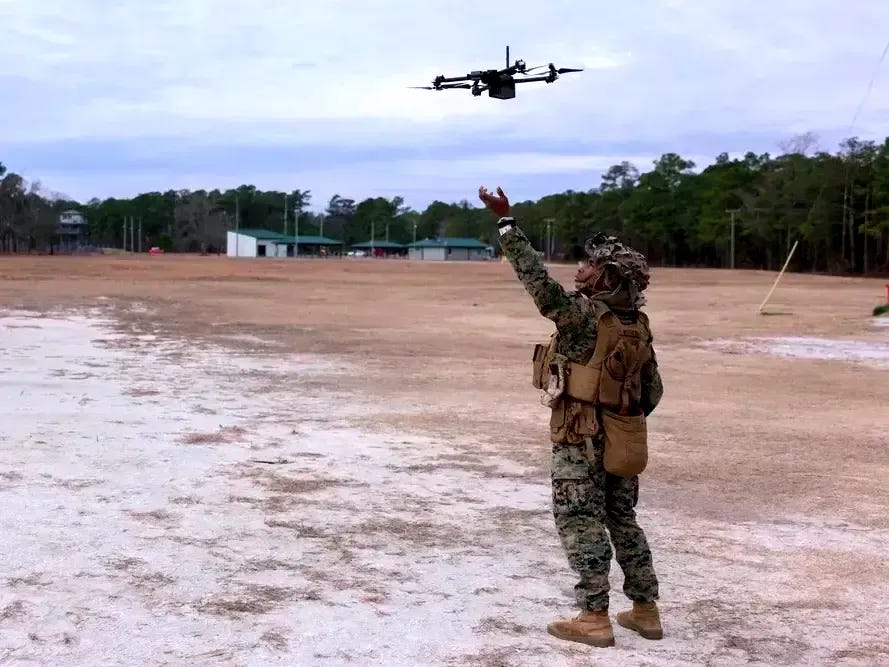
GENEVA — The United Nations and International Committee of the Red Cross warned that autonomous weapons are bringing the world “dangerously close to crossing a moral red line,” urging governments to begin negotiating legally binding restrictions as the technology becomes cheaper and more widely available.
U.N. Secretary-General António Guterres and ICRC President Mirjana Spoljaric renewed a three-year-old joint appeal on Tuesday as governments prepare to resume talks in Geneva next week on lethal autonomous weapons systems.
“We are now dangerously close to crossing a moral red line: the autonomous targeting of humans by machines,” they said jointly. “The development of weapon technology has advanced at record speed, placing increasing strain on legal frameworks.”
The appeal says technological capabilities have advanced faster than international regulation since their previous call, with autonomous systems increasingly being deployed on battlefields and reducing human control over the use of force.
“Technological developments are not waiting for the diplomatic calendar,” Carolyne Mélanie Régimbal, chief of the Geneva branch of the U.N. Office for Disarmament Affairs, told a press briefing.
She said autonomous capabilities are becoming cheaper, more accessible and easier to incorporate into existing weapons, increasing the urgency of establishing international rules before harmful practices become entrenched.
The renewed push comes after more than a decade of discussions under the Convention on Certain Conventional Weapons without negotiations on a binding instrument.
Government experts meet again next week for the final session of their current mandate. But the group is authorized only to develop elements that could form the basis of an instrument, not to negotiate one.
A political decision could come at the convention’s five-year Review Conference in November.
“The international community has spent more than a decade examining this issue,” Régimbal said. The November meeting, she said, will be a “critical moment for states to show political courage” and turn that work into negotiations.
What would be prohibited
The ICRC is not calling for a ban on all autonomous weapons. Laurent Gisel, head of the Arms and Conduct of Hostilities Unit at the International Committee of the Red Cross, said it wants governments to prohibit systems whose effects cannot be adequately predicted and autonomous weapons designed or used to directly target human beings.
Autonomous weapons targeting people pose particular legal problems because a person’s protected status can change rapidly on a battlefield. A combatant who surrenders or is wounded, for example, becomes protected from attack.
There is also a more fundamental ethical concern, Gisel told the press briefing, because directly targeting people with autonomous systems risks reducing “human life to data, algorithms, sensor, and machine operations” and effectively delegating decisions about who is killed to a machine.
Other autonomous weapons would be subject to restrictions, including limits on the targets they can engage, their geographic and temporal range, the scale of force and the environments in which they operate.
Gisel said autonomous defensive systems have existed for decades, including weapons aboard warships designed to intercept incoming missiles. Such systems are less problematic, he said, because they operate against narrowly defined objects in relatively predictable environments with limited risk to civilians.
The concern instead is the trajectory toward systems operating across wider areas, for longer periods and in populated environments, potentially using increasingly complex AI to select and engage targets.
Ukraine case remains unconfirmed
The briefing also confronted the question of whether autonomous targeting has already crossed the threshold highlighted in the appeal.
Asked about recent reporting that an AI-guided Russian drone autonomously selected a target in a July 6 attack that killed three civilians in Ukraine, the officials said they had no confirmed evidence that autonomous weapons had been used to select and directly target people.
“We don’t currently have evidence, confirmed evidence, that autonomous weapons have been used to directly target human beings on the battlefield,” Gisel said.
He stressed that autonomous weapons already exist and have killed people, including combatants, but distinguished that from systems independently selecting humans as their targets.
Régimbal said the reported Ukraine case also illustrated the need to distinguish artificial intelligence from autonomy. “AI does not necessarily equal autonomous weapon but rather is one of the tools that bring these systems to life,” she said.
Gisel warned that waiting for definitive examples before establishing rules carries its own risk. “All weapons have proliferated,” he said. “This will be the case with autonomy in weapons, since they are essentially sensors and algorithms.”
The technology, he said, could spread beyond advanced militaries and eventually be used by armed groups outside conventional battlefields.
“The standards have to be established before the weapons are developed,” Gisel said. “Otherwise it will proliferate.”