

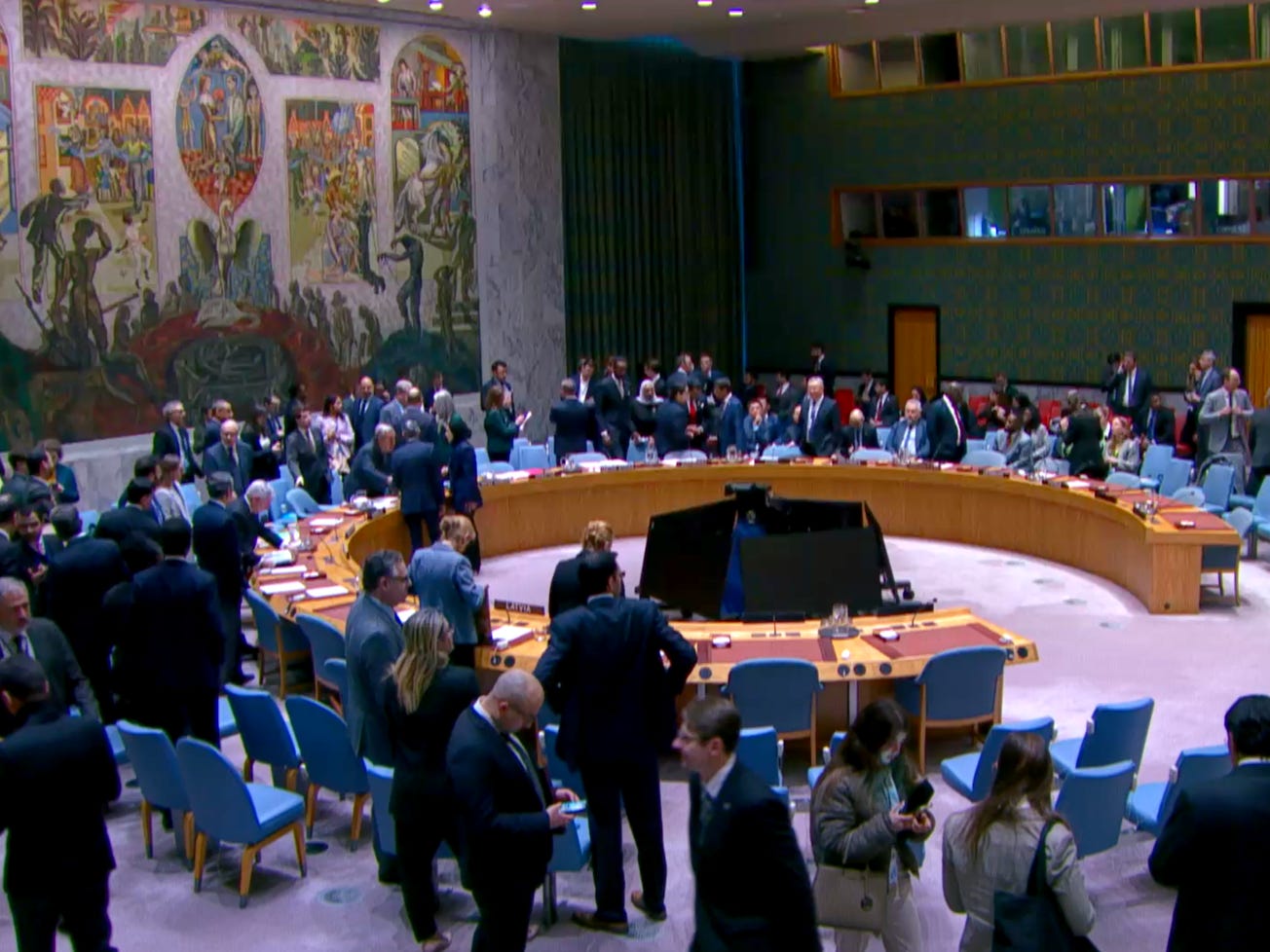
The U.N. Security Council met in emergency session after Iran formally invoked its right of self-defense under Article 51 of the U.N. Charter following coordinated U.S.–Israeli strikes, as multiple news outlets and the U.S. president reported that Supreme Leader Ayatollah Ali Khamenei had been killed.
The strikes followed three rounds of indirect negotiations over Iran’s nuclear program in Geneva mediated by Oman. Those talks adjourned this week with plans for technical-level discussions under the International Atomic Energy Agency in Vienna beginning early next week.
After the strikes, Tehran retaliated with missile launches targeting Israel and U.S. military installations in the Gulf, according to regional authorities. The Israel Defense Forces said its defensive systems were operating to intercept incoming missiles.
Moments before diplomats gathered in New York on Saturday afternoon, Israeli officials told The Associated Press that Khamenei had died in an airstrike on his compound in Tehran. As council members spoke, U.S. President Donald Trump declared on social media that Khamenei “is dead.”
“He was unable to avoid our Intelligence and Highly Sophisticated Tracking Systems and, working closely with Israel, there was not a thing he, or the other leaders that have been killed along with him, could do,” Trump said. “This is the single greatest chance for the Iranian people to take back their Country.”
U.N. Secretary-General António Guterres told the 15-member council that the situation posed “a grave threat to international peace and security.”
“Military action carries the risk of igniting a chain of events that no one can control in the most volatile region of the world,” he said.
Guterres reported that roughly 20 cities across Iran, including Tehran, Isfahan, Qom, Shahriar and Tabriz, had been attacked.
“In Tehran, large explosions were reported in the district that includes the presidential palace and the compound of the Supreme Leader,” he said. “Several high-ranking officials have reportedly been killed, including — according to Israeli sources — Iran’s Supreme Leader, Ali Khamenei, that I am not in a position to confirm.”
He emphasized that the U.N. Charter prohibits both the threat and use of force inconsistent with its purposes and urged immediate de-escalation.
The meeting was held under the agenda item “The Situation in the Middle East” on the final day of the United Kingdom’s rotating presidency of the council. France was the first council member to request an emergency meeting following the strikes, a move later supported by Colombia. Bahrain separately sought a briefing under “The Situation in the Middle East,” while China and Russia called for a meeting under “Threats to International Peace and Security.”
The presidency passes to the United States on Sunday, placing Washington in the chair of the body responsible for maintaining international peace and security less than 24 hours after participating in the military operation. Council divisions were immediate.
“The number of innocents killed continues to rise,” Iran’s U.N. Ambassador Amir-Saeid Iravani said. “This is not only an act of aggression, it is a war crime and a crime against humanity.”
Iravani said the council faced a "straightforward" question of "whether any member state may, including a permanent member of this council, through the use of force, coercion or aggression, determine the political future or system of another state or impose control over its affairs."
Israel’s U.N. Ambassador Danny Danon said the airstrikes were needed because Iran poses an existential threat. “We are stopping extremism before it becomes unstoppable,” he said. “We will ensure that no radical regime armed with nuclear weapons and ballistic missiles can threaten our people or the entire world.”
Russia and China condemned the strikes as violations of international law. Russia’s U.N. Ambassador Vasily Nebenzya argued the meeting should have been convened under the agenda item “Threats to International Peace and Security” due to what he described as an “extremely dangerous ratcheting up of escalation in the Middle East.”
China’s U.N. Ambassador Fu Cong said his country was “deeply saddened” by civilian casualties and called for an immediate end to hostilities.
"This is a moment in history that requires moral clarity and President Trump has met the moment," U.S. Ambassador to the U.N. Mike Waltz told the council. He said the attack is legal because it is based on the international community's longstanding principle of global security "that Iran cannot have a nuclear weapon."
Several Western members criticized Iran’s missile and nuclear activities while also urging restraint. Bahrain, which reported being targeted in Iranian retaliation, protested the strikes on its territory.
Earlier in the day, Iran’s foreign minister sent a letter to Guterres and the council president accusing the United States and Israel of a “flagrant violation” of Article 2(4) of the Charter, which prohibits the use of force against the territorial integrity or political independence of any country.
Tehran called for an emergency session, declaring it was exercising its “inherent and lawful right of self-defense,” and warned that “all bases, facilities, and assets of the hostile forces in the region shall be regarded as legitimate military objectives.”
A technical track under strain
The emergency session unfolded against the possible collapse of a fragile diplomatic channel focused on nuclear verification.
Only days earlier, Oman-mediated indirect negotiations between Washington and Tehran had adjourned in Geneva with plans for technical discussions in Vienna under the IAEA. Those talks were intended to refine verification arrangements and stockpile controls tied to Iran’s nuclear program.
As recently as Friday, Oman’s Foreign Minister Badr al-Busaidi publicly expressed confidence that progress was within reach.
“I can see that the peace deal is within our reach,” he told CBS News. “If we just allow diplomacy the space it needs to get there.”
He described an emerging understanding that Iran would not accumulate enriched material capable of producing a weapon and that existing stockpiles would be neutralized under IAEA supervision.
“The single most important achievement, I believe, is the agreement that Iran will never, ever have a nuclear material that will create a bomb,” he said, with “zero accumulation, zero stockpiling, and full verification.”
If the Vienna technical talks are postponed or canceled, the IAEA’s role could shift from negotiation facilitator to crisis monitor.
Iran also called for an emergency meeting of the IAEA’s Board of Governors to address what it described as “baseless claims” justifying the strikes.
An institutional transition
The timing adds a procedural dimension.
On Sunday, the United States assumes the monthly rotating presidency of the Security Council. Under council procedure, the president sets the provisional program of work and chairs formal meetings. The United States has already designated a signature event for Monday titled “Children, technology, and education in conflict,” expected to be chaired by First Lady Melania Trump.
The juxtaposition is unusual: The council is scheduled to discuss the protection and education of children; today, it struggles to prevent a regional conflagration. Whether the Vienna channel survives now depends on whether science diplomacy can resume under sharply altered political conditions.
As al-Busaidi put it, “I don’t think any alternative to diplomacy is going to solve this problem.”