The U.S.-Iran agreement enters its implementation phase
As negotiators establish a roadmap toward a final deal, attention is shifting to the inspectors, technical experts and verification systems that could determine whether it succeeds.

The first round of U.S.-Iran implementation talks concluded with agreement on a roadmap toward a final settlement within 60 days, while technical teams remained in Switzerland to begin work on the nuclear, sanctions and verification issues that could determine whether the accord survives.
The talks, held at Switzerland’s Bürgenstock resort through Monday, were the first meeting devoted to implementing the agreement signed last week by U.S. President Donald Trump and Iranian President Masoud Pezeshkian, including its provisions on nuclear restrictions, sanctions relief, regional security and maritime access.
Mediators Qatar and Pakistan said the parties had made “encouraging progress” and agreed to establish a de-confliction mechanism intended to reduce the risk of renewed fighting in Lebanon and a communications channel aimed at preventing misunderstandings over commercial shipping through the Strait of Hormuz.
The negotiations were facilitated by Pakistan, which helped broker the original agreement, with support from Qatar and Switzerland. Pakistani Prime Minister Shehbaz Sharif and military chief Asim Munir also took part, underscoring the unusually high level of political engagement behind a process that is now moving into a technical phase. While senior political negotiators prepared to leave Switzerland on Monday, technical teams remained behind to continue discussions through the week. That transition marks the beginning of a new phase in the process.
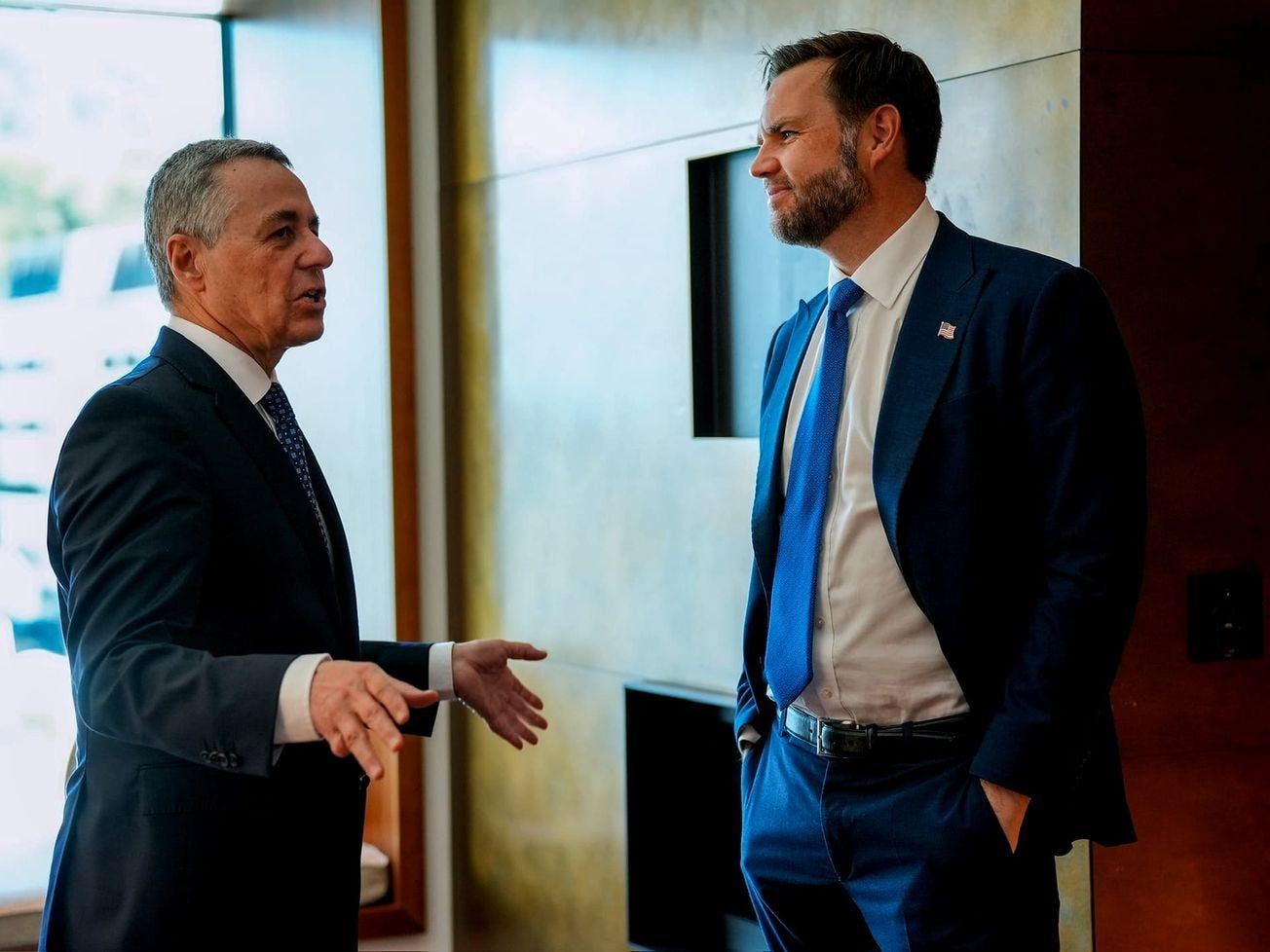
Switzerland, which has represented U.S. interests in Iran for nearly five decades, hosted the talks at the Bürgenstock resort, reflecting its longstanding role as the protecting power for U.S. interests in Iran. "Starting these talks in Switzerland is an essential first step," Foreign Minister Ignazio Cassis said. "As the protecting power for U.S. interests in Iran for nearly half a century, Switzerland enjoys trusted relations with both parties."
The memorandum of understanding signed last week established broad political commitments. The challenge now is translating those commitments into operational arrangements covering nuclear oversight, sanctions relief, maritime security and regional security.
Vice President JD Vance said the talks had created “a good foundation for a successful final deal” and identified four areas where progress had been made: mechanisms to keep the Strait of Hormuz open, coordination regarding the conflict between Israel and Hezbollah in Lebanon, a process for continuing technical negotiations and an agreement involving the International Atomic Energy Agency.
Vance also said Iran had agreed to allow IAEA inspectors back into the country, though Iranian officials had not publicly confirmed the arrangement. The agency is expected to play a central role in implementing the agreement’s nuclear provisions. “The final deal is the house,” Vance told reporters. “We set the foundation. We haven’t built the house, but we’ve laid a successful foundation to get to a good place for the American people.”
Under the memorandum, Iran agreed to place its stockpile of highly enriched uranium under international supervision while negotiators work toward a broader settlement intended to ensure that Tehran cannot develop a nuclear weapon.
Speaking in Geneva last week before the talks began, IAEA Director General Rafael Mariano Grossi described implementation as the next critical phase. “The indispensable role of the IAEA is recognized as a sound point of departure,” Grossi said. “And now it’s for us to sit down with our American colleagues, our Iranian colleagues, and start formulating the concrete steps that will have to be taken.”
Grossi declined at the time to discuss specific technical options under consideration, including whether enriched uranium would remain in Iran, be down-blended to lower enrichment levels or be transferred elsewhere. “There are several possibilities that open up,” he said.
The agency chief emphasized that the IAEA would participate only in arrangements that meet its technical standards. “The IAEA will do only a process which is technically sound,” Grossi said. “If we do not feel that we have the technically sound basis, we would not do it.”
The outcome of the Bürgenstock talks suggests the process Grossi described is now beginning. Mediators announced the creation of a high-level committee to oversee negotiations and said technical discussions would continue immediately on issues including Iran’s nuclear program, sanctions and dispute-resolution mechanisms.
Iranian Foreign Minister Abbas Araghchi described the talks as producing “major progress” on Lebanon and other implementation issues, while cautioning that difficult negotiations still lie ahead.
Negotiators have yet to determine the precise disposition of Iran’s highly enriched uranium stockpile, the scope of future inspections, the procedures for verification and the sequencing of sanctions relief. Those issues are unlikely to be resolved by political declarations alone; they will depend on technical negotiations, scientific assessments and verification arrangements that both sides regard as credible.


