
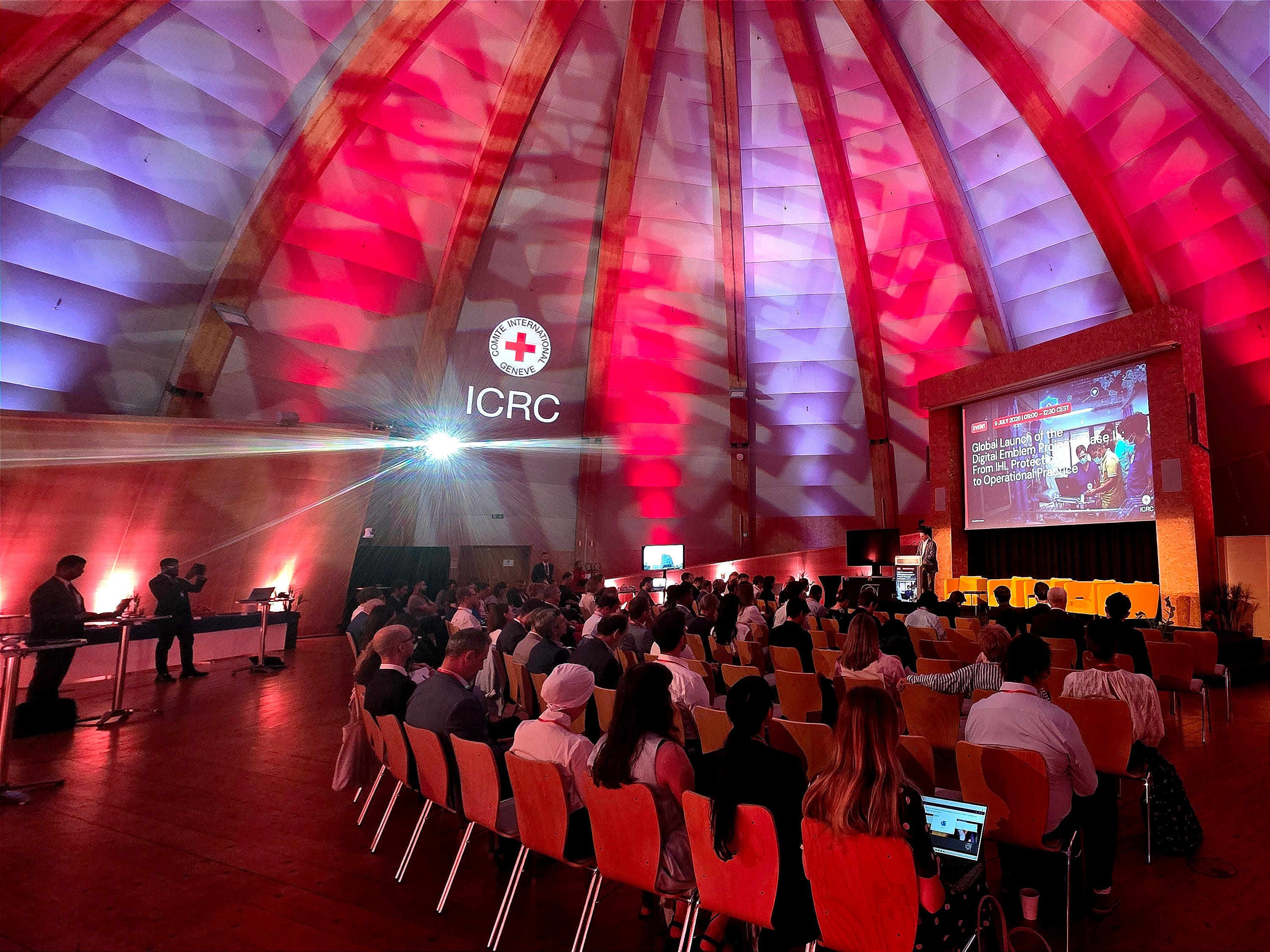
When the International Committee of the Red Cross unveiled the second phase of its Digital Emblem Project at CERN in July, its challenge was to make humanitarian protections visible in cyberspace rather than rewrite international humanitarian law.
The digital solution the ICRC is pursuing depends on a remarkably broad coalition. Microsoft is helping develop the project. The International Telecommunication Union supports its technical evolution. The Internet Engineering Task Force, Cloudflare, cybersecurity specialists, governments and humanitarian organizations are all expected to contribute to standards, testing and implementation.
The ICRC provides the legal legitimacy and humanitarian mandate. International humanitarian law already protects hospitals, medical workers and humanitarian organizations during armed conflict, and for more than 160 years the Red Cross, Red Crescent and Red Crystal emblems have made those protections visible on battlefields around the world. The challenge was translating that authority into an operational system capable of functioning across the global internet.
The problem extends beyond the Digital Emblem. International institutions can set rules, establish legitimacy and coordinate governments. Scientists and standards bodies have technical expertise; private companies have digital infrastructure. The result is a separation between those with authority and those with the capacity to act.
"We are not here to announce a finished solution. We are here to launch a collaborative process,” ICRC Director General Pierre Krähenbühl told participants, explaining that humanitarian protection in the digital age "must be built collectively."
Achieving that goal, he said, requires cooperation among "states, the International Red Cross and Red Crescent Movement, armed forces, humanitarian and medical organizations, technology companies, cybersecurity experts, standards bodies, academic institutions, and others."
Microsoft Chief Responsible AI Officer Natasha Crampton described the relationship differently. "States, humanitarian organizations, and international humanitarian law provide the foundation," she said. "Industry can help translate that foundation into practice through technical dialogue, standards development, and adoption pathways that work across complex digital ecosystems."
The International Telecommunication Union’s work on submarine cable resilience offers another example. Nearly all internet traffic passes through cables crossing the ocean floor that underpin financial markets, scientific collaboration, diplomacy, military communications and cloud computing, but most are privately financed, owned and operated across jurisdictions. Governments regulate aspects of the system.
The ITU coordinates international cooperation. Engineers, shipping companies, insurers, telecommunications firms and navies all share responsibility for keeping the network functioning.
“No region, country, or stakeholder can address the challenges we face alone. Cooperation is not an option; it is indispensable in an interconnected world,” the International Advisory Body on Submarine Cable Resilience’s co-chairs Bosun Tijani and Sandra Maximiano, officials in Nigeria and Portugal respectively, wrote in the report.
Public institutions continue to provide legitimacy, accountability and political representation. Private companies control much of the computing infrastructure and engineering expertise on which modern governance depends. Standards bodies shape interoperability. Scientific communities evaluate rapidly changing technologies.
The same separation between authority and capability also shapes one of the world’s oldest systems of international verification.
When the United States and Saudi Arabia announced a new civilian nuclear cooperation agreement in July, attention quickly turned to what role the International Atomic Energy Agency would ultimately play. The IAEA has the inspectors, laboratories and technical expertise needed to verify that civilian nuclear programs remain peaceful, but it is unable to make use of them on its own. Governments determine which safeguards they will accept, when inspectors are admitted, and what access the agency receives.
The agreement immediately raised questions because published reports indicated Saudi Arabia would not be required to adopt the IAEA's Additional Protocol, the agency’s enhanced inspection framework for detecting undeclared nuclear activities. At the same time, the administration had not released the text of either the cooperation agreement or the bilateral safeguards accord, leaving unresolved how U.S. oversight would relate to the IAEA’s multilateral verification system.
The episode illustrated a recurring feature of international governance. The IAEA’s authority derives from decades of technical expertise and international confidence in its verification system. Whether that capability can be exercised depends on political decisions made by countries.
If the Digital Emblem and submarine cables illustrate institutions depending on outside capabilities, humanitarian organizations demonstrate how those capabilities can be incorporated without surrendering institutional responsibility.
The World Food Program showed how satellite imagery and machine learning can assess earthquake damage across an area the size of Greece within a day, allowing relief agencies to identify the hardest-hit communities far faster than traditional surveys.
In partnership with the German Aerospace Center, it is adapting technology originally developed for planetary exploration into remotely operated vehicles capable of delivering aid through minefields, floodwaters and other environments too dangerous for humanitarian workers.
Also at the summit, the Office of the U.N. High Commissioner for Refugees described how AI helps monitor displacement and assess damage after crises. The U.N. Population Fund showed how it uses AI to identify communities vulnerable to female genital mutilation and to track online narratives that influence public attitudes.
Across the humanitarian system, artificial intelligence is becoming part of the operational infrastructure that supports decisions. None of the organizations presented the technology as a substitute for their own authority or responsibility.
“Local authorities, humanitarian partners, and displaced communities provide context that technology alone cannot capture,” said Hovig Etyemezian, UNHCR’s head of innovation. “Refugees themselves often identify needs, risks, and practical solutions that may not be visible through remote analysis.”
As humanitarian organizations adopting sophisticated digital tools, they insist that operational decisions be held accountable to people and not algorithms. Technology expands institutional capacity, but it does not replace institutional judgment.
The same principle underlies the Digital Emblem. “No single institution can do it alone,” ITU Deputy Secretary-General Tomas Lamanauskas said at the CERN launch. The ICRC brings its humanitarian mandate and operational experience, he said; the Internet Engineering Task Force develops the underlying protocols and technical mechanisms; and the ITU contributes international standardization, interoperability and a platform connecting governments, regulators, industry and technical actors.
"Protection has always evolved alongside the changing realities of conflict,” Krähenbühl said while describing the project as sitting “at the intersection of law, humanitarian action, security, diplomacy, and technology.” Its success, he said, “will depend on each of the communities representing these fields and on our ability to create the synergies and trust among them.”
Science diplomacy has long been understood as cooperation between governments and scientific communities, but it now operates under a different kind of pressure. The expertise, infrastructure and operational capacity needed to solve global problems are spread among public institutions, private companies, technical organizations and civil society. The question is how governance functions when the authority to make decisions and the capacity to implement them are dispersed.