

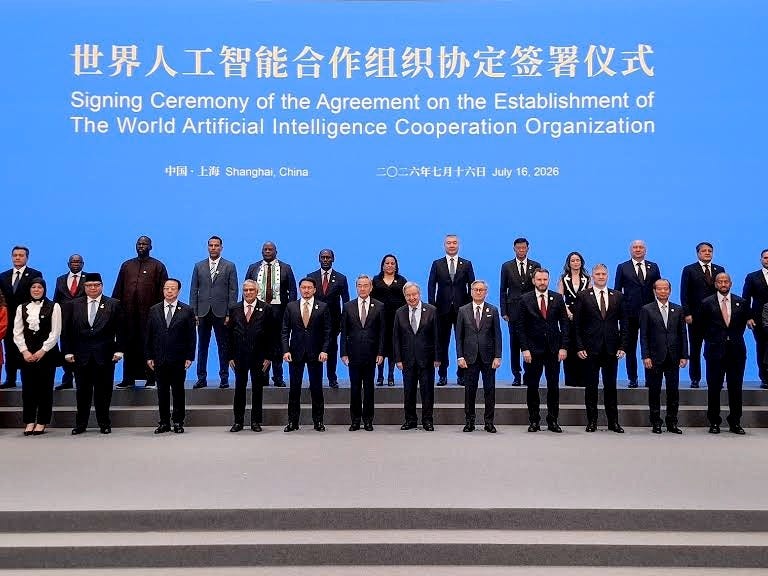
Only a week after governments met in Geneva for the United Nations’ first Global Dialogue on AI Governance in early July, representatives of 29 countries gathered in Shanghai to launch the World Artificial Intelligence Cooperation Organization.
The two meetings addressed many of the same technologies and global risks but reflect differing political traditions, institutional cultures and assumptions about how international governance should develop. As a result, their approaches diverged sharply.
The U.N.'s discussions centered on scientific assessment, international coordination and capacity building. It emphasized broad multilateral coordination through the U.N. system.
The Chinese-led organization focused instead on its own membership, governance structure and vision for how artificial intelligence should be governed. It created a new intergovernmental organization built around sovereignty, development, technology cooperation and stronger representation for countries in the Global South.
Chinese President Xi Jinping called the organization an “important milestone” in the history of AI development, which, he said, “should not be a solo performance by a single country, but a symphony of international cooperation.”
The immediate question became what happens when different systems begin governing the same technology at the same time.
International governance has often responded to pressure by creating new institutions rather than replacing old ones. Existing organizations remain in place while new coalitions, partnerships, technical bodies and regional arrangements emerge alongside them. The result is less a single system than an expanding ecosystem of institutions with overlapping mandates.
Artificial intelligence may become the clearest example yet. At the Global Dialogue in Geneva, participants repeatedly rejected the idea that every country should adopt a single global regulatory model. Instead, discussions focused on interoperability: ensuring that different national and regional systems remain capable of working together despite different legal traditions and political priorities.
“The scientific panel emphasized the shift from static to dynamic system governance,” U.N. technology envoy Amandeep Singh Gill said. As AI systems become more autonomous and capable of interacting with other systems, he argued, governance must evolve from overseeing individual models toward managing continuously changing AI ecosystems.
Paula Bogantes Zamora, Costa Rica’s minister of science, innovation, technology and telecommunications, framed the issue in terms of influence and argued that technical concentration translates into governance concentration.
She proposed what she called “minimum viable interoperability” — shared terminology, comparable risk classifications, documentation standards and incident reporting systems that would allow countries to cooperate without requiring identical regulations.
That approach accepts institutional diversity while trying to prevent fragmentation. The challenge is practical as much as political. Divergent standards can create regulatory arbitrage, encourage companies to move activity toward less restrictive jurisdictions, increase compliance costs and leave lower-capacity countries dependent on systems they had little role in shaping.
Multiple institutions can expand experimentation, distribute expertise and allow governments to cooperate in different political configurations. The difficulty begins when institutional diversity becomes institutional rivalry.
Not every response to pressure creates a new institution. Sometimes governments connect institutions that previously operated separately. Rather than creating a new climate institution, governments are beginning to connect existing ones. Kenya, Germany, the U.N. Development Program and the Global Community Engagement and Resilience Fund launched the Nairobi Toolkit to help governments integrate climate risks into efforts to prevent violent extremism.
The initiative grew out of the Global Counterterrorism Forum rather than the U.N. climate process, bringing together climate, development and security communities that traditionally operated separately.
Ghana's U.N. Ambassador Samuel Liao Kuma emphasized that climate change does not directly cause terrorism but can deepen hardship, displacement and instability that extremist groups exploit. UNDP's Catherine Wong noted that communities most affected by violent extremism “are the same communities that are affected by climate change as well."
Instead of creating another institution, the initiative linked several existing governance systems around a problem that no longer fit neatly within any one of them.
Elsewhere, pressure is playing out inside existing institutions rather than creating new ones. During the Human Rights Council’s emergency session on Sudan, nations were divided over the purpose the institution should serve: whether it should primarily reinforce state sovereignty or strengthen international accountability.
European countries argued for expanding the International Criminal Court’s mandate and extending the U.N. arms embargo to all of Sudan. China opposed those proposals, arguing that the Council’s Independent International Fact-Finding Mission had been established without Sudan’s consent. Russia and several other delegations likewise emphasized sovereignty over additional international scrutiny.
The nuclear nonproliferation regime illustrates yet another outcome. The institution remains intact, but governments disagree about what it should accomplish. The 2026 Review Conference of the Nuclear Non-Proliferation Treaty ended without consensus for the third consecutive review cycle, exposing deep divisions over Iran, disarmament and the future of nuclear deterrence. The treaty itself remains the foundation of the global nonproliferation system, but governments could no longer agree on a common political roadmap for strengthening it.
Conference president Do Hung Viet described delegates as having engaged in “very honest reflection on the current situation,” but acknowledged they could not bridge widening geopolitical differences. U.N. disarmament chief Izumi Nakamitsu warned that governments must “take this third time failure very seriously if they want to preserve this regime.”
At an Organization for Security and Cooperation in Europe conference in Geneva, Swiss Foreign Minister Ignazio Cassis argued that multilateral institutions could no longer afford to remain reactive.
For OSCE, the meeting also pointed to a broader institutional question: how a security organization created during the Cold War adapts to an environment shaped by military competition and territorial conflict along with algorithmic systems, cyber operations and technologies developed largely outside traditional state structures.
"Technology will not wait for us. Geopolitics will not slow down," Cassis said. "If we want to remain relevant, we must anticipate, not react."
Institutions are multiplying because governments are searching for forums capable of responding to different kinds of problems at different speeds. The challenge is whether those institutions remain connected closely enough to exchange evidence, coordinate standards and avoid hardening into competing systems.